On this day in 1959

0

In the early morning of Feb 3, 1959, in a hurry to reach their next gig and against all advice, three monuments to 50s music were killed in a small plane shortly after takeoff in a snowstorm.

Buddy Holly’s star was rising as the new exponent of what would come to be called “pop rock”, melodic and listenable. Holly had recently dismissed his previous band, “The Crickets” and was striking out as a solo artist and a new band featuring an emerging Waylon Jennings on backup guitar. The timing was right, as it was for his colleagues Ritchie Valens and The J.P. “Big Bopper” Richardson, both of whom were carving out an audience as well.

Holly in particular was on his way to becoming an icon:

(From Wikipedia): “Holly is described by critic Bruce Eder as “the single most influential creative force in early rock and roll.” His works and innovations inspired and influenced contemporary and later musicians, notably The Beatles, Elvis Costello, The Rolling Stones, Don McLean, Bob Dylan, Steve Winwood, and Eric Clapton, and exerted a profound influence on popular music. Holly was among the first group of inductees to the Rock and Roll Hall of Fame in 1986. In 2004, Rolling Stone ranked Holly #13 among “The 100 Greatest Artists of All Time”.

The tour was to play 24 mid-western cities in three weeks, many far apart from each other and represented a hardship for tour busses. Due to cold weather conditions, Holly decided to charter a small Beechcraft single engine, four place aircraft in Clear Lake, Iowa to quickly reach the next venue in Moorehead, Minnesota.

J.P. Richardson, suffering fro flu symptoms, coerced Waylon Jennings into giving up his seat. Ritchie Valens beat out guitarist Tommy Allsup on the toss of a coin. Dion DiMucci of Dion and the Belmonts fame decided not to pay the US$36.00 fee and didn’t board the aircraft said to have “American Pie” painted on it’s cowl.

In a combination of poor weather and pilot error, the plane quickly crashed in a cornfield killing all on board. Jennings lamented his decision and is said to have suffered major depression the rest of his life because of it. Holly’s pregnant wife of 6 months miscarried the day after the crash. A band of high school kids in Fargo, North Dakota calling themselves “The Shadows” was offered a replacement slot in Moorehead. Their performance was a breakthrough and directly led to their lead singer Bobby Vee’s success as a solo artist (Blue Velvet, 1963).

When Elvis Presley died on August 16, 1977, over 20,000 Mourners gathered outside the Graceland gate. Shortly after John Lennon was killed on December 8, 1980, literally millions of people filled Central Park for a vigil. But when Holly/Valens/Richardson died, no one attended them. They never had a vigil. Their homes did not become pilgrimage sites and there was never a centralized memorial service. Yet with each passing year, the legend of (especially) Buddy Holly continues to grow.

Fast forward to Don McLean’s introspective tribute to the events of February 3, 1959.

McLean was at the time a struggling folkie performer who had put out a previous album (Tapestry, 1969) that sank like the Lusitania. Overall, his work was rejected 72 times by record labels. In the spring of 1971, Mclean released his magnum opus “American Pie”. The song got it’s first radio exposure on a New York FM station coincident with the closing of The Fillmore East in New York City and was thought to be destined to the fate of his earlier work. “American Pie” exploded, reached number one on the U.S. Billboard magazine charts for four weeks. With a running time of 8:36 minutes, it is the longest song to reach No. 1 and one of the few.

The literal interpretation of McLean’s lyrics has been a source of continuing controversy for many years. When asked what his song meant, McLean famously replied, “It means I’ll never have to work again”.

One of the most insightful and interesting interpretations follows if anyone has an interest:

http://www.rareexception.com/Garden/Pie.php

McLean went on to become a major artist elected to the Grammy Hall of Fame in 2002 but although nominated for multiple Grammies, never won for “American Pie”. McLean has been eligible for the Rock and Roll Hall of Fame since 1995 but has yet to be inducted. American Pie is listed by the RIAA as the No. 5 song on “Songs of the Century”.

————————————

On 4 Feb 2013, at 3:19, Farhad N Kapadia wrote:

“Rolling Stone ranked Holly #13 among “The 100 Greatest Artists is stupid beyond belief.  Holly is good, no question, but not great. Rolling Stones needs to reclassify, it’s greatest artist in the rock era, or 2nd half of the century. As just one example, Art Tatum. Buddy would be outclassed completely & totally. Wonder where Rolling Stones ranks Tatum. All his contemporary musicians called him God”.

*******
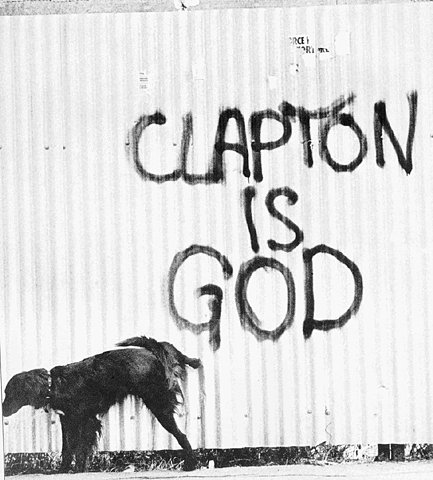
ClaptonWell, you have to remember that this has to be looked at in the context of the times. Clapton was considered God too (see photo). He remarked that the dog said it all.

Everyone has a complaint about who should have or not should have achieved a place in music history. Giving Jethro Tull a Grammy for best metal artists in 1989 and ignoring Metallica is considered one of the biggest gaffes ever. When Metallica finally did get a Grammy in 1992, Lars Ulrich thanked Jethro Tull for not putting out an album that year.

I never heard of Art Tatum but he’s not alone in lack of recognition. Lynyrd Skynyrd, The Doors, Jimi Hendrix, Queen, The Grateful Dead, Led Zeppelin, the Who and Bob Marley never won Grammies. Linda Ronstadt, Steppenwolf, Johnny Rivers, Chicago, The Doobie Brothers, The Guess Who, Bachman Turner Overdrive, Deep Purple, Joe Cocker, KISS, The Electric Light Orchestra, The Moody Blues, Jethro Tull, Rush, Heart, Stevie Ray Vaughn, Emerson, Lake and Palmer, The Zombies, The B-52’s, Cheap Trick, Peter Frampton, Bon Jovi, Todd Rundgren, Bad Company, Yes, The Cars, Heart, Kool and the Gang, John Mayall, Procol Harem and Rare Earth are nowhere to be found in the Rock and Roll Hall of fame.

Buddy Holly must be appreciated for his place in the evolution of Rock as an art form. It’s all a huge tangle of connections, people moving from one group to another and bringing fresh and innovative ideas with them, then building on those ideas that others pick up and so ad infinitum. Just following the trail of Eric Clapton makes you dizzy.

Back in the 50s, Rock was in its infancy. Most listenable pop music was variations of do-wop, performed mostly by black artists portrayed on album covers in sepia to soften the blow to white audiences. Do-Wop is multi-part voicing of very melodic R & B. A lot of it originated in Philadelphia extending to the suburbs of New York City. Punks standing on street corners harmonizing a cappella, including nonsense syllables known as scat. Early exponents of the style in the 50s were the “Bird groups”: The Orioles, The Penguins, The Crows, The Flamingos and The Larks. Also groups named for cars: “The Edsels, The Cadillacs, The Fleetwoods, The Impalas, and Little Anthony & The Imperials). Occasional City groups: “The Manhattans” and the “Hollywoods”. Then in the early 60s, white groups, usually Italian-Americans, got in on the action. The Four Seasons, Dion & the Belmonts.

The next iteration in this evolution came with Buddy Holly, who converted 50’s popular music performed with stand up slap bass, saxophone, piano and clunky acoustic guitars with glued-on electric pickups to a more specialized form of “Rockabilly” using what remains today the classic basic mode of Rock, two electric guitars, electric bass and drums. He was one of the first artists to write, produce, and perform his own songs. For the first time, Holly popularized the classic Fender Stratocaster’s unique tone and vibe combined with the Fender Precision electric bass.

This arrangement became the classic standard of the 60s and was made permanent with the Beatles. Elvis and Jerry Lee Lewis (for want of a better term) “legitimized” music with black roots to white audiences that Little Richard couldn’t access. Holly introduced Rock/Rockabilly to black listeners previously steeped in blues and R & B. Lennon and McCartney have cited Holly as a primary influence. The band name Beatles is said to have been chosen in homage to Holly’s band, The Crickets.

So, Holly is more revered for his groundbreaking influence than his absolute talent as a singer/songwriter, and that’s fair enough.
“Untouchable: The strange life and tragic death of Michael Jackson” (Randall Sullivan 2012)

0

Book Review:

“Untouchable: The strange life and tragic death of Michael Jackson” (Randall Sullivan 2012)

I never had the slightest past interest in Michael Jackson. I always thought he was made out of hype and glitz until I perused the latest crop of mediocre and non-talents whose lives are manufactured by marketing specialists and COMPLETELY made out of hype and glitz. Yes, that includes (but not limited to)  Justin, Nikki, Rhianna, Pink, Gaga and anything remotely resembling hip-hop or rap.

I noticed this book on Kindle and it sounded interesting. After I waded through all of 2688 pages of meticulous compulsive detail about the life and death of what now appears to be an absolutely fascinating creature. The data and conjecture is totally objective and beholds to no one involved. Meticulously referenced (600 pages). This volume is a masterpiece of investigative journalism and I will proceed to summarize it for your perusal, maybe to generate some interest in reading it for your general education.

As he emerges in this volume, a great deal becomes clearer about Jackson. Clearly he was the only talent in the entire family, part of a curse that essentially destroyed any possibility of having a normal life. The other curse was having too much money (mainly from acquiring the Beatle’s catalog), which draws his family into it as well.

Early on, his father figured he could make a buck or two and retire from his assembly line job in working class Gary, Indiana. As the Jackson 5 emerged, it became apparent that the focal point was Michael and his father worked it to the max, but ultimately, like all centerpieces of otherwise good bands, Michael went out on his own and put his non-talent siblings and manipulative father behind. They failed as performers immediately and started working the only source of income available, Michael.

Michael then became a major star with all the trimmings, but because of his abominable upbringing, his emotional and even intellectual level stalled at about ten years old and remained that way through the remainder of his life. Accordingly, he reacted like a kid with unlimited cash in a candy store (Neverland Ranch). His spending habits made Elvis look like Scrooge, and in his glory days, his fund of cash had no bottom. The glory days were impressive. 13 Grammies, 31 Guinness World Records, Elected to the R & R Hall of fame, and to this day, the biggest selling album of all time (Thriller, 1984).

The combination of his child-like naiveté and his certifiable weirdness made him a lead pipe cinch for leeches of all varieties, including family, friends and especially lawyers and “financial advisors”, all of whom sucked his blood for years with no seeming limit. The author makes the supposition that the turning point was Jackson’s acquisition of the entire Beatle’s music catalog, a collection of inestimable value, destined to increase yearly with no limit. Paul McCartney felt scammed and never spoke to Jackson again.

In terms of tangible assets this made Jackson arguably one of the richest men on the planet. The author then elucidates in excruciating detail how the rest of his no-talent family schemed to max out their meal ticket, with a special excoriation of his otherwise talentless sister LaToya who earned a special place in one of the seven circles of Hell for her activities and her ability to manipulate the media.

Michael loved children and related to them if for no other reason than he was one himself in his 30s. He much preferred the company of children to adults and made the mistake of very publicly adoring them. This, of course, set him up beautifully for a very specialized fauna of bloodsucker and it came to pass in 1993 when a meticulously orchestrated action by experts for child abuse and child endangerment surfaced. Even his own family joined the fray. La Toya Jackson offered proof her brother was a pedophile and she would disclose for a fee of $500,000 (never paid). The evidence was thin, but his attorneys told Jackson that his best course was to settle without assuming guilt to avoid the endless media circus and go on with his life. Following this settlement, however, Jackson’s career went into decline and he began to sell off assets to pay for his vast spending habits, his family’s upkeep and the endless supply of lawyers.

But the success of the 1993 lawsuit invariably bred more attempts. In 2003, another similar suit was filed on behalf of another young boy of Jackson’s acquaintance. Ultimately, after more millions spent for a media circus trial and celebrity lawyers, Jackson was found innocent, but the downward momentum continued. Ultimately the bottom of the financial barrel appeared, forcing Jackson to sign up for arduous personal appearance tours to maintain his lifestyle. By this time Jackson was nearing 50 years of age and was not in the same physical shape as when a youth. The amount of emotional and physical stress from his family, friends and lawyers was oppressive and he found himself consistently worried about everything possible to be worried about. He became an insomniac and took the Elvis route of doctor shopping for a huge pharmacopeia of relaxants, sedatives, uppers, downers and sleep aids.

Enter Dr. Conrad Murray, a cardiologist of somewhat dubious repute who had established a low-grade celebrity practice in two cities. The search for a “personal physician” ended with Murray who originally demanded five million dollars a year to be at Jackson’s beck & call but settled for US$150,000 per month. As with most celebrities, their personal physicians earned that fee my giving them whatever they wanted, which in Jackson’s case was anti-anxiety and sleep medication of all varieties.

Somehow Jackson got a taste of propofol, an extremely potent and titratable anesthetic ONLY used in highly monitored operating rooms and ICUs by trained and experienced personnel. Jackson demanded this drug as it was the only one that would facilitate sleep (after a fashion). Records showed that Dr. Murray ordered hedge quantities of propofol (four gallons at a time!) and used it frequently in Jackson’s bedroom with no monitoring other than the bedside judgment of the physician.

Accordingly, in the early morning of June 25, 2009, Jackson was under general anesthesia in his bed with Murray at the switch. The events that followed varied depending on who was relating them. What is known for sure is that Murray departed for the bedside for an undetermined period of time, and on his return, found Jackson apneic with a questionable pulse. There is much evidence presented thereafter, but apparently when the paramedics arrived they pronounced Jackson dead, but Murray insisted they continue CPR. Jackson was pronounced dead on arrival following transfer to a hospital. Also in evidence was the fact hat Murray attempted to collect all the bottles of propofol in the house, unsuccessfully. A search of the house later revealed a treasure trove of multiple drugs.

A no nonsense forensic autopsy was performed on June 26, 2009. It showed Jackson to be otherwise in reasonably good condition, but with interesting asides. He had close-cropped white hair (at age 51) and normally wore a black wig. His nose had collapsed down to cartilage and he wore prosthesis. There was evidence of multiple plastic surgical procedures and bleaching of his skin, with tattoos of black eyeliner and red lips. Direct cause of death was listed as respiratory failure secondary to acute propofol toxicity, and other sedatives (lorazepam) were also found in the blood work. Naturally, photos of Jackson dead in the autopsy suite made their way to the British tabloids.

Subsequently, Murray was tried and convicted of manslaughter. Of great interest is that the defense found a reputable physician willing to opine that Jackson may have himself turned up the propofol resulting in his death, a revelation met by a round of guffaws by the jury and a stern frown by the judge who sentenced Murray to the maximum jail term of four years. If the price is right, any expert can be found to opine anything in deadpan. Ever the showman, Murray continues to work the media today and is eagerly awaiting his release to find another state to obtain another medical license. The Jackson family rode the media circus till it finally dropped from exhaustion.

The author made some very convincing and exceptionally well-documented points in this extensive volume.

1). Jackson was an exceptionally talented performer who resonated with many fans throughout the world. He was severely damaged emotionally and intellectually in his formative years.

2) In business and in the performance arts, stragglers and the debilitated will be selectively killed and eaten by a wide variety of predators.

3. A love of children is a dangerous thing if you are a child yourself in a man’s body.

4. Absolute dominion breeds incapacity for control.

The author makes a very convincing case that Jackson was not a molester of children, and the events of the late 90s set the stage for his emotional debilitation, following which he was simply bled to death by predators. It was a self-fulfilling prophecy.

The author makes very special reference to and singles out the upper echelon of vicious, manipulative predators here, led by his sister LaToya a masterful manipulator of self interest, followed by his father and several (not all) of his brothers and a special mention to the lawyers in his life who presented bills for millions of dollars with little or no evidence they did anything other than shuffle papers no one understood but them. His mother Katherine escapes criticism and remains the best deal Michael’s children have for a role model

Even if you have no interest in MJ, this is a totally engrossing book of meticulous investigative journalism, top of the heap. It will give you a new understanding of the art of investigation.

Best part: The mode and manner of Jackson’s death.

Not so best part: Too long at 2688 pages, but 600 pages of that are notes and references. Some parts can easily be skimmed.

I give it 4.5 of five moonwalks. Truly fascinating and easy

Film Review: “Zero Dark Thirty” (2013)

0

The long awaited pageant of obsession, meticulousness, intrigue, suspense and ultimately, vengeance.

The vengeance portion is actually only a small part of the intricate and involuted plot, revolving round Maya, a very Carrie Mathison-like persona from “Homeland”. The similarities are striking and probably indicative of a new breed of CIA intelligence analysts, probably female and certainly consumed with the tedious ask of neutralizing dangerous people in the world. The CIA recruiter knew what he or she was looking for. Maya was recruited out of high school.

The film starts by a rather cold and graphic depiction of the kind of torture politicians deny. This coercion yields small bits and pieces of information, or even lack thereof that when correlated over the long haul yields connections with otherwise undetectable villains.

In real life, it’s unclear whether physical coercion is very effective. The Vietnam experience suggested physical coercion didn’t yield much useful information, as few of the captureable players knew much about centralized strategic decisions.  The current Middle East situation may be different as the whole point is getting to the central decision makers. These players do know centralized strategy this film suggests their giving it up directly led to the death of Bin Laden, who had escaped detection for 10 years.

The film also vividly points out the value of the new breed of straight up warriors, mechanized extensions of the “007” ethos. Extensively trained and single-minded pursuers of the completion of a mission. These are different guys that were sent out in 1980 in the failed “Eagle Claw” mission to rescue the Tehran hostages. These are the same guys that in 2009 accurately sniped three Somali pirates floating in a boat at night, rescuing Captain Richard Phillips.

The entire film is masterfully directed by Kathryn Bigelow  (The Hurt Locker, 2008). The cinematography is immaculate and vivid. The progression of events is smooth without lapses or diversions. The actors are incomparable.  In my opinion, Jessica Chastain should win the Academy Award for best actress in a dramatic role. “Lincoln” will take the rest of them.

Best part:  The meticulous military precision of the raid and the vision shown the audience through night vision goggles.

Not so best part:  The portions of the film leading up to the raid is just a little long.

Character you’ve seen before:  Look for the Damon Pope character out of Sons of Anarchy.

I give this film four and a half of five water boards.  Will do well in the Academy Awards.

Must see.

————————————–


FOLLOWUP COMMENT:

Like any other film, I call it fiction unless it’s billed as a straight up biography or history. I’m not sure I see much if any manipulative political intent in this film. If any, I think it shows that “intelligence” and meticulous gathering and interpretation of information by obsessed, single minded anylists “John LeCarre” style brings home the bacon. That’s not political. The undisputed reality is that we sometimes, not always, use “enhanced interviews” to get that information. Sometimes it doesn’t yield anything. Sometimes it adds to a body of information that gets results. Without that body of information, it would be virtually impossible to find some of these monsters and take them out of the loop. I think the film doesn’t try to say anything else political. I enjoyed the film as fiction and didn’t try to read anythign more into it. It’s a brilliant film.

There are many, many bits of info from many sources that mean nothing until they’re put into perspective. That’s where the obsessed, tireless analysts come in. Just like Carrie on “Homeland”. Were it not for her, no one would have ever suspected Brody. We are in a war with totally committed opponents who vow to destroy out civilization if it takes 100 years and they are willing to die to do it. We’ll still probably be fighting this war 100 years from now if there’s anything left of the world. They’re like “The Terminator”: “Listen, and understand. That terminator is out there. It can’t be bargained with. It can’t be reasoned with. It doesn’t feel pity, or remorse, or fear. And it absolutely will not stop, ever, until you are dead”. Should we do whatever it takes in this kind of war maintain an advantage or should we insist on Marquis of Queensbury rules and only win if we win as nice guys?

“Django (2012)

0

Django (2012).

Director Quinton Tarantino’s paean to the spaghetti westerns of the late 60s, including a musical scores my Ennio Morricone. The credits mention Franco Nero, the original “Django” in the 1966 film of the same name. Franco has a small role in the 2012 version.

Tarantino‘s films are noted for at least three themes.  Meticulous detail, at least one humorous, out-of-context group discussion signifying nothing and an intense, prolonged moral dilemma scene inevitably followed by cataclysmic violence. In the case of number two, a prolonged discussion amongst hooded vigilantes as to the size of eyeholes is a howl.

Otherwise, Django is a fairly stock retread of “for a few dollars more”(1965) with a bit more involved plot and a lot more gratuitous carnage, including very vivid bullet wound impacts. In interviews, Tarantino says his intent was to show the “true nature” of slave trading in 1859, not the sanitized versions frequently seen in other films. He succeeds in this a little too intensely. The brutality of slave trading is quite well known and adequately chronicled by a five year war between the States resulting in the death of 620,000 young men. One wonders if there is a need to gratuitously portray it again in 2012.

Jamie Foxx as Django is appropriately laconic and committed to the tasks at hand. As the slave master, Leonardo DiCaprio is a bit too heavy handed in his portrayal of pure evil. Samuel L. Jackson is wickedly sycophantic and shrewd. The real eye-catcher is Christolph Waltz (of “Inglorious Basterds” (2009).  He’s an amazing actor. You can’t take your eyes off him. He single handedly rescues this otherwise mediocre film, more or less.

Best part:  Django’s steely-eyed reply to a bar side conversant (Franco Nero) who asks him how his name is spelled. “D.J.A..N..G..O..  The D is silent”.  Franco replies:  “I know”.

Not so best part:  Overwrought, very visually provoking mass death. Detracts from the film.

Cameos:  Look for a brief appearance of Michael Parks from “Then came Bronson” (1969), a biker adventure epic in the vein of “Route 66” (1960-64). In the pilot, beautiful Bonnie Bedelia was briefly filmed topless in a beach scene, later cut by censors, but the original clip remains on the Internet (naturally, I have it).

Wait till it comes out on cable and watch it only for the amazing Christoph Waltz.

I give it two of five blood spurting bullet wounds.

Review: “Sons of Anarchy” (2008 – 2012)

0

“Sons of Anarchy” on FX (2008-2012)

Five season, Golden Globe award winning drama about the workings of a motorcycle gang in California. Working class stiffs with incredibly tight bonds with each other as members of “the club” and as an ancillary issue, with their women. In the words of Gemma Teller-Morrow: “You love the man, you learn to love “the club”. Motorcycles serve not so much as the transportation but as the vehicle that explores the limits of fealty and loyalty.

Their roots are much like the original Hells Angels MC whose earliest members came back from Korea bored with civilian life and found a common bond in motorcycling. Looking for “adventure” eventually taking the form of illegal activities bringing tension relieved as intense group bonding. The Sons of Anarchy are similar, wearing “colors” (identifying leather jackets) loudly advertising their bond, scruffiness and attitude. The ultimate expression of male bonding.

They all work in an auto repair shop which hides their money making enterprise; running guns to anyone who’ll purchase them, including those they know will use them for mayhem. However, they draw moral line at drugs and prostitution, endeavors they consider anathema for their town. They work with the town lawmen to keep these entities at bay, and the police look the other way as it pertains to guns.

These guys then get into incredibly complex adventures with various levels of the law and each other. They emerge as classic anti-heros in the Marlon Brando-Lee Marvin mold from “The Wild One” (1953). Alternately mean and self-serving then loving and caring for others in various capacities. Sonny Barger, the original Hell’s Angel President and Maximum Leader is a perfect role model for Clay Morrow.

Hunter Thompson described the Angels to perfection in his 1966 book “Hell’s Angels: A Strange and Terrible Saga”.

“They were a bunch of overgrown adolescents, stuck in their religious

mind-set as a way of life.  They defined themselves by their opposition to

any and everything.  The strength of their antagonism was the source of

their faith, and like all holy wars, their greatest enemies and their greatest

source of bloodshed was from within, battles against rival factions competing

for bottom of the barrel status”

Murder and mayhem come easy for them if it’s in the best interest of the Club. Revenge and retribution are their stock in trade. The viewer finds him or herself liking and even grudgingly respecting them despite their shortcomings if for no other reason than they’re such an interesting side of an alternative life.

The characters come alive in a hierarchy of texture and subtlety. Reviews have been positive and Katey Segal has won awards for her role just about yearly. The plot line is consistently coherent and interesting. Ally Walker as June Stahl is perfectly smarmy, nasty and vulnerable. The rest of the boys have their characters nailed.

Not for everyone. I give it four brotherly bear hugs.

Film Review: “Jack Reacher” (2012)

0

My wife has been a concerted fan of British writer Lee Child (real name Jim Grant) for a number of years and has read his entire works. She was very leery of Tom Cruise playing Jack Reacher as virtually none of the specifics match. The real Reacher is said to be 6’ 5” tall and weighs over 220 pounds. He rarely says much in the novels.  Cruise is about 5’ 7”, considerably lighter and more loquacious.

So critics who know the character weren’t happy with the choice, but it’s always risky counting Cruise out in any role. Back in ’94, critics howled at Cruise’s selection to play Lestat in “Interview with the Vampire”. Author Anne Rice threatened to pull her name off the project. But Cruise pulled it off with great reviews. Similarly, in “Jack Reacher”, Cruise re-crafts the character admirably such that if you didn’t know the real Reacher, Cruise would be a pretty good fit for the otherwise interesting plot.

Progression of events for Jack Reacher was well written and maintained interest throughout. There are some relatively minor shortcomings that can easily be forgiven. The evidence issue is a bit of a stretch. The end was dragged out a little too long. There was some gratuitous violence that wasn’t really necessary.

The female lead Rosamund Pike is a beautiful British actress that captured every scene. What does a frightened assistant district attorney do when tied to a chair, guns on her and bullets flying everywhere?  Why, cross her shapely legs in a short dress and heels, of course.

Best part:  Great scenes of Pittsburgh.

Not so best part:  Tom Cruise as a penniless drifter that just happens on the scene with no visible means of support is a bit of a stretch.

I liked it in spite of some shortcomings. Interesting plot, held my attention.

I give it two and a half toothy Tom Cruise grins.


Pawn Stars revisited (Dec 2012)

0

IMG_0361

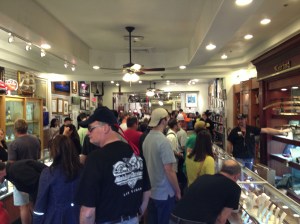
The Pawn Stars shop is nestled in the middle of a rather seedy area, across the street from a particularly seedy nudie bar and bail bond office.  There was a substantial line in front to get in, cordoned off like a movie premier. It’s said that this line is present all day, and the shop is not open 24 hours as advertised on the neon sign. It closes from 9 pm till 9 am, but there is a window open for late night customers.  There is an armed guard at the door.

Once inside, the floor plan is nothing like what’s seen on the TV show.  The room is very narrow and cordoned so the foot traffic proceeds along the sides forming a circular circuit ending at the exit. Much of the stuff seen on the TV show is there in glasses cases. There are a lot of sales people in black and gold “Pawn Stars” shirts, but Rick, Chumlee and the Old Man were not present. The entire of the center floor contains Pawn Stars memorabilia, t-shirts, sweaters, coffee mugs, EVERYTHING, even lip balm adorned with the photos of the particulars, especially Chumlee.

They film all day long in a separate room built for the program. Would-be customers are pre-screened for interesting items and it’s all staged from A to Z. The expert consultants know all about the items before they enter the door. It’s rumored that those selected to show their items are paid, and the expert consultants definitely are.  There is some chatter on the guitar sites that one of the episodes involving a famous instrument was not only staged but faked. A guy brought in what was said to an original 1960 Les Paul Custom worth a lot of money. The guitar and all the personnel involved, including the customer, were employees of a local music store.

If you watch Pawn Stars for a while, it’s noticeable that Rick definitely low balls most if not all of their items, sometimes considerably compared to what the same item might go for on EBay or Craig’s List. They also jack the prices of their sale items up equally considerably. I know a bit about vintage guitars, rock music memorabilia and even vintage wristwatches and I checked out some of it.

It’s my opinion that Rick jacks up the sale price anywhere from 50% to 100% from what these items can be had for elsewhere. Customers are paying for the “Pawn Stars” container like they pay for Rolex on a watch.  As an example, you may have seen the show where Rick purchased a vintage “Pepsi-Cola” machine in fair condition for US$3500.  He then had Rick the restoration guy refurbish it for US$4800.  Total Rick has into it = $8300.  It’s sitting in the corner for US$15,000. Pretty nifty profit.

My impression: It’s a big downer like finding out that Greg House is a highly paid actor that knows nothing about medicine.

Speaking of real life, check out the Death Valley ride at:

http://youtu.be/CVVydrfOLbQ

Phenomenal.

Film review: “The Life of Pi” (2012)

0

Most moviegoers anticipate a coherent, engrossing plot and actors skilled enough to interpret it. But without the vision of a Director, the actors wallow like a rudderless ship. It’s the Director’s vision that pulls it all together.

Look to the past.  The scene in “Lawrence of Arabia” (1962) where Peter O’Toole blows out the match and the scene instantly morphs to wide angled desert dunes. Dr. Zhivago’s dacha silently covered in ice (1965). A space station in “2001: A Space Odyssey” spinning to the strains of Johan Strauss (1968). The constant backdrop rain in “Blade Runner” (1982). These were all creations of the Director. The actors were coached on how to fulfill the Director’s vision.

The Life of Pi (2012) is, stem to stern, a Director’s film. The action sequences are custom formulated for the actors to inhabit. The sets are magnificent, the world-class cinematography as good as it gets. Ang Lee has matured since “Brokeback Mountain” (2005), to my mind an underappreciated masterpiece of human emotion. He can now sit comfortably at the table with David Lean, Alfred Hitchcock, Stanley Kubrick, Stephen Spielberg, Ridley Scott, Martin Scorsese.

That said, The Life of Pi is a conceptual dud. A film adaptation of the book by Yann Martel was said to be impossible. This proved to be prophetic. The plot is contrived and preachy; a sow’s ear crafted into a silk purse by a masterful Director. The pseudo-religious connotation doesn’t work as an elegant proof of God. The “surprise” ending doesn’t quite get off the ground as an allegorical morality conundrum. “Cast Away” (2000) did it better.

I recommend this film specifically for the beyond incredible visual effects. See the 3-D version as it’s worth the extra three bucks. Otherwise,  Hold your nose at the end.

Best Quip:  “Then it’s done….We sail for America….Like Columbus”.  “Yeah….but Columbus was looking for India”.

I give it 3.1416 of 5 snarling computer generated tigers, and that’s a gift to the gifted Director.


Followup remarks:

This is a book that many said could not be made into a film. There is one other book in my memory that critics said the same thing about and that was “Catch22” by Joe Heller (1962). The book was so convoluted and so many complex threads that any film made of it would have to be ten hours long. But they did make a movie out of it in 1970 and the hype surrounding it permeated the universe. Big name stars like Alan Arkin, Art Garfunkle, Orson Welles, Anthony Perkins, Bob Newhart, Jon Voight. Directed by Mike Nichols fresh off “The Graduate”.  It was filmed on location all over the world, cost a ton of money and was expected to be the blockbuster of the century.

It was a critical and commercial flop. It was reported that it nearly brought down Paramount Pictures at the time.  Why?  All the ingredients were there. Interesting story line, excellent actors, world class director.

Sometimes there has to be a quotient of magic to make a great film other than the personnel coming together in concert. Some indefinable prestidigitation to make the brew digestible. No one has yet figured out how to make that happen in advance.

At the 2010 Santa Fe Film Fest, Alan Arkin, Richard Benjamin and Paula Prentiss gathered to discuss the film.  It’s an interesting read and can be found at:

Features

Arkin remarked:

“For one thing, we had about 30 B-25 bombers on the runway of the set. Real B-25 bombers. And the Mexican government was very nervous because with all those bombers, we were the fifth largest air force in the world. Had we wanted to, we could’ve taken Mexico. And if we did, it would’ve been cheaper than making the film”.

Film Review: “Lincoln” (2012)

0

There are several immutable ground rules for moviegoers that mandate unquestioned attendance. One is any film directed by Steven Spielberg and another is any film Daniel Day-Lewis appears in. Someday I’ll list the rest.

Daniel Day-Lewis doesn’t do too many films. Anything he’s in is a lead pipe cinch to be good. That said, I resisted “Lincoln” because I thought there’d be a real chance of having to sit through a good actor struggle through a dry, period historical drama like “Anna Karenina”.  However, Rolling Stone gave “Lincoln” rave reviews and it rated 90% on the Tomatometer, so I gave it a chance.

The portrayal of Lincoln’s domestic life is passed over briefly to dwell on the politics of passing the 13th Amendment repealing slavery.  Lincoln is willing to the amendment passed by any means possible and his opponents are set on insuring its defeat. “Lincoln” brilliantly portrays the callous Barbary well as the subtlety of politics, what advocates and opponents are willing to do to pass or stop laws. It’s a vivid lesson in history and politics reminiscent of what’s going on in Washington right now.

“Lincoln” is a film treasure. It comes alive on every level. Spielberg’s cinematographer, Janusz Kaminski, captures the style and texture of the film masterfully. Day-Lewis absolutely nails the characterization, but he relinquishes the center of attention to connect many other fabulous actors with incredibly strong performances. Sally Field yields an unusually interesting portrayal as Mary Todd Lincoln. The list then widens, including magnificent performances by James Spader, Tommy Lee Jones, David Strathairn and many more. The whole manifests much more than the sum of its parts.

Best scenes: The political antagonists and protagonists describing each other in colorful terms on the floor of the House of Representatives.

Not so best scenes:  The issue of Lincoln’s assassination was treated as an extraneous aside.

Some of the real history is probably revised by Spielberg and doesn’t quite jive with that in the film, but the actors do a magnificent job of bringing history to life. Well directed and photographed.

I give it four and a half of five Derogatory shouts from the speakers box.  Must see.


Crippen Mergers & Acquisitions Dept (11/18/12)

0

“Triumph of Great Britain” is one of the oldest makers of two wheeled vehicles in the world. Started making bicycles as the Triumph Cycle Company in 1889. In 1898, Triumph extended its production to include motorcycles and by 1902, the company had produced its first motorcycle, a bicycle fitted with a small Belgian-made engine. In 1904, Triumph began building motorcycles based on its own designs and in 1905 produced its first completely original motorcycle. By the mid-1920s Triumph had become one of Britain’s main motorcycle producing 30,000 motorcycles each year. By 1939, the 500 cc Tiger 500, capable of 100 miles per hour was released. To satisfy the American desire for more long distance riding, Triumph turned out the “Thunderbird, a 650 cc version of the Speed Twin design.

The Triumph brand got a lot of publicity in the United States when Marlon Brando rode a 1950 Thunderbird 6T in the 1953 film “The Wild One”. In 1959, the T120, a double carburetor version of the Tiger which came to be known as the Triumph “Bonneville”.  In “The Great Escape” (1963), the famous motorcycle jump over the fence performed not by Steve McQueen but by Bud Elkins, was done on a ’59 Triumph TR-6 camouflaged as a war bike.

As Triumph developed massive sales in the USA, Harley-Davidson became aware that their motorcycles were not as sporty as modern riders would like, resulting in a decreasing share of the market. This resulted in the introduction of the smaller Harley “Sportster

In the 60s, Triumph began to excel in racing. In 1969 Malcolm Uphill, riding a Bonneville, won the Isle of Man Tourist Trophy race with an average speed of 99.99 miles per hour.  By 1969 fully half of the US market for motorcycles belonged to Triumph, but, inevitably, technological advances from competitors marched on and Triumph failed to keep up. Triumphs lacked electric start, relied on out-of-date push-rods engines rather than overhead cams, vibrated and famously leaked oil.

Japanese competitors such as Honda were building more advanced features into cheaper, more attractive machines. Triumph’s manufacturing processes were very labor-intensive and inefficient. Inevitably, Triumphs became obsolete quickly. The British marques were poorly equipped to compete against the massive Japanese financial resources that targeted their competitors for elimination via long-term plans subsidized by the Japanese government.

Triumph and other British bikes like BSA and Norton created variations on their previous themes, but were insufficient to counter the wave of Japanese bikes flooding the USA. The original Triumph Company in Meridian, UK went into receivership in 1983.  Residuals of the original Triumph team visited its competitors’ facilities in Japan in 1985, determined to find a way to get back in the game competitively. They became especially interested in the new-generation computer-controlled production machinery. By 1988, the company had moved into a new factory site in Hinckley, Leicestershire, UK.

In March 2002, the Hinckley facility burned to the ground and by 2006. Triumph had relocated into a new ultra-modern plant with cheap labor overhead in Thailand. September 2008, Triumph announced that they were expanding their Thailand factory to increase capacity to over 130,000 motorcycles per year. Modern Triumph motorcycles are well made, stylish and get good reviews for design and safety.

The vintage Triumph motorcycles are considered strong collector’s items as they appreciate in value while still being functional if kept in pristine condition. Of all the array of collectable Triumph motorcycles, the two that lead the list are the early 70’s 650 cc Bonneville and the 500cc Daytona. The ‘Daytona’ name was derived from American racer Buddy Elmore’s win at the 1966 Daytona 200 race, with an average speed of 96.6 mph on a 500cc Triumph Tiger T100, the precursor to the T100R that I now own.

As the aesthetics of motorcycles go, I think the 70s Triumph Bonnevilles and Daytonas rank in the upper reaches, and they are very rideable for limited uses. The Daytona of the early 70s (ended production in 1974) was truly a thing of mechanical beauty. I am lucky to have found this one in another Midwest city. The 500cc engine puts out only 40 horsepower, the same as a Volkswagen Beetle of the same era, but it’s plenty enough for riding around town on nice days. It has drum brakes, but the bike only weighs 370 pounds wet so that’s plenty for occasional riding. An Antique license plate avoids inspections and the insurance is a hundred bucks a year.

There aren’t many of them around. This one is a ’72 and has been aggressively restored from the ground up by professionals. 10,000 miles on it. Check out the photos and see what you think.