The Orient Express: Paris to Istanbul. (8/24 – 9/1/2016)

0
1.Orient ExpressWife Linda and I took the trip from August 24 – Sept 1, 2016. Some observations for whatever interest anyone on this list of friends might have.
The original “Orient Express” connected the English Channel with the Black Sea in the 1920’s, an era where trains were “the” modes of travel. With its connecting trains, it passed over the railway systems of thirteen different countries of the continent of Europe. Even then, it was expensive travel and those doing so insured that it was a class act. Black tie and female finery for dinner and each car the lap of luxury. The genre was immortalized by Agatha Christie’s “Murder on the Orient Express” (1934) and the film of the same name in 1974.
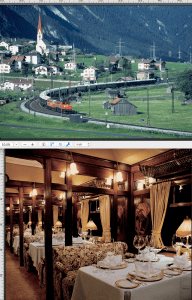
Automobiles and super highways made it pretty obsolete and the original trains fell into disrepair in numerous train graveyards across Europe, to be resurrected in the 1980’s to their former glory by entrepreneurs. There are several routes now, the centerpiece being the Paris to Istanbul route, 5 days and five nights. The cars are truly opulent now (see photos) and the former glory has been maintained.
First, some observations on some of the characters we met.
Seven middle-aged women that lived on the same block for 33 years somewhere in Connecticut. They got married there, had their kids there and now they’re in their late 50s. They could have been the models for “Desperate Housewives” (2004-2012). There were originally eight of them and they all had vowed to make this trip together at some time in their old age. Then one died unexpectedly and left the money to make the trip to the remaining seven in her will. So the seven went together as a group, did all the activities together. I watched them and saw a veil of sadness within them, an occasional tear.
There was a gaggle of very Arabic women, complete with headdresses. Must have been about ten of them, maybe more and they were pretty much together on some of the end cars. One of them stood out from the rest. Some of the guys called her the Queen Bee. She had a different kind of hair-containing appliance, exposing her neck and face. She was tall, had the cheekbones and complexion of a drop-dead beauty (see photo).
So when we got into a hotel and some WiFi we “think” we found her. Best evidence is she’s “Her Highness Sheikha Mozah bint Nasser Al Missned” the second wife of the former ruling Emir of Qatar. He has three wives. My guess is that none of them assemble in the same room at the same time but they manage some contact as the Emir as 24 children, six by this woman. He appears to be retired since 2013.
She’s incredibly well educated and has had her fingers in many world social, political and cultural pies. Said to be one of the best-dressed women in the world. She’s been seen hanging out with numerous world leaders. They all stayed to themselves and I suspect some of them were bodyguards. My wife ended up tangling with one of them after wandering around getting told that one of the bathrooms was “private”. Wrong thing to tell a woman that (she opined loudly) has been thrown out of worse places by better people. Snake eyes all around.
This lady apparently got the train in trouble when we tried to pass into Turkey. The Turks are famously neurotic about who gets into their country and demanded to eyeball each and every passenger and their travel documents including mandatory visas. A weak variation on the theme of “Midnight Express” (1978). According to our porter, the train was held up for a while as the Turks decided how much they liked the former Emir’s politics, but since he was no longer in power, they relented and we ultimately went on our way.
So, what was the experience like?
First of all, it was expensive, very expensive and the adventure we had anticipated wasn’t quite what we got. This was billed as a nostalgic trip back in time to experience what it was like to make this trip the way it was in 1920. To a certain extent, it was that, but with some caveats.
The temperature on arrival in Paris was 95 degrees F and it stayed that way for most of the trip but the train was beautiful. The modules are tiny, barely room to sit and the heat was oppressive, including in the evening. Luggage must fit on an overhead rack like on aircraft. A cabinet opens for a washbasin and mirror. There are no shower or bath facilities. No WiFi. There is no air conditioning except in the bar car and the dining cars. Open window suffices. Every other day we were all shuttled to five star hotels in various Eastern European cities for showers and to get away from the tiny train accommodation.
Dinner was black tie and females gussied up to the max, including lots of bling. Food was world class excellent, with a named chef in residence on the train, the kitchen running 24/7 to feed a hundred passengers. He came out every night and accepted lots of praise. French, of course.
Two adults getting dressed for dinner in such a tiny space is fraught with unintended humor and physically exhausting, each literally reaching around the other. During the day there was not much to do but gawk out the window at the rarely changing landscape. At night, after dinner, the porter converted out tiny module for sleeping, two fold out trays about 6 feet long and maybe 2.5 feet wide. It was so hot that the window had to be open and it was VERY noisy thought the night, bright lights and trains proceeding the opposite direction 6 feet away at over 100 mph about every half hour. It sounded like a full-on Guns ‘n Roses concert all night long.
The highlights of the trip were dinner and the every-other-night hotel to get a shower and sleep in a real bed quietly. Yes, it was an adventure but one I’m pretty happy not to repeat. It’s a been-there-done-that trip with lots of photos to remember it by. Happy to have had the opportunity to do it, but much more of the world to see.
If you’re interested in this trip look deeply into it and talk to me before deciding. Maybe I’ll comment on our wondering around Paris and especially one of my top five favorite cities in the world, Istanbul. A city no one should die before visiting. Maybe next Sunday. I have a ton of photos.
I give the trip 3 of 5 clickity-clacks for the overall noise and discomfort experience, definitely 4 of 5 for the adventure quotient.
Orient Express Paris to Istanbul

0

Orient Express 1Wife and I have not taken a real “vacation” since we were in Nepal in 1983. I figured time to celebrate her burgeoning career as chief nurse anesthetist at one of the UPMC hospitals, basically the boss, running the operating rooms. A big, tough job. Then sort of making note of my semi-retirement, cut back to teaching only. More time on my hands.

We’re taking the reconstituted Orient Express train from Paris to Istanbul. 36 sleeper, restaurant and Pullman cars, the styles originating from the 1920s. The original Orient Express ran from 1983 through 1977. At it’s peak, it was the lap of luxury and really the only way to get anywhere quickly in Europe in the late 1800s. It’s a six-day trip, Travel through seven countries with day/overnight stays in Budapest and Bucharest.

The Orient Express name became synonymous with old-world luxury train travel – as well as with international glamour and intrigue, culminating in the film “Murder on the Orient Express”, that’s a classic.

http://www.imdb.com/title/tt0071877/

This is a much bigger deal than I realized when I signed up. There IS a strict dress code, something I have eschewed in the past. No jeans, t-shirts, tennis shoes. All clothing must be “smart business attire”. That means “slacks” and shirts with collars. I own nothing like that. Dinner at the hotel stops, gentlemen will wear jacket & tie. Dinner aboard the train will be “black tie” for gentlemen and appropriate female attire (long dresses), sending me out to rent a Tux and my wife out to purchase female finery, including “heels”, none of which she owns.

Why this trip?

Some of you might remember a film a while back, “Somewhere in Time” (1980)

http://www.imdb.com/title/tt0081534/

Christopher Reeves becomes obsessed with a portrait on the wall of a woman from the early 1900s and desires to go back there for her so desperately that he is able to accomplish that goal by dressing in impeccable 1900s garb and self hypnotizing himself physically into that era. They fall in love and plan a life. But (no spoilers) this is not his time and there are ripples in that time that unpredictably and suddenly return him to his correct time. He sinks into a deep depression, sits in place at his original departure place and dies of starvations, whereupon his young woman greets him and they are re-united. It’s a really, really interesting film.

I have no plans to follow Christopher. I do, however, have an interest in returning to sites where I existed much earlier in my life to feel any faint vibrations of that time. I returned to Vietnam over 40 years on to feel those vibrations and I wrote a book about it. Much of it was disappointing. I return to various homes and places where I have lived and sit for a while just looking at them, feeling what I can of the past. I got off my bike and sat in the middle of a Route 66 leg in New Mexico for a while feeling the faint vibrations of my childhood and my father riding on that road in the 50s.

I do feel the vibrations of my past in some of these places and I savor that. They were “better” times for me. I would go back if it were possible to accomplish it Chris Reeves-style. I would build another full life there, then I would hide paintings and photos of me living my life again and dying there for any of you to find behind some boards in the attic as my house is eventually torn down to make way for progress.

I think the train is a throwback to the past that a lot of those on it want to return to. The trip is done exactly as it did in the late 1800s, no WiFi, no TV or other modern amenities. I guess it’s the kind of throwback I like to think about.


Film review: “Everest” (2015)

0

1280x720--njFascinating film loosely based on the disaster occurring on Everest in 1996 in which 8 climbers died in a freak storm. Several books were written about it. Jon Krakauer’s version is considered to be a masterpiece on life and death at high altitude and is mandatory general education reading.

http://www.amazon.com/Into-Thin-Air-Death-Everest/dp/B00005B1WA

The plot involves the trek of two coincident expeditions, costing each climber US$65,000 to attempt the feat with no guarantee of success. However, because of pressure to succeed, both trek leaders Rob Hall (New Zealand) and Scott Fischer (USA) bend their own safety rules to accept more risk in hopes of making the summit. Both sets of climbers actually reach the summit but there is a delay in descending, allowing a sudden vicious storm to move in, wiping out 8 climbers including Fischer and Hall, both of whose bodies have never been recovered from the mountain. There are said to be over 150 bodies scattered around the mountain today.

The real saga, however, consists of the story of Dr. Beck Weathers from Dallas, Texas who, left for dead on several different occasions, manages to find the strength to descend the mountain in perilous condition. He describes in detail how it felt to be dead and for what reason he felt the desultory need to move on anyway. When he finally stumbled into a lower camp, they set him in a corner of a tent to finish the dying process. But he’s alive today and his book is fascinating for his descriptions of very existential concepts involving death and survival:

http://www.amazon.com/Left-Dead-Journey-Home-Everest/dp/0440237084

The cinematography is stunning and greatly enhanced by the new 3-D process that gives splendid depth to the visual effects. Of course, the effects are a little too good, suggesting the liberal use of Computer Graphics Interface (CGI). Most of the mountain scenes were filmed on the Tyrol in the Italian Alps for safety and cost-effective ergonomics. Some scenes were filmed on Everest but in the lower altitudes. Many panoramic shots of the mountain were superimposed with actors via computer effects, especially the high altitude scenes.

“Everest” is a very tense experience, but in the end the tension dissolves into sadness amid tearful goodbyes, violent storms and frozen corpses.

I give it five of five icy eyebrows. Highly recommended by me. Warning: the ending is a four-hankie weeper.

Addendum: I can offer some perspective on this film because I was on Everest in the spring of 1983.

I came upon a private group that wanted to go to Nepal to do some serious peak ice and snow climbing with all the accouterments. So after some discussion, they agreed to take my wife and I even though we didn’t have much practical experience. They said we could learn on the job and they would look after us. I studied up on high altitude issues and brought a supply of Diamox and IV solumedrol, antibiotics, decongestants and other things.

After some acclimatization time doing lesser peaks, we crossed the Khumbu Glacier uneventfully complete with all the scary cracking of the ice. We reached Everest Base Camp at around 18,000 feet and decided to go ahead and climb up the col to South Face Base Camp I at about 20,000 feet just to see it. It was pretty arduous.

There was no point in climbing up to Base Camp II at 21,3000 feet. The route to the summit begins there. It was really more of the same and we would have to spend more time coming back. These camps are nestled between steep ridges on both sides to the only way out is the way you came in.

The Base Camp and Base Camp 1 are famously filthy dumps, with abandoned oxygen bottles and other detritus laying everywhere. It looks like a junkyard with hundreds of climbers in season milling around waiting to go their way in whatever trail. At times in the past there has actually been a “traffic jam” of climbers trying to get to the various bases. Many of the would-be summiteers were famously inexperienced as were their guides, setting situations up for disasters in the “Death Zone” (over 26,000 feet) where many of the physical laws of God and man are suspended.

We swung around to the Southeast back over the Khumbu to the other peaks in the Nuptse vicinity. It was all ice climbing with crampons and ice axes, attached to each other via ropes through pulleys.

As we climbed, I progressively felt the effects of altitude. Over 21,000 feet or so, every step was a superhuman effort and required stopping to catch your breath such as it was.  Much of this for me meant no sleep. Every time I’d doze off I started hyperventilating and work up with a start. I also developed a very irritating persistent dry cough said to be common at high altitude. Acetazolamide helped somewhat until we got over 20,000 feet. I was pretty much sleepless the rest of the time.

Some of the things I saw were so spectacular I can close my eyes and see them now and I took a lot of photos but to be truthful, I have no interest in ever doing it again. It was a good thing to do at my then age, but it was definitely a one-time thing. For the life of me, I cannot remember the formal names of any of the peaks we climbed, if they even had one.

* A YouTube montage of other photos I took in the area. This montage is high-def and so you can open it up to full screen. (60’s-era Nikon FTn).

https://youtu.be/9ujmSnanEfI


The Blue Ridge Parkway

0

blueridgeparkway07One of the most easily assessed and spectacular field trips in the country isn’t too far from here. The Blue Ridge Parkway, America’s longest National Park, meanders from Virginia to North Carolina, a distance of almost 500 miles. The pre-start of the ride begins in Front Royal, Virginia and is named the “Skyline Drive” down as far as the Waynesboro area, 109 miles where it turns into the BRP from then on. The Skyline Drive isn’t all that great but it’s the most direct lead-in to the BRP so it’s just as well you start there.

The “real” BRP connects Shenandoah National Park with Great Smoky Mountains National Park. It begins at Rockfish Gap near Waynesboro. You can easily do the entire length of the BRP and get home in about a week. It usually takes three days to traverse the entire length because you can’t go very fast. There are several lodges actually on the BRP road and they are about equidistant from each other and you can easily get off and back on for food and lodging along the entire route.

Click to access BLRImap1-1.pdf

By history, the construction of the BRP began as part of Franklin D. Roosevelt’s “New Deal”. Work began in 1935. The Works Progress Administration, the Emergency Relief Administration and Civilian Conservation Corps camps performed most of the work. During World War II, conscientious objectors were pressed into this construction. The parkway took over 52 years to complete, the last portion opening in 1987. 2015 marks the 150th year anniversary of the last Civil War shot fired east of the Mississippi near present-day Waynesville, NC.

The BRP is considered by many to be the gold standard of American touring trips. Many bikers and sports car clubs congregate to run all or part of the BRP. Most of the road consists of what bikers like to call “twisties”, tight corners and switchbacks in heavily forested areas with very little if any traffic. The elevation also varies dramatically from lower areas to over 6000 feet, changing the weather patterns from warm to downright chilly. The BRP is amenable for family sedans and SUVs, but of course not nearly as enjoyable as in a small open-air vehicle.

The traditional pinnacle of bikers’ rides, further west where Tennessee meets North Carolina is the “Tail of the Dragon”, an 11-mile stretch of US 129, an incredibly twisty road sporting 318 tight hairpin corners. However, the Tail has become overcrowded, especially with novices riding it much too fast and getting hurt pretty regularly.

If you follow the BRP on the map down to it’s near end where it makes a right turn toward Cherokee land, you’ll see a little town called Waynesville, NC. In that area, the crème de la crème of spectacular and sometimes challenging tours occur. Rides in this area are named and mostly bikers come from all over the world to access them. The “Moonshiner 28”, “Devils Triangle”, “Diamondback 226”, “Six Gap North Georgia”, “The Rattler” and the “Copperhead” to name a few. These roads were built long before Interstates and surveyors were forced to build them around the mountainous conditions with many twists and turns around obstacles. There is virtually no traffic on any of them anymore except sports car clubs and bikers.

http://www.motorcycleroads.com/75/1335/North-Carolina/The-Copperhead-Loop.html

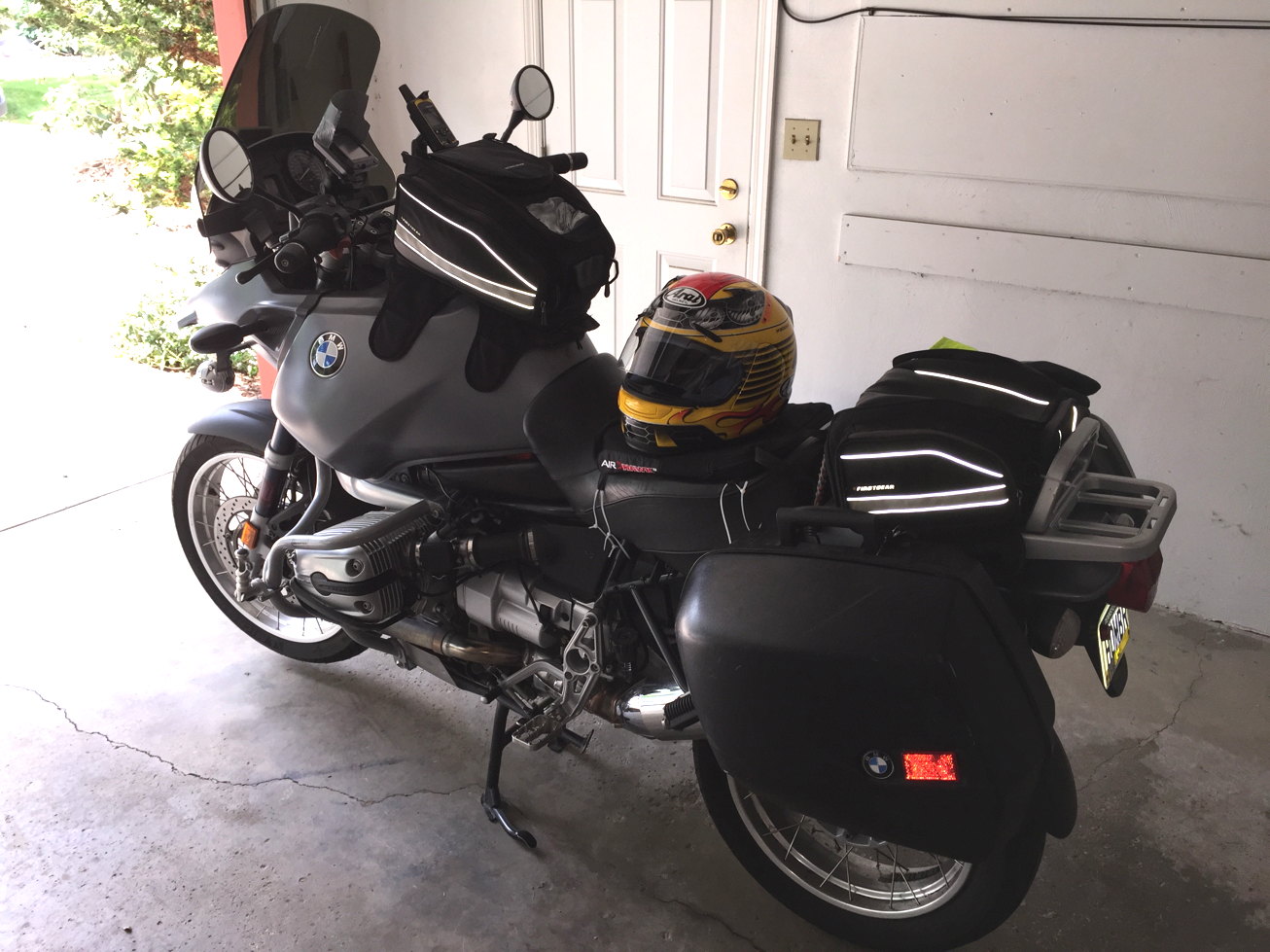
I’ve been riding these areas for over ten years and I know all of it by heart. Last week was a time slot with nothing much to do and the weather was good so I decided to do it all again. I also decided to just ride down there on my venerable BMW R1150GS, the Rock of Gibraltar on two wheels, because having to deal with a trailer on several motel overnights would be a time wasting problem.

From my house to Waynesville, NC is about 560 miles. This is the area of all the fabulous rides so I decided to forego doing the entire BRP again as I’ve done it stem to stern in the past and didn’t have the time this trip. So I rode the Interstates to the area of interest and did it all in four days. I did do parts of the BRP in North Carolina this trip. On the return trip, I was weary of motels and so decided to ride it straight, 560 miles in about 11 hours. I wasn’t sure I could do it and so had the option of stopping along the Interstate anytime, but I did OK.

I’m now wondering if maybe I might try the “Saddle

sore 1000” put on by the Iron Butt Society (1000 miles in 24 hours). Would be cool to have the “World’s Toughest Motorcycle Riders” badge on the back of my Beemer. If you recall, former Chief CCM Fellow Erik Diringer did this ride successfully a few years ago but I was engaged elsewhere at the time and I couldn’t try it with him. At any rate, here are the photos of the trip, giving you some idea of the beauty of the area. Even along the Interstate. You’ll notice one photo with a red arrow. This is one I didn’t quite get showing two huge Confederate Flags on the porch of a home. Enjoy if you have an interest:

Bike trip to Tune town

0

Dells 1Somewhere on my bucket list was a trip back to Wisconsin Dells (Wisconsin), a shameless tourist trap drawing thousands of visitors to a town normally (in winter) housing only 2800 souls). Water slides, roller coasters, various carnival-type attractions over literally square miles now.

The original Dells tourist area was created for boat trips to see the limestone rock formations along the Wisconsin River. Then Tommy Bartlett created a big water ski show. An entrepreneur acquired an army surplus DUKW (an amphibious truck commonly called a “duck”) and opened a scenic duck ride to see the accumulating sights and the theme park followed.

My pal Gil Ross hit the description of rounding the bend into the Dells area perfectly. It’s like entering “Tune Town” (Who Framed Roger Rabbit, 1988)

Summer of 1964, my family had moved to Georgia and I was more or less on my way down there by car from our previous home in Menomonie, Wisconsin. As I passed through the Dells area, I ran into a friend from Menomonie who was working as a waiter somewhere and he talked me into staying. I found a room to stay cheaply and looked for work. Everything I owned was packed into my MG Midget.

First job was stuffing windshield wipers with Tommy Bartlett Waterski Show ads. 12 hours a day, seven days a week for 80 cents an hour. They supplied the old beat up junk car and I was expected to be in constant motion all day long. Every once in a while I noticed someone from the Bartlett show driving around checking on me. That lasted one day.

I then found a much better job at Paul Bunyan’s Logging Camp Restaurant as a table bus boy, clearing dinner tables. 90 cents an hour 14 hour days but one day off and all the food I could eat. This was a great deal.

Restaurant

College kids from all over the State descended on The Dells to work the various attractions, all for thinly veiled child labor conditions, but in the immortal words of ZZ Top, “they gotta lot of nice girls there…..”, and they did. The social life was pretty much full time. No one slept much. I met and went out with a lot of girls, taking one to nearby Madison to see a Beach Boys live concert (their white pants, striped shirts era) with Brian Wilson singing and playing bass. The show opened by the Kingsmen (“Louie…Louie”).

Took another one down to see the opening of the Beatles “A Hard Day’s Night” from which I emerged with a hearing deficit. Young girls screamed at the top of their lungs the entire show, could not hear one word of spoken dialog. Took another to the Museum of Science and Industry in Chicago to see the “Visible Woman” exhibit. A woman sliced vertically from tip of scalp to thigh and encased in glass both sides. All organs in position and visible. As far as I know it’s still there.

It was a good time and I look back on it as a very good part of my young life at age 21, before the next shoe dropped and I found out about responsibility. Going back there has always been on my bucket list but it’s at least 700 miles from me and I never got around to it till now.

Because of another trip postponement, I found myself with a full week with nothing at all to do other than hang around the house, so I figured this would be a good time to make a long distance bike ride of it. I’d much rather be on the road on a bike than a car so it seemed like a good trip. Part of that was to see how I would do considering I still have some residual weakness here and there from a flare-up of Guillain-Barre. I would make an attempt with the option of stopping or turning back if I got into trouble. I might get ten miles, 100 miles or make the whole trip. Unknown quantity.

As it turned out, I made the trip with minimal difficulty. I did note some weakness difficulties in my back, shoulders and upper arms but none enough to be a significant problem. My left hip continues to be a bit weak but quite stable on the bike seat so it never gave me a significant problem.

On arrival in the Dells, I found it to be much, much bigger and noisier than it was when I was there. In my day there was one thoroughfare, now there are several four-lane highways traversing the area. LOTS of water slides, roller coasters and theme parks now. Lots of shops and traffic.

Paul Bunyan is still there with the big statue of him and Babe the blue ox. The place is now about three times bigger than it was when I was there. Now ensconced in a maze of other attractions. In my day, it was pretty much stand-alone by itself at one end of town. Entering, one walks thorough a huge curio and tourist memento area before getting into the actual dining area.

My waitress dressed in logging attire asked if I had been to Paul Bunyan before so I sang the saga of the busboy experience in the summer of 1964 in five-part harmony. She and I talked for a while. The waitresses make $3.00 an hour plus tips and they still have to share part of their tips with the bus-boys, without whom they would not have table turn-around. When I was there, some of them tried to stiff the bus boys, who soon figured it out and cut back turning their tables. She was a sophomore at the University of Wisconsin and, yes, the social life there was still to die for.

The cuisine, such as it was, is still about the same, all you can eat of such staples as chicken and beef. The food was barely edible, but for tourist trap food it was fairly cheap to feed a family. I sat around and soaked up the memories for a while, rode around the area briefly, and then headed out for home.

The entire trip from stem to stern ran four days, 1500 miles averaging nearly 400 miles a day, three overnights along the way. So I marked off #379 on my bucket list. #378 coming up.


Dells 3


Dells 4

40th anniversary of Vietnam reunification.

0

Stuff you never heard of and had little interest in 😉

saigon-tankThis date (April 30, 1975) marks the 40th anniversary of the day North Vietnamese tanks rumbled through the streets of Saigon and broke through the fence at the Presidential Palace to formally re-unify North and South Vietnam. Today, this action is called Reunification Day (Ngày Thống nhất) and is a public holiday in Vietnam.

https://www.dailyherald.com/article/20150429/news/150428483/

This action signaled the bitter end of the “Vietnam War” (technically more of a “conflict”), known in Vietnamese as Kháng chiến chống Mỹ (“Resistance War Against America”). It was the start of the transition period beginning July 2, 1976, when the Provisional Revolutionary Government of the Republic of South Vietnam and North Vietnam merged to form the modern-day Socialist Republic of Vietnam.

I bring this date up for two reasons. First, because I would like you to think just a little about Vietnam. It was one of the most important events in modern history, in many ways shaping the new millennium. But the Vietnam Conflict is quickly headed for obscurity if for no other reason than the exigency of our current nonsense conflict in Afghanistan. A war that can never be won by anyone, as the Russians previously proved in the 80s.

Secondly, I want to passionately recommend to everyone in earshot to find and view a new documentary by Rory Kennedy (Robert F’s daughter): “Last Days in Vietnam”. This documentary can be viewed on the PBS channel intermittently and also free on some of the PBS websites. It can be watched free on several sites:

http://www.pbs.org/wgbh/americanexperience/films/lastdays/player/

It can be easily downloaded off iTunes as well.

This is a very objective and important documentary because it vividly portrays the human aftermath of extremely bad political decisions. It is painful to watch but necessary to give a perspective to the human suffering that occurs following imperious political policy. The bad decisions of the French resulted in 1,726 killed in action and 1694 missing in action in about 6 months at Dien Bein Phu. The Russians were unceremoniously thrown out of Afghanistan after 13,310 soldiers had been killed, 35,478 wounded. Those lessons should have been heeded.

I went back to Vietnam in 2011 after 43 years and I have some profound reflections on things pertaining to it. Vietnam has changed so radically and yet has so stayed the same. In 1968, the entire country was a big American military base. Many troopers never saw any of the cities or the rest of the country. Ankhe City didn’t exist. Camp Radcliff dwarfed the entire region. Same for Camp Holloway In Pleiku, Camp Eagle in Phu Bai and endless others.

In 2011, I saw the real country for the first time without the Army green and camouflage that had obliterated every landscape. Therefore, that trip was much more of a simple tourist effort than a trip back in time. Many in my present reality were not alive in 1968. Coming back to that place was a much emptier experience than I had previously anticipated.

Most or all of the areas where I Iived my life are no longer recognizable. I felt no particular clarification or verification of any of my life as a result of going back to the past. Whatever I might have been seeking has eluded me. Thomas Wolff was right on more accounts than one; you can’t go home again and you can’t go back in time to re-live either. Trust me, I have tried.

Perhaps I yearn for a “Somewhere in time” where Chris Reeves desires to go back so intensely and approximates himself into a time warp so accurately it actually happens and he is given another chance at another path to take. But alas, in the end it might be possible to have it transiently, but the coin always lurks that brings it all tumbling down.

And so we come back to the clearing at the end of our road and make what we can of it.

“Goodbye to all my friends at home
Goodbye to people I’ve trusted
I’ve got to go out and make my way
I might get rich you know I might get busted
But my heart keeps calling me backwards
As I get on the 707
Ridin’ high I got tears in my eyes
You know you got to go through hell
Before you get to heaven”

Steve Miller Band (1977)

Some acerbic notes on the new generation of physicians

0

“My impression is that the older ones found work-life integration while the younger ones are focused on work-life balance. There’s not a lot of balance when up at 3 am with a sick patient or 5. And the a common refrain is “I don’t want to work weekends “

Crippen: When I was a medical student on clinical rotations in the early 70s, I was expected to be the first to arrive and the last to leave. I “took” patients and was responsible to the resident for reporting on morning rounds everything going on. I did procedures under guidance and I got chewed out or my ass kicked when I didn’t perform up to expectations. I was expected to have no other obligations during that rotation and it NEVER crossed my mind to complain that I was overworked. Had I done so, that revelation would have been greeted with dropped jaw astonishment and an admonition to get with the program or take my mangy ass elsewhere.

When I was a resident at Bellevue, there were about 100 patients on the general surgery service and ten in the surgical ICU. There were two first year residents on the service and every-other-night call. Do the math. Similarly, there was no excuse for not getting the work load done. One learned to prioritize to get the important stuff done and suck up the hassles on the rest. Complaints of overwork were nonexistent. Not conceived of.

And yes, I did walk to work 20 miles one way on crutches in waist deep snow fighting off alligators and snakes along the entire course.

Then in the new millennium, Libby Zion came along and the path of least resistance led to the proposition that residents were overworked and too sleepy to function so they had to be given a break. That evolved to a situation where medical students and residents became entitled. No more of this “service” stuff, it has to be all book learning education. Complaints of “I’m overworked” are forwarded to the RRC (Residency something Committee) a body that immediately investigates all such complaints and the burden is on the teaching program that they’re not overburdening the poor babies with a work load that they can’t handle. As a result, that work load gets smaller every year.

This is an honest to God true anecdote told to me by the Chair of one of our clinical departments here. He was teaching a session for medical students on some subject he felt was important and after a while one of the students raised her hand. She told him maybe he had spent enough time on this subject and maybe he should move on. Astonished, he told her he wasn’t finished yet, whereupon she picked up her books and walked out.

Medical Emergency Teams (MET) appear in at least some, not all, data to be doing a good job in interdicting acute deterioration episodes for hospital inpatients. As they evolve, however, the propensity for nurses to call for the MET instead of the responsible resident evolves with it, for a number of complex reasons. Then the responsible resident stands at the back of a crowd of people watching as their patient is taken care of by someone else. The issue as far as the hospital is concerned is that patient safety trumps medical education, and that may be. But in the immortal words of Bill Gates:

“We always overestimate the change that will occur in the next two years and underestimate the change that will occur in the next ten”

And that’s exactly what’s happening with medical education. We’ve entered a realm where the “education” portion has exceeded the “experience” portion. We’re teaching them all the contents of the Textbook of Medicine and then sending them out into a world where the translation of education into experience is required to survive, and it isn’t there. They were standing in the back of the crowd that day, and every day they survive the mix is a day that their minuscule experience base fails them. To be exceeded only by the next wave of graduates.

Similarly, critical care fellows have complained about night and weekends now for the 28 years I have been involved with the UPMC system and they are following the lead of the rest of them. When I was a fellow in 1986, I was on call every third night and every other night when someone one went on vacation or got sick. Now the fellows are on call one night a week and the night calls are progressively being taken over by Certified Nurse Practitioners and Physicians Assistants. The fellows want to think of themselves as executives now, in a teaching and mentoring mode for the night and weekend crews. How they are getting that knowledge base now is with books and simulators.

I hasten to add that there is nothing intrinsically wrong with the CRNP and PA mode of direct patient call after hours. I have some in the NICU and they are REALLY great in every respect. They do EXCELLENT patient care and they know when to call for the executive modulators, which consist of the Resource Intensivists covering the house at night.

The problem with this model is that since every critical care fellow has the same training as most other residents in their specialty, they are at risk for the same dumbing-down (not always). As the syndrome as Med Student/resident Entitlement continues, will the fellows not bear fruit from the poisoned tree? Unclear at this point. We shall see.

There has been a lot of hand wringing about the poor overworked physician trainees that I am not particularly impressed with. I went through all that and not only did I survive, it made me a provider that is never surprised at ANY clinical situation because I’ve seen them all, and there aren’t many physicians that have had a fuller personal life than me (trust me on this).

Hand wringers lament that overwork and overstress creates drop outs, landing in psychiatrists office, going through ten divorces or killing themselves from what amounts to PTSD related disorders. Sorry, I can’t fix those that sink into PTSD. I wish there was a better way to sort those with a tendency for PTSD out before they get into medical school (unlikely as long as grades move all). I went through all that in Vietnam and I just worked it out and went on. I know Viet vets that thrived on it and wish they could go back and do more of it. PTSD is just luck of the draw.

I don’t know what the fix is for PTSD. I think arbitrarily decreasing work loads may solve some of it but invokes the Great Principle of Unintended Consequences (GPUC), we’re seeing it now and we will continue to see it in the future. Well rested physicians aren’t necessarily the ones you want to look up and see during a disaster in the middle of the night. But then at the rate things are going, no one may ever see one after 5 pm anyway.

I am the last of my kind.

Some comments on the Veterans Hospital situation in May, 2014

0

I have a book somewhere in my library written in the late 70s that details how Vietnam vets got the same treatment as those complaining now at a New York Va. The problem was identical. That facility, however, had a huge number of injured and sick vets referred them from all over the area. They simply rationed so that no population of vets got more than others. They all got the same and there wasn’t enough for anyone.

I prefer not to think that these people are intentionally stiffing vets, although the woman head of the Phoenix VA is now showing signs that she did all this to “look efficient” to her bosses so she could climb the career ladder faster. I think they figured out ways to ration care and hide it from the media (for a while).

I “think” the problem is an overwhelming mass of returning vets with a ton of medical problems and a limited amount of resource to deal with them. There are more doctors than Carters has Liver Pills all over Iraq and certainly Afghanistan. None of these doctors can do much definitive care there but they can “patch up” and send them back to the USA alive but with disastrous issues they would have ordinarily died from. Then they require a ton of expensive care that isn’t available in the system.

This is especially true for neurosurgical injury. If a soldier got a serious neurosurgical injury in Vietnam they died. In fact, if s soldier got an injury that a paramedic couldn’t fix at the scene he still had a pretty good chance of dying. Now they get patched up by doctors at up-front field facilities and sent back to the USA for a lifetime of expensive care and many remain non-functional, requiring some form of welfare support. All this is incredibly expensive and the funds were never available.

Most of the Vietnam vets were sent back with relatively inexpensive health care issues and there was enough resources in the VA system to cover them. When I was a resident in both Indianapolis and New York City, I trained at the VA hospitals in both those cities and I was never impressed that their resources were stretched. I thought patients there got pretty good care and very good training of doctors. Now they’re coming back requiring a LOT of chronic care for injuries that should have killed them and the system is dramatically overloaded.  So what do you do when you have resources for 100 soldiers a week and you have 1000 pushing at the gate to get in?

The answer in a perfect world is you prioritize in some way so those requiring the more acute care get it first and the rest stand in line till their number comes up. But watch the “Wounded Warrior” commercials on TV. They’re all acute and they all need more expensive technical care, ICUs, neuro care, extensive rehab for blown off limbs.

In this country, allowing one group to cut in line on the basis of anything will get vociferous complaints of favoritism and discrimination. So I have little doubt that the VA simply found ways to thin out the demand for services by backing them all up into a barrel and turning the spigot open to allow a defined number of them into the system that could deal as effectively as possible. The rest just backed up waiting their turn. There are lots of ways to do that. What they did in Phoenix is one. Then the media got hold of it and the resulting feeding frenzy didn’t point out the fundamental problem of too many injured soldiers trying to get too few resources. It pointed out incompetence and stupidity which is much better copy.

So how to fix the fundamental problem.

As long as we’re resuscitating otherwise mortal injury in Afghanistan, we will continue to deal with them inadequately in the overheated VA system. Now that the toothpaste is out of the tube in the media, it won’t go away. We have several choices.

1.  Pour a ton of money into the VA system creating a “separate but equal” care system for acute injury and rehab.

2.  Close the VA system for acute injury and spread these patients out through the nearly overheated public health care system and pay for that care via a separate reimbursement provision that the military has in place anyway for veterans who for some reason cannot access a veterans facility.

I “think” that #2 is the logical way to deal with these patients most effectively. The VA system clearly cannot deal with them at all, much less effectively. It would cost a lot more to bring the VA system up to speed than to adjust the “private” system. At any rate, we better do something soon because there are a lot of soldiers out there who deserve better.

International MotoGP race at the Circuit of the Americas, Austin, Texas, April 11 – 13, 2014.

0

38A new track constructed specifically to lure the Formula 1 for the World Championship of Drivers circus back to the USA. The track is immaculate, beautiful and specifically constructed for fans to see and absorb as much as possible from any vantage. Very fan-pleasing.

My medical credentials allowed me pretty much full access, but not necessarily into the “seats” where I could sit, have food and drink. That was “extra” but I managed to finesse my way in, at least on Friday where there weren’t too many people.

My buddy Billy Fanstone of Brazil and I wandered around the track all day and each site was as good as the next, although we nor anyone else can never get too close to the actual track. Double levels of fence.

The track is huge, biggest track I’ve ever seen. Something like 3.5 miles from one of the six parking lots to the main gate.  And of course, extremely expensive to get tickets US$1000.00 or so for the three-day race weekend including parking and a seat.

The Formula 1 circus directors liked this track and so the Formula 1 motorcycle series was a natural to add to its itinerary.  There are paramedics on the track but not doctors. The safety director is my old friend from CART Lon Bromley and we had a nice reunion. Long time CART medical director Dr. Steve Olvey is the Medical Director and there are several other doctors around under his direction.

This is the big leagues of two wheel racing, three separate series- Formula 3 (250 cc engines), Formula 2 (600 cc engines) and finally the big boys at 1000 cc, 220 mph on the straights.

It’s difficult to accurately describe the phenomenon of a flat-out motorcycle on the front straight. It’s so incredibly fast it’s difficult to understand how a human can retain control. The rider tucked in behind the diminutive windscreen…..then sitting upright to catch wind (slowing down), followed by clutching the side of the bike like a spider as it tilts to an impossible angle in a corner at speed.  And most of these riders are kids. It’s just ridiculous.

We wandered though the pits watching engineers and techs correlating virtually everything the engines do on a computer. On the actual track, each machine has a shack full of computer monitors that follow every stroke of the piston and turn of the wheel. Each rider has a tiny air conditioned apartment” for sleeping and resting during the day. They hang their tracksuits out to sun.

Then though the paddocks where T-Shirts and other memorabilia are hawked with a blood lust for money that would embarrass the Whore of Babylon. Of course I couldn’t resist picking up a couple of t-shirts, even at blatantly rip-off prices.

The state of motor racing in the new millennium continues to amaze me. When I was there in the 60s, we drove our MG-A’s, Triumph TR-3’s and Porsche 356’s to the track, taped the headlights, fitted a tubular roll bar behind the front seat, raced all day, uninstalled it all, then drove home. The few people that showed up had a good time and went home with full wallets.

Now it’s a big business indeed. Every square centimeter of space on a race bike is filled with an advertisement. Riders and drivers are forced into indentured servitude from their sponsors, the females, of course, encouraged to exhibit as much sexuality as they can pull off without looking “too” much like Playboy centerfolds. The money gleaned from everything and anything associated with racing is parceled out by intricate contracts.

Interestingly, the “fans” have little or no access to the really top riders.  I had a medical pass which allowed me to go anywhere I wanted and I never got anywhere near Dani Pedrosa, Casey Stoner, Nicky Hayden or Valentino Rossi. Their pits were carefully sequestered and closed to everyone and anyone not directly related to them. I got some shots of Rossi coming and going out of his pit.  If they do address “fans”, it’s briefly and very meticulously orchestrated with lots of sponsor visibility.

The MotoGP speeds are difficult to process. Any accident at these speeds would be reliably fatal. Each rider on swinging around the final turn before the main grandstand goes out of their way to lift he front tire for a while just to show their control at over 100mph. Their control of the machine if phenomenal.

All this forces the question of whether MotoGP is a “Sport” or an exhibition. In order for it to be truly a sport, the skill of the rider must exceed the inherent performance of the machine. Of course, the more money put into the machine, the faster it goes. A skillful rider can theoretically overcome limitations in the machine’s performance by simply taking more chances than the next guy.  This potential stoked by the sponsors’ demands to go faster presents a very dangerous situation indeed and transcends skill.

I think that nine time world champion Valentino Rossi is technically the fastest rider that ever lived, but is in the process of lugging a really uncompetitive machine. So, it’s unclear at this point how many chances he’s really willing to take before he cuts his losses and changes teams. .

Unclear also how any of this applies to open-wheel motorcar racing where driver’s ability is less than the car’s performance in a situation where passing is difficult or impossible. In Formula 1, the first cars on the grid usually finish first. Not so much in MotoGP as there is more room to pass.

This race was won by Spaniard Marc Marquez, who started from the poll, let the entire race and set the track record. The Honda team came in first and second, making them pretty much unbeatable so far. He looks like he’s ten years old and started shaving yesterday. Rossi finished 8th, complaining of tire issues.

The actual race is typically colorful and exciting. The fans can see much of the action from good vantage points. I think you have to see it live at least once to fully appreciate the unique ambiance. Then the best seat in the house is always in front of a nice, big high resolution TV screen. I was happy to have had the opportunity to experience this adventure.


A quick tour of the USS Midway in San Francisco

0

While in San Diego for a CODES gig, I got a chance to tour the USS Midway, a simply enormous aircraft carrier sitting in the bay. This thing is a small city, laid down in the year of my birth,1943 and after many years of service, towed to San Diego as a historical exhibit.

After some refurbishing, a modernized Midway began service in the South China Sea during the Laotian Crisis of spring of 1961. In1965, she flew strikes against military and logistics installations in North and South Vietnam. On 17 June 1965, aviators of Midway’s Attack Carrier Wing 2, VF-21 downed the first two MiGs credited to U.S. forces in Southeast Asia.

On 12 January 1973 an aircraft from Midway made the last air-to-air kill of the Vietnam War. For her service in Vietnam from 30 April 1972, to 9 February 1973, the USS Midway and her crew received the Presidential Unit Citation from Richard Nixon.

Only twenty bucks to tour, this paltry fee offsets the half million dollars it cost to tow it to San Diego.  The Navy requires another half million in the bank from the promoters in case the exhibit goes bankrupt to finance the cost to tow it elsewhere.

One can walk all over the ship with recorded headphone remarks. It could easily take a full day to see it all. Most interesting part was the deck side lectures on taking off from- and landing on the Midway, given by retired fighter pilots mainly in the Vietnam era.  Both saw combat action.

Taking off from a catapult involved racing from standing still to 165 miles per hour (265 KPH) in two seconds over about 250 feet. Pilots pull 2.5 G’s. The steam driven catapult beneath deck weighs about three tons and while travelling 165 mph at the end of the flight deck it’s stopped cold in five feet by a water trap (shakes the entire ship).

The deck personnel wear color-coded jackets to delineate who is responsible for what and they communicate by a series of elaborate hand gestures. All are junior commissioned officers. Hands over head for pilots and hands under waist for other deck crew. When everything is set and the pilot is ready, he or she salutes, the lunch officer returns the salute and the switch is flipped. Just like in “Top Gun”.

The landing lecture was given by another retired pilot and was equally fascinating. The landing area is about 300 feet. The approaching aircraft drops a tail-hook (below the wheels) and on touchdown (at 150 mph) the hook has a grab at one of four wrist thick wires a few feet apart. This is usually successful, bringing the aircraft to a dead stop in 2 seconds with about the same G force as takeoff, except from the opposite direction.

Landing Signal Officers guide the plane in through radio communication as well as a collection of lights on the deck. The pilot will see different lights depending on the plane’s angle of approach. If the plane is right on target, the pilot will see an amber light, dubbed the “meatball,” in line with a row of green lights. If the amber light appears above the green lights, the plane is coming in too high; if the amber light appears below the green lights, the plane is coming in too low. This system is especially interesting at night where the pilot sees only the meatball bobbing up and down with the motion of the ship.

http://gizmodo.com/night-vs-day-aircraft-carrier-landings-in-one-harrowin-979263050

Accidents are infrequent but can be dramatic. Former Presidential candidate John McCain is said to have been sitting in the cockpit of his aircraft on the deck of the USS Forrestal stationed off the coast of North Vietnam, conducting combat operations. A rocket accidentally exploded on another plane, causing a chain reaction of dangerous fireworks. Hundreds of sailors were injured or killed in the melee. McCain is said to have ejected from his stationary aircraft. He was not significantly injured.

This is an incredible tour- highly recommended by me if you find yourself in sunny San Diego.

Here are the brief collections of photos by me. Remember these are high def. and you can increase the size of the screen by the appropriate YouTube icon.