Rock Band “Boston”. Looking for a connection.

0

Tom SholzIf you’re a fan of Rock, you know and love the band “Boston”.  They burst on the scene in 1976 with the classic self-titled album and they have been a mainstay since. Tom Scholz is the heart and soul of the band, an authentic genius schooled at MIT and a hopelessly neurotic perfectionist that puts out an album about every eight years.

If you look around, you’ll see there is NOTHING written about the band in the way of an anthology or history. This is quite unusual, as virtually all the other big league bands have a historical biography in the mainstream media. Unclear why this is, possibly Tom Scholz’s enduring fear and distrust of all media.

At any rate, I would really like to write that biography, and I think I can do it justice. I have a few thin connections to some of the Boston personnel but none sufficient to get me an intro.

The problem with this effort is that I don’t have any major Rock journalism chops. Neither David Fricke and Ben Fong Torres know who I am, but  Rolling Stone has taken a chance of talented amateurs in the past, allowing Cameron Crowe to explore the Allman Brothers in the early 70s at age 18.  Gregg Allman demand Crowe to his room and told him to bring identification to prove he was not a DEA shill.

And the selection of Tommy DeCarlo (an incredible Brad Delp look-a-like with the same vocal range) occurred when Scholz noticed Tommy doing a cover of a Boston song on “My Space” and invited him to audition. So, it isn’t out of the question that I can get a foothold.

Another problem is that Tom Scholz is about as eccentric as they come and rarely if ever communicates with anyone outside his circle.  Without access to Sholz, it would be difficult if not impossible to write their history.

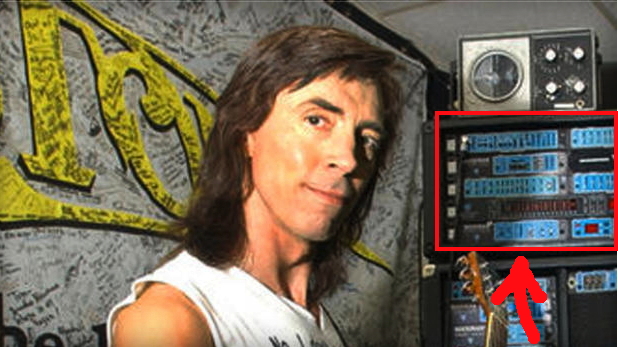
I think I understand a lot about Tom Scholz and his passions. They were similar to mine at the same age and we both made them happen. He and I are a lot alike in many ways although he’s much smarter than me.  I have extensively researched him and also his innovations in the field of sound processing.  In the mid 80s, he designed and created “Rockman” modules for guitarists that allow an incredibly rich array of analog sound processing guitar-to-amplifier. Each module creates a different effect, compression, sustain, chorus, echo, distortion and a full range equalizer is a very small package.

He designed these for studio use and they must be played through a different kind of sound system than a common guitar amplifier, but as you can see from the number of switches and controls, the processing of tone and audio is virtually endless. (See Photo).  Over about two months I obtained all the hard to find modules, set them up in my music room and I am playing with them. The creation of these modules is just simply genius.

So I’m looking for volunteers to get me a connection to anyone that could help me some kind of intro to someone that could help me accomplish this goal.

Film Review: “Elysium” (2013)

0

A morality play about illegal immigration built on an Amalgam of three other films:

Oblivion (Tom Cruise- 2013)
Blade Runner (Harrison Ford- 1982)
Mad Max (Mel Gibson-1979)

And of course the obligatory CGI backdrop, although some scenes were filmed in Mexico.

It’s way far in the future and the earth is a hopeless overcrowded, polluted chunk of misery. The rich and entitled have moved to Elysium, a huge rotating space station full of mansions and Stepford Wives, overseen by a particularly cold blooded “Homeland Security” officer insuring no dilution of the lifestyle occurs from the unwashed denizens below.

Matt Damon is an earthbound guy with a quickly terminal disease trying to get to Elysium for the freely available curative health care. By an accidental chain of events, everyone needs to catch Damon for different reasons, so the second half of the film is a prolonged chase replete with the obligatory CGI pyrotechnics.

The film is a thinly veiled criticism of what some consider our current immigration policy to be, with a side comment on universal health care. This criticism of the inequity of closed borders fails to address bigger pictures such as how it got that way and how the earth might benefit over the long haul owning a small respite. The portrayal of the earthly losers and the rich entitled are both overblown for effect.

The story line is small-bore, the “real” problems of immigration are minimized or ignored and the inability to effectively kill any of the villains becomes tedious. An aging Jodie Foster is woefully miscast and doesn’t come off as a bloodless bureaucrat. Matt Damon puts in a lifeless performance that could have been accomplished by any other minor leaguer.

That said, the villains came more to life than the heros. South African filmmaker Sharlto Copley, with his strange quasi-Australian accent is impeccably menacing and effectively evil with a smarmy twist. Brazilian Wagner Moura is super as the overwrought computer hacker bent on taking over Elysium. the villains are far more interesting than the heros.

Best feature: Sharlto Copley

Worst feature: Matt Damon’s silly ectoplasm. Too many improbably endless chase scenes.

I give it 2 of five computer screens screwed into Damon’s skull. Wait till it comes around on HBO and root for the villains

Hombres MC visit some American Civil War National Battlefield Monuments.

0

flagHombres MC visit some American Civil War National Battlefield Monuments. Many located between Washington, DC and the Confederate Capital in Richmond, VA.  We had five days and we put on about 700 miles. Then we went up part of the Blue Ridge Parkway toward home (in the rain and fog)

Most of the landmarks within the battlefield areas are not well preserved after 150 years.  The farmhouse named “Chancellorsville” is no longer there and the crossroads where the battle was fought is now a four-lane highway. The Fredericksburg site is in the middle of a housing project.

The National Park Service has constructed exceptionally interesting sites containing films outlining the events, artifacts and on-site lectures from park rangers. All well done, and I might add limited now because of the “sequester” so if you go, be sure and put some cash in the pot to maintain this essential American history.

Naturally, it would be impossible for me to delve into much of the history of the American Civil War as very notable authors have spent lifetimes trying to understand it. Ken Burns filmed the progression over 12 hours.  There are, however, a few issues of personal interest to me I can scratch the surface of.

Some of the famous battles are remarkable not so much for what happened as what might have been.

The first major battle to take place on Union soil occurred on Sept 17, 1962 at Antietam creek, near Sharpsburg, Maryland. Union Maj. Gen. George McClellan launched a frontal attack on the Confederate Army led by Maj. Gen. Joseph Hooker in and around a cornfield used for cover for both sides.

After the brutal battle in which over 23,000 young men lost their lives in one day, was fought to a brutal draw, but advantage lay with the Union as the Confederate troops were outnumbered and disorganized.  Lee ordered the Confederate troops to withdraw and re-group. At this point, a further push by the Union Army might have decimated Lee’s meager residual forces before they could re-group.

However, McClellan was a notoriously cautious General and fearful of ordering his men into actual battle unless victory with minimal casualties was a virtual lead pipe cinch. McClellan refused to pursue Hooker, even with the assistance of reinforcements from Maj. Gen Ambrose Burnside’s fresh troops lingering outside the action. He simply didn’t think he needed to. The Confederate Army was conceptually doomed and would collapse soon anyway with no additional loss of his troops. This allowed Hooker to safely retreat back south of the Potomac to re-constitute.

In terms of military strategy and tactics, McClellan fatefully failed to bring the full brunt of his forces to bear as a “Force Multiplier”, to make a given force more effective than that same force would be without it. Essentially, to cause disproportionate losses on the enemy, and therefore destroy the enemy’s ability to fight.  Sherman notoriously used this strategy that came to be known as “scorched earth” in his “march to the Sea” in 1864.

This lapse allowed Hooker to shift his forces to meet each encounter with the best possible efficacy using fewer men. Some historians believe that Lee’s army could have been wiped out at Antietam and had that occurred, the war would have been dramatically shortened or over.

The battle at Fredericksburg, VA occurred on December 11-15, 1862 between the Confederate Army commanded by Robert E. Lee and the Union Army commanded by Maj. Gen Ambrose Burnside. This battle is remembered for one of the most spectacular tactical blunders in the history of warfare, resulting in Union casualties twice as heavy as Confederate.

Burnsides plan was to cross the Rappahannock River on pontoon bridges to meet the Confederates south of the village of Fredericksburg. However, on arrival at the riverbank, Burnside found no pontoons (due to bureaucratic blunder) and was assured they would arrive in a day or two. So Burnside camped out and waited.

Meanwhile, Lee’s forces wondered where the Union Army was, so Lee sent scouts up who reported the situation. This allowed Lee to move up to meet Burnside in and around the town of Fredericksburg and more importantly, occupy the high ground south of the town with a stone wall for cover.

When the pontoons arrived, Burnside was forced to endure withering fire moving his troops across the river. On finally arriving on the opposite bank, Burnside ordered multiple frontal assault against 3,000 Confederate infantrymen lined up in multiple ranks behind the stone wall for about 600 yards and another 3,000 with artillery behind it. The Union troops were repulsed with heavy losses. It’s said that a walk along the entire of the killing field would not allow a boot to touch a single blade of grass. Only bodies.

Burnside stubbornly continued these assaults until he essentially ran out of manpower, following which he attempted to blame his subordinates. The following day, Dec 14, Burnside asked Lee for a truce to attend to his wounded, which the latter graciously granted, but ultimately proved to be a tactical mistake. The next day Dec 15, the Federal forces retreated across the river, and the campaign came to an end. The Union army suffered 12,653 casualties in three days of fighting. The Confederate army lost 5,377 men. Burnside was relieved of command a month later.

Again, as at Antietam, the military strategy and tactics are remarkable. For the entire battle, Lee’s forces needed only maintain their position and thin out assaulting Union forces from a position of relative safety. By the evening of Dec 14, the Union army lay decimated and extremely vulnerable, trapped between a superior confederate force occupying protected high ground and a river. For unclear reasons, Lee decided to wait out the night before actually assaulting the Union forces the following morning. This allowed the residual Union forces time to escape back across the river and eventually regroup on Union soil. Lee is said to have regretted this decision bitterly.

The Union Army (of the Potomac) then went on to another defeat at Chancellorsville in early May of 1963, followed by a series of smaller but cumulative losses. Ultimately, the loss of the Confederacy became a self fulfilling prophesy ending with the ill fated Appomattox Campaign and the evacuation of Richmond that culminated in Lee’s surrender on April 9. 1865.

A neutral spot, The McLean House (a private residence near the Appomattox Courthouse) was selected for the two Generals to meet and discuss terms, which were exceptionally generous. Roughly 175,000 Confederates remained in the field were allowed to keep all the possessions except arms and flags.  Each was issued a signed “parole” document guaranteeing free passage back home (avoiding potential charges of desertion).

Maj. Gen. Joshua Chamberlain, commander of one of the major Union brigades was a stirring figure responsible for one of the most poignant scenes of the era. He had personally directed 20 battles, was cited for bravery four times, had six horses shot from under him and was wounded six times.

Chamberlain ordered the line of Union troops to “order Arms” as the Confederates passed by as a measure of respect.  Observing this action, surrendering General of the remaining Confederate troops, Gen. John Brown Gordon wheeled his horse around, drew his sword placing the point against the toe of his boot and decreed similar respect for the Union troops. This order was carried out and the two movements proceeded silently and mournfully.

Thus ended the bloodiest battle in American history.  A total of 214,938 deaths in combat. At least 500,000 deaths from disease and ultimate wounds for a total death count of ~ 625,000. WW II yielded 405,000 deaths and Vietnam a paltry ~58,000 deaths in eight years. 23,000 men died at Antietam in one day and ~50,000 at Gettysburg in three days.

An interesting medical aside is the story of Dr. Jonathan Letterman, a Civil War surgeon said to have developed the concept of “triage”. Born in Canonsburg, PA, he was named medical director for the Union Army of the Potomac in May 1962. He initiated forward first aid stations, devised systems where fallen soldiers would be classified as to urgency of treatment while attending casualties at Antietam. He also refined ambulance systems and distribution of supplies.  He was light years ahead of his time.

Interestingly, there is a note on EBay (and a mention on “Pawn Stars”) flatly stating that any Confederate Flag that might be found on any Internet auction site is virtually guaranteed to be fake. There are simply none left that aren’t in museums and the chances of finding one, however unlikely, would bring tens of thousands of dollars. Virtually all Confederate swords and other hardware are expert fakes.

In my photo gallery, you will see his portrait, the barn where the “enlisted” troops were treated (Naturally- officers were treated up at the mansion) and some of the accouterments of his trade.

Here is my photo journal if you have an interest:

http://youtu.be/aI_sEAIAkog

(Click the HD icon and full frame)

——————————

Further Study:

I think Mississippian Shelby Foote writes the definitive history of this era and it’s as complete as it gets. His trilogy contains over a million words.

http://www.amazon.com/gp/product/0679643702/ref=pd_lpo_k2_dp_sr_1?pf_rd_p=1535523722&pf_rd_s=lpo-top-stripe-1&pf_rd_t=201&pf_rd_i=0394749138&pf_rd_m=ATVPDKIKX0DER&pf_rd_r=14ZA0Z6DJS0HAPSWXTAH

For the visually inclined, Ken Burns’ twelve-part documentary of the era on PBS (1990) is a masterpiece.

http://www.imdb.com/title/tt0098769/
Film Review: “Man of Steel” (2013)

0

“Superman” originated as a comic in June 1938. The thrust was to present a hero pre-war depression public could identify with, mysterious and omnipotent, fighting crime and standing up for the common man.  After 75 years, this action hero continues to be an American cultural icon; star of radio serials, television programs, films, newspaper funnies, video games and of course- “Man of Steel” (2013). Action Comics Volume 1, #1 (first Superman issue) in poor condition recently sold at auction for US$175,000. A pristine copy sold for over two million dollars in 2011.

Like the original story line, we’re given a lengthy history of how the planet Krypton came to be destroyed and the clash over good and evil involved in sending it’s genetic material out into space in the hope it would plant somewhere hospitable. The original story line then departs quickly and becomes more labored. The Superman character departs from the usual attributes of strength, flight and x-ray vision to encompass the more dubious elements of vulnerability and a political conscious.

After the child lands on earth and is nurtured by Kevin Costner, the film collapses in more blinding special effects than when God created the universe. Any semblance of plot vanishes as the protagonists destroy most of Metropolis by slinging each other into buildings, with incredulous bystanders gawking as they did when Godzilla wiped out Tokyo. This goes on nonstop for over 45 minutes, culminated by the ultimate hero finishing the deed after all that destruction by a quiet snap. The point of all that trashing?

After seeing this monstrosity and reading audience reviews, it’s clear why there is nothing on network television anymore but empty headed “reality” shows and dimwit sisters talking dirty on camera to preserve their “brand”. Zack Snyder and Christopher Nolan are giving the pubic exactly what they want. A thin plot for about an hour punctuated by another hour and a half of overwrought CGI pyrotechnics. Simplistic one-dimensional characters caught in a barrage of exploding buildings, aircraft, spacecraft, and hapless citizens running through the streets like wet rats. It’s the film allegory equivalent of “American Idol” and “The Voice”. For whatever reason, this is what the public wants and they’re out seeing it in droves.

Best quip:  Lois Lane shortly after kissing Superman: “You must remember that culturally, it’s all downhill after the first kiss”.

Best brief cameo role:  Richard Schiff (Toby on the West Wing).

Best feature: The first hour is entertaining.

Worst feature:  At two and a half hours it’s TOO LONG, and the last hour and a half is nothing but CGI pyrotechnics that get BOOOOORING after the first ten minutes.

This film is as embarrassing to first-rate filmmaking as disco was to blue chip music. Be prepared for gait and balance abnormalities on leaving the theater. Maybe seizures.

I give it 3 of 5 “Hope” chests, and that’s a gift for Russell Crowe and Kevin Costner.

Film Review: “Star Trek: Into Darkness” (2013)

0

“Space: the final frontier.
These are the voyages of the starship Enterprise.
Its five-year mission: to explore strange new worlds,
to seek out new life and new civilizations,
to boldly go where no man has gone before.”

In order to Savor the new generation “Star Trek” series produced/directed by JJ Abrams, you sort of have had to be there for the original beginning in ‘66’, cancelled by NBC in ’69 due to low ratings. However, NBC and others failed to recognize the impact of this series on American culture and it eventually spawned five more similar series and 12 films. In 2011, the decision to cancel Star Trek by NBC was ranked #4 on the TV Guide special: “The 25 Biggest TV Blunders 2”.

JJ Abrams re-created the first of the truly high-tech Star Treks in 2009, retroactively re-uniting most of the original characters in their youth and the beginning of their Star Fleet careers. The ’09 film worked well and set the stage for the latest Iteration this month: “Star Trek II: Into Darkness” which should have been a smooth, logical transition.

Unfortunately, the new film doesn’t completely deliver as it could have.  The story line is hokey and needlessly convoluted, tending to wring overacting skills rather than character development from its participants. Abrams tends to use flash and light shows to augment and ultimately replace plot. The villain isn’t very believable and the crisis involving Kirk at the end elicited groans from the audience. Bones McCoy is particularly rendered a caricature of his original self (“Damn it Jim….I’m a DOCTOR, not a engineering technician!).

3-D adds little and the IMAX experience ends up bloated and feeding on itself, promoting sore necks from audiences heads moving side to side for two hours. Chris Pine was mildly disappointing this time around, unable to grab a firm connection to the plot or the audience. Zachary Quinto as Spock was given a meatier role than last time and he runs with it well. The rest of the cast were either throw-aways or add-ons.

Best part:  The coherent story line and action sequences in the first five minutes, all of which dissolved quickly.

Worst part:  Too much flash and glitz, quickly numbing the audience like a big screen JLo concert. McCoy’s irritating use of glitzy metaphors for every occasion: “You don’t rob a bank when the getaway car has a flat tire!”

I was disappointed in this effort. JJ Abrams succumbed to dumbing down the film for a quick box office blast from thrill seekers. He should have demanded better writing and more substance. He could have had it.

I give it three of five Blond PhDs with great legs knowledgeably fiddling with photon torpedo innards.


Loneliness of the long distance rider

0

16

This sentiment was also picked up by JD Salinger in “Catcher in the Rye” (1951), featuring a protagonist consumed with defeating the regimentation and “phoniness” of contemporary society. Holden Caulfield’s rejection of traditional middle-class values signaled the first widely recognized public stand against conformism in post-war 50s culture.

The road as catharsis for motorcyclists holds some variations from what would be a typical voyage in the early 50s. Few if any contemporary bikers have much interest in bucking all that much societal conformity. The number one reason for long distance riding is to see as much as possible in the time allotted. The danger of course is the increasing distance the rider is willing to negotiate in order to get all desired visitation in.

The chance of a rider biting off more than he or she can chew is omnipresent. In Leo Tolstoy’s short story “How much land does a man need”, the protagonist was given as much land as he could circumvent on foot provided he return to the same spot he departed from in one day. Of course, the walker continued to find more land he wanted as he walked, ultimately running out of sustenance and dying of exhaustion out in the hinterlands nowhere near the point of origin.

That said, some species of riders comfortably evolve to long distance roadwork naturally. Author Joel Rappoport discovered early that he liked riding for the sake of riding and the distance didn’t matter. Riding 650 miles to visit a relative and 650 miles back the following day wasn’t an issue. He simply became part of the road; it engulfed him and he became one with it. Rider Rappoport explains the phenomena of the yearly “Iron Butt Rally” in his book “Hopeless Class”. “11 Days, 11,000 Miles”. Finishers are dubbed “The World’s Toughest Motorcycle Riders”, a claim few would doubt.

http://www.amazon.com/Hopeless-Class-ebook/dp/B00805FFQG

Long distance riders usually customize their machines to facilitate comfort during a long haul, including wind-diverting fairings, GPS, radar detection, satellite location gear, computerized suspension adjustment for road conditions and even CB radio rigged to blue tooth and helmet earphones. The preferred ride for the majority of long distance riders is the venerable BMW R1200GS, considered by most to the Rock of Gibraltar on wheels. Most other similar models are thinly failed copies.

Accordingly, my trip to the Balkans last week was a tour de force of long distance riding to accommodate as many sites as possible in the time allotted, which turned out to be about 1500 miles in ten riding days. I did manage to get it all in and recorded most of it on (digital) film that I have made into a high-resolution movie. The movie is definitely in high definition and if you click on the wide screen at the bottom right of your screen, you can fill your computer screen with high-resolution photos.

Here it is: http://youtu.be/XTTZkE9X3Qg

Enjoy.

A passing: Ray Manzarek

0

Today, Ray Manzarek, co-founder of The Doors died peacefully of biliary cancer at age 74, surrounded by his family, as it should be.  Technically it was the end of a musical era when Jim died of personal demons in 1971. Ray’s death adds to the sadness as a harbinger of all our eventual passages.

The history of Rock as a musical art form evolved vertically from its roots in the blues with jazz inflections beginning in the mid 60s. REO Speedwagon in the Midwest,  Aerosmith in Boston,  The Rascals in New York, The Allman Bros in Georgia to name only a few.  But the true epicenter of 60s Rock was Laurel Canyon in LA, central to the evolution of Rock as a serious medium.

The cross fertilization, cross pollination and insemination leading to the arrival of Buffalo Springfield, The Byrds, Crosby Stills & Nash & Young, the Eagles, Frank Zappa, the Turtles, the Mamas & Papas to name but a few.  And of course, more to the point……The Doors, created in LA and nurtured in Laurel Canyon. There was nothing like them before and there will probably be nothing like them again.

It was 1967, the year “Alice’s Restaurant” signaled the emergence of a radical change in things.   The strains of “Are you Experienced” from Jimi Hendrix and “When the music’s over” from the Doors wafted around the dorm hall leading to stunned silence. No one had ever herd anything like that before.  It was literally electrifying and it led like the auditory pied piper to the culture that created it.

Music is in a class by itself in its ability to pluck at the strings of the human heart and the masters have the ability to bypass technique. Mozart is said to have been able to perfectly play the identical piano piece upside down or with his arms crossed. Similarly, it wasn’t what Jim said; it was the way he said it and the words paled quickly.

If I play Jim Morrison in a pitch-black room, I physically return to many a curious and forgotten lore. I still get dazed and confused just as my generation did in 1967. When I play “If you’re going to San Francisco” by the late Scott McKenzie, or “Kiss and say goodbye” by the Hollywoods, it moves me to tears. “Gimmie Shelter” by the Stones makes me crazy. When I play on stage with the CODES and watch people absorbing the music and reacting, it reminds me of the awesome power it holds.

Rest in peace Ray and Jim.