A bit of 60s and early 70s history (by me)

0

BillIntroduction

What follows is about  3000 words of personal observations on this history as it applied to me as an observer and participant. I barely scratch the surface of it. Pulitzer winner Taylor Branch wrote three complete volumes on the Martin Luther King years. Robert Caro wrote three volumes on Lyndon Johnson, almost 2500 pages. If I had the time and energy, I could easily write three volumes of my life from 1962 through 1972. Someday maybe I will.

At any rate, I would encourage everyone to read this missive because observer/participant accounts of the 60s are dying out fast. Much political history of the period died with Hunter Thompson. The definitive history of the Vietnam Conflict died with Bernard Fall. The social history of the 60s and early 70s will die with Tom Wolfe. Soon the only accounts for you to read will be from partisan politicians.

A superficial scratch on the history of protest in a previous generation

“Yes, my guard stood hard when abstract threats

Too noble to neglect 

Deceived me into thinking

I had something to protect

Good and bad, I define these terms

Quite clear, no doubt, somehow

Ah, but I was so much older then

I’m younger than that now”

                 Bob Dylan, “My back pages”, 1964


http://www.latimes.com/entertainment/movies/moviesnow/la-et-mn-angela-davis-20130405,0,2829526.story


In order to put the Angela Davis issue into perspective, one must understand the temper of the times. That requires an exploration of the socio-political situation in the 60s and early 70s, a time of intense social and political unrest that will probably never be seen again in this country. The next revolution will be financial.

We understand the progress of the 60s generation play by watching the players. In modern times we are allowed to view the aftermath of this progression as astronomers view dying galaxies from a safe distance.  An alternate universe of unconventional social mores passing through optimistic iterations to ultimately to end in a fatal mutation. An exploration of “no limits”, the price of admission for which a number of very talented players paid with their lives.


Music and revolution

The price you paid for your riches and fame

Was it all a strange game?

You’re a little insane

The money, the fame, the public acclaim

Don’t forget what you are

You’re a rock ‘n’ roll star!

                The Byrds, “So you want to be a Rock and Roll Star”, 1967


Parenthetically, this social upheaval was irrevocably intertwined with the music of the day. The medium of Rock has always been one of rebellion against conformity and conventionality, and accordingly fit like a hand in a glove with the 60s. Rock is the stuff of existential anti-heroism, inviting those seeking salvation by immersing their souls in cathartic rock media masquerading as social profundity.  The high risk-high gain medium selects for those who actively live the dream. The musicality selects strains and chords evolved to selectively pull resonant strings of the human brain, abandoning order.

Those selected as the cast had no safety net and were drawn in at their peril. Normally composed hominids become temporarily irrational and start ripping out seats at a Jerry Lee Lewis concert. Jerry Lee lights a piano on fire and is carried out with it by firemen, still playing. A surging crowd trying to get prime seats at a Who concert trample and kill eleven people. Concertgoers assault the Rolling Stones on stage at Altamont resulting in one death at the hands of the Hell’s Angels. Dimebag Darrel of Pantera is assassinated on stage. Duane Allman thought he was immune to laws of traffic. Bonzo and Moonie thought they were immune to the toxicity of ethanol. Hendrix couldn’t sleep without escalating soporifics that ultimately put him to sleep forever. Cobain chose the brief pain of a shotgun blast to end the constant pain of his life. Jim Morrison died alone in a bathtub.

It’s also necessary to understand the influence of former President Richard M. Nixon. 


Nixon Agonistes: The crisis of the self made man (Garry Wills, 1970)

“Well, come on generals, let’s move fast;

Your big chance has come at last.

Now you can go out and get those reds

‘Cause the only good commie is the one that’s dead

And you know that peace can only be won

When we’ve blown ’em all to kingdom come”.

                      Country Joe & the Fish, “Feel like I’m fixin’ to die rag”, 1967.


The demonization of our current sitting president is a frolic compared to the bitter division Richard Nixon incited among a huge fraction of the population, mostly young people and students galvanized by his diffidence regarding the Vietnam conflict and his oppression of the American citizenry (using the IRA and FBI as political weapons against dissidence).

Richard Nixon has no peer in contemporary politics. Many remember him as one of the most nefarious humans that ever drew breath.  He was so spectacularly evil he glowed in the dark. Dr. Hunter S. Thompson said it eloquently in 1972:

“For years I’ve regarded his existence as a

monument to all the rancid genes and broken

chromosones that corrupt the possibilities of

the American Dream; he was a foul caricature

of himself, a man with no soul, no inner convictions,

with the integrity of a hyena and the style of a

poison(ous) toad”.

Nixon permeated and exacerbated the revolution by injecting his own agenda into the irrepressible change and got squashed like a bug in the process, but not before he became identified as the compleat villain on virtually every level. There was no possibility of his survival. He was the ultimate sacrificial lamb necessary to complete the revolutionary process. If he hadn’t existed, he would have had to be invented.


Angela Davis and her part in 60s history

“Her brothers been a fallin’,

Fallin’ one by one.

For a judge they murdered

And a judge they stole,

Now de judge he gonna judge her

For all dat he’s worth”.


                Rolling Stones “Sweet Black Angel”, 1973


Angela Davis rose through the ranks of professional protesters to become a polarizing figure making Sarah Palin look like Cinderella. At this point in my diatribe, you’ll have to endure a bit of dry history.

Angela came up through the School of Hard Knocks in 50s racial discrimination. She combined a lot of brain-power (PhD in Philosophy) and a serious head of advocational steam for the poor and downtrodden of society, particularly for persons of color and women. In order to set herself apart from her perception of societal oppression, she worked hard to alienate herself from mainstream white rank & file.  She assumed a very ostentatious Afro hairstyle, membership in the Communist Party and a very cozy relationship with the Black Panther Party, an organization famous for frequent firefights with the local Federales.

Because of her brainpower, she was recruited for an assistant professorship at UCLA in 1969 and promptly fired for her social views at the behest of then Governor Ronald Reagan. The cry immediately went up that she was a victim of race discrimination. Later that year, a federal judge ruled the university could not fire Davis because of her affiliations with the Communist Party, and she briefly resumed her post, followed quickly by another dismissal because of the inflammatory language of she media speeches.

In 1970, Davis became a full time social activist, plying the media expertly. In August of 1970, a black student took hostages in a courtroom and affected an escape by car, following which the police fired on the vehicle killing the judge, a hostage and three accomplices. It turned out that Davis had purchased the firearms used in the melee, she was prosecuted for “aggravated kidnapping and first degree murder” as an accomplice and she vanished into the social activist underground to avoid arrest. FBI director J. Edgar Hoover made Angela Davis the third woman and the 309th person to appear on the FBI’s Ten Most Wanted list.

She was, of course, ultimately found and jailed in January 1971. A splashy, racially saturated movement to “Free Angela” followed, the subject of this film.  After spending 18 months behind bars, Davis was acquitted of all charges by an all-white jury. The fact that she owned the guns used in the crime was judged not sufficient to establish her responsibility for the plot.

The incarceration of Angela Davis stands as a monument to the evolution of racial discrimination in the 70s post Selma, Alabama. She was selected for this honor pretty much because of her visibility in the social activist movement, that ostentatious females were a relative rarity within those groups and because of her eloquent articulation to the media.  John Lennon and Yoko Ono recorded a song “Angela” on their 1972 album some time in New York City in support of her. The Rolling Stones song: “Sweet Black Angel released in 1972 on their seminal album “Exile on Main Street” is dedicated to Davis.

I think that the Angela Davis situation was one of the seminal events that gelled 70s political activism.


Welcome to the evolution, revolution

“You say you want a revolution

Well, you know

We all want to change the world

You tell me that it’s evolution

Well, you know

We all want to change the world”

Beatles, “Revolution”, 1968


Although difficult to imagine for most of you, the years 1970-71 were a straight up revolution, exacerbated by the assassinations of Robert F. Kennedy and Martin Luther King in 1968 and nurtured by the violent Democratic National Convention of 1968. Much but not all of it related to an intensely polarizing President and the unpopular Vietnam conflict that remained in full swing while the “peace accords” spent months arguing about the seating.

Virtually every city in the country brimmed with firebombs, looting and the crackle of small arms fire. Business owners sat in shifts with shotguns propped on their toes outside their storefronts nightly. You kind of had to be there to appreciate the frightening enormity of it.


On the nature of protest

“Come mothers and fathers throughout the land

And don’t criticize what you can’t understand

Your sons and your daughters are beyond your command

Your old road is rapidly agin’

Please get out of the new one if you can’t lend your hand

For the times they are a-changin’.

                             Bob Dylan, 1964


In the middle and late 60s, protest against racial discrimination, an established and entrenched culture in the South (and equally so but more occult in the Northern cities) took the form of “nonviolence” (passive resistance) after the late Martin Luther King. The working theory was that if enough resisters brought media attention to racial inequality, it would eventually collapse under it’s own weight. To meet violence with more violence would be contra-productive and also violate the strong religious undercurrent of the movement. It was just a matter of time and MLK protesters were willing to wait it out.

However, the forces of social and racial culture continued full steam ahead with the assassination of Robert F. Kennedy, Martin Luther King and the violence at the Democratic National Convention in 1968, acerbically chronicled by Dr. Thompson in his formative work: “Fear and Loathing on the campaign trail, 1972”. The spectacle of cops on horseback busting kids heads with nightsticks in Chicago and kids shot dead at Kent State by National Guardsmen in 1970. It suddenly dawned that non-violence and simply pointing out evil and waiting for a logical response wasn’t working. Every kid clocked by a nightstick became an instant radical.

It was only a matter of time before a selection of the protesters escalated their visibility to make the establishment take notice. If violence were the answer to protest, then protest would meet that challenge by becoming more violent. Accordingly, the Students for a Democratic Society (SDS), previously a leftist student group advocating participatory democracy evolved to a radical revolutionary unit. The earlier iteration of the SDS was oriented along the lines of the Student Nonviolent Coordinating Committee headed by Stokely Carmicheal.  The next SDS iteration, Weather Underground (WU) rose because of the failure of passive resistance to accomplish its goal. Bernadine Dohrn articulated the manifesto: “You don’t need a Weatherman to know which way the wind blows”, a line taken from Bob Dylan’s “Subterranean Homesick Blues”


Any way the wind blows

“Blood on the rocks

Blood on the streets

Blood in the sky

Blood on the sheets

If you want blood – you got it…”

                     AC/DC, “If you want blood”, 1978


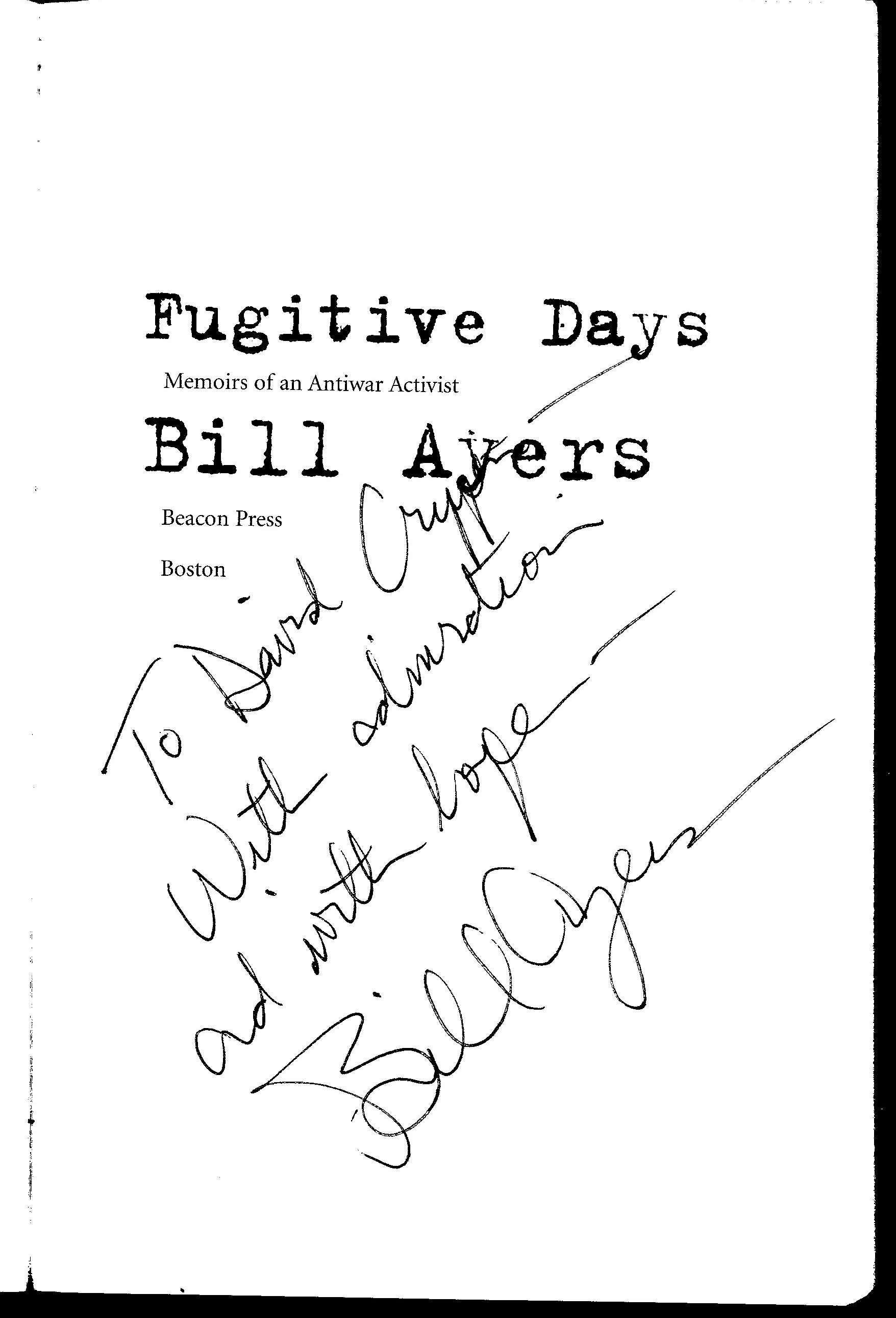
The Weather Underground consisted of mostly upper crust students dedicated to reforming what was considered to be a thorough corrupt and morally bankrupt government. Two of the prime movers of the WU were BiIl Ayres and Bernadine Dohrn, both of whom flashed across the underground activism sky briefly but brightly, and both of whom I will discuss later.

The SDS considered Nixon to be a politician so aggressively evil he glowed in the dark and an administration that needed to be brought down by an escalation of protest to that more physical.  To quote Malcolm X:  “We declare our right on this earth to be a man, to be a human being, to be respected as a human being, to be given the rights of a human being in this society, on this earth, in this day, which we intend to bring into existence by any means necessary (1964).”

This was to be accomplished by selective property damage associated with the government, specifically to bring media attention to the problem. Violent demonstrations raising public consciousness and civil disobedience used to generate publicity pointing out the evils of mainly the Nixon administration. The express purpose of the Weather faction was to get attention via property damage they knew would attract media coverage, and this was the goal. With media coverage came visibility of the protest. So for a time, small bombs were planted in strategic areas like the Pentagon, with the express purpose of doing damage and generating publicity by which the message could be disseminated. If they got busted for property damage, so much the better. Martin Luther King became more famous for his sojourns in jail, not marching.

Briefly paraphrased, this faction figured out that the only way to get the attention of the public was break the machine. Mario Savio at Berkeley: “place your bodies upon the gears.” Bernadine Dohrn: “There’s no way to be committed to non-violence in one of the most violent societies that history has ever created.” Mark Rudd: “The weather is changing for this government and we’ll be forecasting it. We’re the Weathermen!”


Domestic terror redux

“Oh, a storm is threat’ning

My very life today

If I don’t get some shelter

Oh yeah, I’m gonna fade away

War, children, it’s just a shot away”

                 Rolling Stones,  “Gimmie Shelter”, 1969


In recent years, would-be meta-politician Sarah Palin has referred to the Weather Underground and those associated with it as  “Domestic Terrorists.” She has no idea what she’s talking about since she wasn’t there and everything she says is scripted by partisans. Whether you believe the “domestic terrorist” theory depends on which acts of “terror” you’re looking at.

Never at any time did anyone in the Weather faction intend for death or injury, as this was, of course, totally opposite to their protest message against random death and injury. There were actually very few of these bombs set, fewer actually went off and each was loudly advertised in advance to insure no one was in the area.  If Ayres et al, were guilty of anything, it was property damage, a misdemeanor punishable by a fine and probation.

Tim McVeigh set off a bomb calculated to kill as many innocents as possible. No one knew it was going to go off and there was no “protest” of anything. It was a random killing. McVeigh turned tail and tried to get out of town, never intending to tell anyone who did it and why. There was no protest message and no responsibility by anyone. Tell me again how McVeigh’s bomb relates to the Weather Underground?


Did we matter?

“I’ll tip my hat to the new constitution

Take a bow for the new revolution

Smile and grin at the change all around me

Pick up my guitar and play

Just like yesterday

Then I’ll get on my knees and pray

We don’t get fooled again”

                             The Who,”Won’t be fooled again”, 1971


It was arguably the first time in history that a major youth uprising against a political regime occurred with such singularly coordinated organization. I was at the Vietnam Vets against the War rally in Washington DC, April 1972, wearing my LRRP tiger stripes along with then President of the VVAW (now Secretary of State) John Kerry. I bumped into him at least once in a To Do Street Saigon bar as I recall. He wouldn’t remember me but Kerry has a face you don’t forget. We stood by as Vietnam veterans lined up around the block in crutches and wheelchairs to toss their Bronze Stars, Silver Stars, and Purple Hearts over the White House wall. I wept openly. I have never been so moved before or since. In character, Nixon ignored it all, setting the stage for what was to come next.

Did a bunch of scruffy, longhaired kids bring down a President of the United States? What is “morally acceptable” in bringing down a nasty, repressive, oppressive regime?  Was MLK’s passive resistance the “right” thing to do as these regimes burn themselves out under their own weight?  Or was Bill Ayres right: “There is no way to be committed to non-violence in the middle of the most violent society history has ever created”.

In retrospect, I think history shows that we were an association to the fall of Richard Nixon and the end of the Vietnam War, not necessarily a cause. Nixon ignored anything and everything that occurred in the way of early 70s protest, walked away scot-free in 1974 and dying peacefully of old age in 1994. The Vietnam conflict simply burned out in 1975.  If we were primary movers and shakers, it didn’t show up in the time line. By a stretch, we may have hastened it just a little.

Looking back now 40 plus years later to issue a blanket condemnation of the SDS and Weather faction demonstrates a lack of understanding as to   the way things were then. Few if any of you can fully appreciate the passions of youth in the late 60s unless you were there and you were a part of it. There was no road map. No one knew what was right or wrong. We didn’t know what a “terrorist” was. We were on a mission from God. There was only the passion. Were we Domestic Terrorists or righteous protestors against unfair government? It will be for history to decide.


Urban Warriors: Bill Ayres and Bernadine Dohrn

“Cancel my subscription to the Resurrection

Send my credentials to the House of Detention

I got some friends inside”

                 The Doors, “When the music’s over”, 1967


Bill Ayres and his wife Bernadine Dohrn are in perfect positions to teach modem youth what the politics of the 60s and early 70s was all about, and how the Students for Democratic Society and the Weather faction fit into it. This is history that needs to be preserved, and what better teacher than someone that was a part of it. His political positions are a matter of public record. Both Ayres and Dohrn grew up and out of the 60s as most of us did, and now reside quietly in Chicago where Bill is retired Professor at the University of Illinois at Chicago, College of Education. He is active in community activities. Dohrn became a lawyer and espoused this as an example of a person’s ability to “make a difference in the legal system.” Dohrn said of her political beliefs: “I still see myself as a radical.

If I were a graduate student studying history or sociology, I would drool to take a course with Ayres and pick his brain extensively. I don’t have to share any of his views but I certainly can learn from them. He, like Israel, has a “right to exist” because we are a pluralistic society.

For those interested in serious study, you cannot begin to understand the era without reading:

*  The Sixties: Years of hope, Days of rage.  Todd Gitlin.  (1987).  0-553-27212-2

*  SDS:  The rise and development of the Students for a Democratic Society.  Kirkpatrick Sale. (1973). 0-394-71965-4

*  Fear and Loathing: On the campaign trail, 1972.  Hunter S. Thompson. (1973) 0-446-31364-5


Film Review: “Looking for Sugar Man” (2012)

0

08570_show_landscape_05

Released in 2012, “Looking for Sugar Man” was rarely seen by the average viewer despite a stellar rating of 96% on Rotten Tomatoes and an Oscar for best documentary at the 85th Academy Awards. Never released for wide distribution, many viewers saw it on airplane entertainment consoles.

The film details the story of a talented singer/songwriter in the genre of Bob Dylan that arrived in the early 70s, essentially a social injustice protester without the marketing money that Dylan enjoyed. He make two well received albums that never sold, and then vanished into the mist like many others of his ilk and time.

But talent is rarely completely vanquished even though it may not be marketable.  The artist’s eloquent musical attacks on social injustice emerged halfway across the world in South Africa where it became bigger a seller than the Rolling Stones or Elvis. One of his albums sold 500,000 copies 30 years after it was pressed, outselling Abbey Road.

In 1998, two South African record shop managers set about tracking down the artist Sixto Rodriguez in his native Detroit, ultimately finding him in 2011 toiling at construction labor.  This film details that search, and how virtually anyone can be found using the Internet.

Following the film’s release, Mr. Rodriguez has enjoyed some modest reemergence in his American popularity. 30 years is a long time to find the kind of fame Mr. Rodriguez discovers at age 70, but like the old Nashville adage goes: “Anyone with talent will make it big in country music…….eventually”.

The film documentary does much more than detail the search for a personality. It effectively explores the caprice of the rock scene, the nature of celebrity and appends the history of popular music.  Most of all, it’s a revealing saga of how a significant talent could vanish without trace in the world of show business where everything is publicized on Entertainment Tonight, Twitter and the Internet.

The nature of “talent” has always been ephemeral at best and, of course, varies with the eye or ear of the beholder. The popular on-line review site “rottentomatoes.com” shows two ratings for film, viewers and critics. The opinions thereof can be widely variable, the critic portion there to standardize objective benchmarks away from capricious personal opinion.

Accordingly, critical acclaim goes to Mr. Rodriguez for standing in place without extraneous hype or glitz, singing original material accompanying himself serviceably on a single musical instrument. Visions of Paul Simon, Don McLean, James Taylor, Cat Stevens, Doc Watson and Kris Kristofferson in the early years.

One rarely if ever sees this kind of talent in the year this film was released. The entire concept of talent has evolved to how much visual and auditory impact an audience can absorb in lieu of simply singing a song with a clear voice and interesting lyrics.

One now sees female vocalists warbling within vividly embellished stages dressed as a ham sandwich, others with pink hair and outfits that can be covered with a thumb. Retina shattering blasts of light and sound accompanied by “Cleopatra”-like stage effects. Vocalists that make the evening edition of Entertainment Tonight when they change their hairstyle.

Tom Wolfe describes it as Plutography- the photography of the rich and famous for being famous.

““Looking for Sugar Man” is a very interesting chronicle of our time and a sad vision of the end of music as an art form as we knew it in the 70s.

Highly recommended by me.

I give it four and a half of five flopped albums.


I get a Fiat Abarth

0

Fiat3Well, they made me a deal I couldn’t refuse. Apparently the paint scheme on my car (black with red stripe on side) is in hot demand, and so he made me a deal on an Abarth that made me burst into tears. I didn’t want to wake up with a horse’s head in my bed so I traded up and got a stellar deal. He knew I wanted an Abarth anyway but they weren’t available last year.

This little beast is a contradiction in form and function. It’s tiny, which is fine as there’ll never be anyone in it but me, occasionally my wife. So the back seats are down yielding a reasonably big space to carry things. Plenty of room for a full sized amp, two guitars and other junk for a gig. But, you fire this thing up and it’s instantly apparent what, in my youth I would have described as “glass pak mufflers”. I haven’t heard a rumble like this since I personally gutted the mufflers ’40 ford in 1960. On some level it’s beautiful, but sadly, it remains a harbinger of my mis-spent youth.

It’s fairly loud, and it gets louder when I pour the poison to it, but surprisingly well mannered at usual cruising speeds. A little more mellow than stock, but definitely not obtrusive to conversation and radio. The twin pipe exhaust song signals that this is not your grand-dads Fiat 850. This thing has a twin inter-cooled turbocharged engine with a potential of 18 psi boost (as measured by the meter on the left dash). When it hits 17.5 a little sign flashes: “your engine is going to explode now-goodbye”. The next closest is 12 psi on one of the Mini Cooper turbo models. That’s a serious hot rod engine for a conventional car sold to a mass public. But you know me; I’ve got my boot in it most of the time anyway.

So, this thing feels and handles like a Volkswagen at rational speeds, but when you stomp on it the car changes personality quickly from the lead singer of U2 to Stone Cold Steve Austin with an attitude. It’s a sensation not many casual drivers should ever feel, that the car has the ability to keep accelerating without any plateaus until the engine blows up. A distinct possibility as I don’t believe the engine has a functioning rev limiter like a Formula 1 car.At some point in the acceleration, you’re aiming, not driving it. That makes it a tricky proposition to keep this tiny car on the road at speed.

Otherwise, the appointments are nice. Full leather throughout including the steering wheel and shift knob. 5-speed manual is standard. Not really any need for a six-speed. The seats are comfortable although a little high. Headroom is plenty for a six-footer, foot room is fine, pedals spaced well. I got the “regular” radio which is fine for playing MP3s as there is n such thing as “high fidelity” in digital music (yet). 4 wheel anti-lock disc brakes, 17″ wheels. Uses regular unleaded gas, unlike the Mini Cooper. There is an option for a “TomTom” GPS that slips in and out of a holder on the dash. Not a good idea as it’s expensive, interferes with vision and the Garmin gets better reviews.

So in summary, this is a very nicely appointed LITTLE car with cool styling that acts pretty much like it looks until the gas pedal is righteously stomped. It then turns into a little rocket sled in the same tiny body and has the capability of quickly getting away from the average driver accustomed to a LITTLE car.

I give it an advised 4 or 5 scorpion badges. Be careful with this thing unless you’re experienced with performance driving. It’s a wolf in sheep’s clothing and it’ll bite you if you give it a chance.

Book Review: Lean-In (Sheryl Sandberg)

0

Facebook COO Sheryl Sandburg: Corporate boardroom stilt meets the feminine mystique.

http://www.amazon.com/gp/product/0385349947/ref=Bks_BB_HR_VIBK_1_lean?pf_rd_m=ATVPDKIKX0DER&pf_rd_s=merchandised-search-2&pf_rd_r=6AA821C4EBB4439F9CA3&pf_rd_t=101&pf_rd_p=1513716262&pf_rd_i=283155

Interesting book detailing the evolution of (for want of a better word) “Feminism” to its current level of social visibility. In order to understand this transition, it’s helpful to review how life was for females in the 60s and 70s.

‘Horses sweat,

Men perspire,

Ladies feel the heat”

(“Debbie”, Alpha Chi Omega house, Athens, Ga, 1965)

In the mid-60s at the University of Georgia, females were told they would be “Southern Ladies” in every respect, whether they liked it much or not. Girls were not allowed to be seen on campus unless they wore a dress. No shorts and no slacks. Raincoats to hide physical education apparel encumbered trips to gym.

My then girlfriend was a straight up Dean’s List student with a double major in history and political science. (I was on a rather different Dean’s List). She applied to the UGa School of Law with great qualifications including strong letters from lawyers she had worked for. At her interview, she was said to be highly qualified. Too bad she was a girl.

That culture collapsed in the later 60s and early 70s as the Hippies redefined femininity as an encumbrance identifying them as chattel to be used and abused for the pleasure of males. This revelation prompted rejection of any modes or manners rendering them “attractive” (to males). The only way for a female to break free of these bonds was to do so on terms that set them apart in every way from the enemy. No fashionable clothing, makeup or feminine manners, and of course, no other “comfort measures” males had become comfortable with. The rise of the “natural” woman, complete with hairy legs and birds nest coifs.

Although this ambiance was made much of in the media, trust me, it didn’t last all that long and was limited to mostly die-hards with lots of other axes to grind. If for no other reason, “burn your bra” feminism flew against the genomic imperative for the sexes to “get together” in a manner that insures procreation of the species. Sorry, that’s just the way it works.

“Well, I met a girl at the Rainbow bar

She asked me if I’d beat her

She took me back to the Hyatt House…”

(pause)…
”I don’t want to talk about it”

(Warren Zevon, “Poor, Poor Pitiful Me” (1976)

Regardless of whether you’re a creationist or evolutionist, you will probably agree that the genome for human function was designed a very long time ago. In the beginning there was only the slim potential for live births to survive and adaptation to a harsh and unforgiving environment. 
In the beginning, there were no Ivy League universities, no board rooms and no rules of law. The genome didn’t understand how to adapt to the inevitability of change any more than the 2nd Amendment of the Constitution knew how to adapt to shoulder mounted weapons capable of firing over 100 rounds per minute in a civilian environment.

Accordingly, the genotypic male brain facilitated the fighting of wolves from the door and the clearing of a few acres before lunch. The female brain was designed for enhanced non-verbal communication to facilitate the understanding of infants (and ferreting out deceptions from males). Arguably, the ability to effectively fight wolves from the door is more useful in a boardroom than second guessing the occult emotional expression of business or political adversaries. This is not to say that the female brain cannot and would not adapt to this environment, it is only to say that it’s a bit of a bigger stretch.

The genome also carves out “attraction” criteria for getting people together who would otherwise kill each other on sight. Those criteria are locked and loaded by acculturation. Hosiery, four and a half inch heels, “little black dresses” and cleve-bras were not designed to impress other women. Guys plinking at loud electric guitars till their fingers bleed do not set a stage to mimic Clapton. It all gets males and females together, sometimes for only a few seconds at a time like Diamond Dave Lee Roth, all with their eyes rolled up into the backs of their heads like Mr. Spock at his wedding.

“Survival kit contents…. check. One forty-five caliber automatic; two boxes of ammunition; four days’ concentrated emergency rations………. one issue proph-lactics; three lipsticks; three pair nylon stockin’s……. Shoot, a fella’ could have a pretty good weekend in Vegas with all that stuff”.

(Major T. J. “King” Kong: Dr. Strangelove, (1960)

Unfortunately, the genome is designed only to get the players together long enough to whelp a few kids. It then fades and cares little what happens next- reliably divorce attorneys and forensic accountants. But I digress.

“Well, she really worked me over good

Just like Jesse James

She really worked me over good

She was a credit to her gender

Poor, poor pitiful me

These young girls wont let me be

Lord of mercy on me”

(Warren Zevon, ibid)

Ms. Sandberg nurtures the innate capability of women to excel at anything they choose, which is of course true, but goes further to subjectively suggest women have an innate ability in the upper reaches of business and politics not necessarily shared by others (men). Not so fast. Looking back to the 70s, the reason “The Feminine Mystique” (Betty Friedan) caught fire so fast and to such revolutionary effect was that the American housewife saw herself in the vision.

Conversely, Sandberg’s vision is anything but translational on populace terms. They reek of Harvard, Goldman Sachs, Google, Facebook and the Upper East Side. They inhabit a tiny floating raft out of reach of the middle class, which itself is slowly vanishing Ms. Sandberg had a self-fulfilling shot at that brass ring because of her bankrolled upbringing. She was guaranteed open-ended support for any endeavor she chose, and she happened to have the random access grey matter to achieve it. The choices of other women, or anyone else for that matter, are shaped by factors that cannot be controlled.

Women don’t choose where they enter the world, what resources are available to them and they don’t (usually) choose rich mates as a priority. 
They raise families under whatever circumstances they find themselves in, one of the toughest jobs in existence, and their ambitions are necessarily constrained within that sphere. Sandberg’s call to press forward has an equal potential to make women born with plastic spoons in their mouths to feel inadequate for not following her footsteps more when they are already trying as hard as they can to keep their heads above water.

Ms. Sandberg, implies, but does not actually verbalize, the proposition that XX chromosomes are inherently more effective in big league corporate and political leadership positions, possibly because they are more attuned to function rather than glitz and hype (afflictions afflicting males). This is very shaky logic.

There’s no reason why women should not have the same ability as men for high end CEO jobs and upper crust politics, but there’s also no phylogenetic reason why they are better equipped for it either. 
 Carly Fiorina very nearly ran Hewlett-Packard into the toilet and was, in the immortal words of “Apocalypse Now”, “terminated with extreme prejudice”. As CEO of EBay, Meg Whitman bought Skype high and sold it (to Microsoft) low. It’s supposed to be the other way around.

There is also little prospective guarantee that women in positions of authority will have any more concern for the welfare of other women than male CEOs. Madeline Albright once famously remarked that if you want to see how a world run with women works, watch how they treat each other in high school.

There is some conjecture that Ms. Sandburg came out strongly for Hillary Clinton for President in 2008 because Ms. Clinton’s chromosomal makeup put her into a winner’s class. Never mind Ms. Clinton’s extensive history of ruthless male-like political manipulation and riding her husband’s coat tails.

Aggressive female executives may run more effective companies than male executives, but they’re no more likely to advocate day care as the law of the land. CEO Marissa Mayer of Yahoo recently made it clear that she did not see her job as helping women live in Sandberg’s fair and equitable female world by halting any work done out of the office. Yahoo employees quickly discovered that, when market forces collide with gender equality, market policies win. It doesn’t matter who runs the company.

Despite a few errant mutations of feral female free spiriting (Sarah Palin and anyone named Kardashian), Ms. Sandburg envisions women of all stripes as media fed ambition for achieving to the strains of “we are the champions!” Realistically, exhorting women to visualize success by how much leeway they have to bring their own their own choices to fruit would be more interesting.

Ms. Sandberg would be more credible if she came out strongly in favor of women getting the same deal in life and love and business as anyone else without having to negotiate any more or less for it. Addressing the continuing problem women traditionally face: less pay for the same work as men and violence perpetrated on them because of their inherent vulnerability, but it’s quite arguable whether the COO of Facebook understand Children of Lesser Gods’ visions.

How to deal with psychiatrists

0

tumblr_lv6alyj3O71qz9ffqPsychiatry is a different world, a different universe. So when some medical guy in a white coat, lots of badges and a stethoscope in the pocket goes over there, it’s a big entertainment deal, like half of LA showing up when U2 plays “Street with no name” on the top of a building. They come from all over and hang from the rafters.

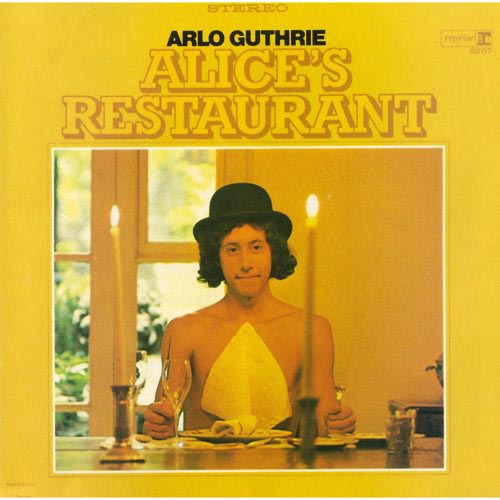
So, the most effective way to deal with Psychiatry is to walk in there with a totally authoritative air….fix them all with a withering sneer and…..of course……sing a bar of “Alice’s restaurant”.

(in A minor) “So I wanted to look like the all American kid from New York City.
I wanted to BE the all American kid from New York City,
So I walked in, sat down, I was hung down, brung down, hung up, and all
kinds o’ nasty ugly things. And I walked in and sat down and they gave
me a piece of paper, said, “Kid, see the pyschiatrist, room 604.”

So I went up there, sat down and I said, “Shrink, I want to kill.
I mean, I wanna, I wanna kill. Kill.
I wanna, I wanna…….. I wanna see blood and gore and guts and veins in my teeth.
Eat dead burnt bodies. I mean kill, Kill, KILL, KILL.”
And I started jumpin up and down yelling, “KILL, KILL, KILL” and
he started jumpin up and down with me and we was both jumping up and down
yelling, “KILL, KILL KILL.” And the sargeant came over, pinned a medal on me,
sent me down the hall, said, “You’re our boy.”

Then of course, nail down the group experience:

…….the only reason I’m singin’ you this song now is cause
you may know somebody in a similar situation, or you may be in a
similar situation, and if your in a situation like that there’s only
one thing you can do and that’s walk into the shrink wherever
you are ,just walk in say “Shrink,
You can get anything you want, at Alice’s restaurant.”. And walk out.

You know, if one person, just one person does it they may think he’s really sick and
they won’t take him. And if two people, two people do it, in harmony,
they may think they’re both gay and they won’t take either of ’em.
And three people do it, three, can you imagine, three people walking in
singin a bar of Alice’s Restaurant and walking out. They may think it’s an
organization. And can you, can you imagine fifty people a day, I said
fifty people a day walking in singin’ a bar of Alice’s Restaurant and
walking out. And friends they may thinks it’s a movement.
And that’s what it is , the Alice’s Restaurant Anti-Massacre Movement,
and all you got to do to join is sing it the next time it come’s around on the
guitar. (With feeling).

So we’ll wait for it to come around on the guitar, here and
sing it when it does. Here it comes-

“You can get anything you want, at Alice’s Restaurant
You can get anything you want, at Alice’s Restaurant
(patient chimes in “excepting Alice”)
Walk right in it’s around the back
Just a half a mile from the railroad track
You can get anything you want, at Alice’s Restaurant

Some late breaking comments on medical politics (from Med-Events)

0

>The system in US is now designed

>to fail. The AHCA of 2008 will destroy

>American Healthcare as we know it.

>It is all over. “The government is here

>and they are here to help”.

Crippen:  The above cluster of sour grapes is political in nature and ordinarily, I would scotch it immediately but I can’t let you get away with it as a stand-alone without an alternative view.

In 1965, the medical establishment, including the AMA and my father the surgeon loudly exclaimed that Medicare and Medicaid would “destroy American health care as we know it”.  In fact, those services made my father’s generation of physicians rich and created the Medical-Industrial Complex which has now grown to the point where it threatens to “destroy American health care as we know it” by it’s sheer volume and weight. The Affordable Health Care Act of 2008 is not needed to hasten that eventuality.

The bill for a typical 6-day hospital stay for childbirth in 1951 was $85—well within the out of pocket range of most families. A 6-day hospitalization for cardiac workup at a large urban hospital in 2010 has recently been calculated to be $19,254; the facility lost $2,695 of that amount after reimbursement.

This cost situation arose in part because physicians in such a system have little motivation to reduce costs, given that the care is paid for by a third party relatively unable to process the value of need versus desire. Similarly, consumers of health care are not the purchasers thereof and so have little motivation to assess cost versus value. More is always better, especially when it is free.

Virtually every other civilized country in the global village has evolved to lowest common denominator of health care for ALL of their citizens, and that is single payer, government sponsored health care indemnification. The price paid for that is enforced prioritization of entry and “saying no” to expensive treatment that has a dismal benefit at great cost. It isn’t perfect, but in the end, everyone is covered and it’s more or less affordable. America runs on a consumer satisfaction mode, a situation that everyone agrees is unsustainable even if it were not for the global recession of 2008.

In 2009, the USA spent (all told) twenty five trillion dollars on health care but only indemnified about 40% of its population (some are underinsured). That’s US$8,000 per person, 17.3% of the GDP and increasing about 6% annually.  The USA ranks below Portugal in preventable mortality.  California increased its cost of health insurance 20% this year and there is no end in sight. As the price of health care goes up, fewer businesses can afford health care for their employees.  62% of all personal bankruptcies involve medical bills in 2010.

So, the AHCA of 2008 is not anywhere on this screen. We’re on our way to insolvency all by ourselves right now, and we’re still only covering a small portion of our population doing it, expensively and inefficiently.

The AHCA of 2008 purports rectify three glaring omissions we don’t have now. It effectively ends insurance payment discrimination, adds an estimated 31 million needy potential patients to an already overloaded system and it’s portable. These are all GOOD things, and I might add GOOD things that most if not all of the other civilized countries in the global village provide for their citizens.

The argument against the AHCA of 2008 is twofold:  a) Straight up political partisanship. ANYTHING that comes out of this sitting President is spawn of the devil, and: b) It will be expensive.  However, complaining that the AHCA is going to break the bank implies that the bank would remain solvent without it. Nothing could be further than the truth. The bank is hemorrhaging right out into the street and is reliably headed for insolvency all on it’s own. The worst that can be said about the AHCA is it will hasten the process. Maybe.

So if you ignore the political aspects, which you definitely should, what remains is how to finance it. Of course the best way is to mandate everyone buy into it to keep the cost of participating down. If anyone is allowed to opt out, our culture mandates we still have to treat them anyway. So if opt-out is allowed, it will collapse instantly. We’ll see how that works out.

Otherwise, there is another reality that must be faced. There is NO possibility of a system that creates demand and then supplies it in a customer satisfaction mode can remain solvent. So, if the whole system is swirling around the bowl, which it is, there are several options available, two of which are painful prescriptions for providers.

1.    Allocate resources toward health care and away from other previous priorities such as entitlement programs, military security, and bureaucratic priorities.

2.    Pay providers less for the same (or increased) workload.

3.    Reorganize health care spending so that more money is spent on some services and less or nothing is spent on others; essentially, say no more often.

History suggests that it is unlikely any modern society can or will decrease support of entitlements such as social welfare, unemployment insurance, social security benefits, or retirement benefits that citizens depend on and have paid into during their working careers. Cutting military security funding is equally unlikely. Most if not all national budgets include little else that can be reallocated in any meaningful amount. That leaves options 2 and 3. It is virtually certain that providers will have to reorganize their priorities one way or the other, and accept less remuneration in the process.

So denigrating the AHCA because it will break the bank is (I think) a “straw man” argument. We’re pointing our finger at something that hasn’t even happened yet as we descend into the depths. We can continue on the path we’re on into insolvency while indemnifying only a portion of our patients at huge expense and great inefficiency, or we can continue toward insolvency indemnifying 96% of our patients more efficiently avoiding personal bankruptcies, asking our providers to work harder for less pay. Then we can just pay for it and get over it.

If we decide not to just pay for it and get over it, we’re going to crash, and when we do, we’ll discover the reason why most of the other civilized countries of the global village have evolved to single payer system, prioritization, saying no and standing in line.

BTW, the government is indeed here and it’s helping. MOST health care in this country is government funded. All care for Washington politicians, military, VA system, Medicare, Medicai

>In critical care, the trend is to use Nurse

>Practitioners and Physicians

>Assistance to do the grunt work,

>especially at night, with the physicians

>evolving to executive managers.

Crippen:  The problem of course is the eventuality of all chiefs and no Indians. Critical Care fellows are clearly showing signs of wanting to get away from clinical responders to become managers. So the practical problem then becomes who will do the grunt work to be managed by suits. I see the model as the rise of NPs to fill the available niche field where doctors once grazed.

I would be surprised if Physicians Assistants moved much into that niche, not because they are any less competent than NPs but simply because the NPs have more experience in ICU patients care. Most of them, including ours are former ICU nurses. That’s just my initial thought, and again, I hasten to add that I know PAs here and elsewhere and I would NOT disparage them, all other factors remaining equal. It’s a matter of local experience in the field where they work.

The issue of ICU (in my case, NICU) nurses taking orders from NPs is going to be interesting to sort out. In my case, the NCU nurses feel a bond with Danielle because she is one of them, and also of course, that she knows how to generate confidence and when to call me to get involved when needed. So they feel comfortable with her because they trust her nursing judgment that has come u a level and they know she knows when to call, and if she doesn’t, they know they can call me anytime. This issue has not expressed itself with Danielle, but it might in the future with others. I might add that I am also impressed with the NP over in the neuro-trauma unit next door to me and she has similar trust and acceptance from their nurses. I think this issue will sort itself out in time for no other reason than if an individual is found wanting, they won’t be working here.

I am very concerned that doctors are abdicating direct patient care because it’s too time and energy consuming and there are too many hassles.  OK, here comes the “I slogged to school in three feet of snow” speech.  When my ilk and I were residents, we were expected to have a head of steam because that was how the game was played, and the rules had been established long before us.  Our job was to deal with ALL the patient care issues, and do them well or we would be fired. Every buck stopped with us. If any of us couldn’t take it, there were lots of other things to drop out into, like dermatology and ophthalmology.

The upscale of that, especially in surgery and critical care is that helpless, defenseless people had at least a shot at reversal of a death spiral, especially after hours when it was inconvenient and everyone was tired. Maybe not perfect, but at shot at it.  Once “intermediate” providers replace that ethos, then the disasters in the middle of the night will have a shot, but that shot will be holding on till the suit arrives. Better deal? More cost effective? Depends on which side of the bed you’re on.

Will NPs eventually evolve to the former expertise and experience of doctors, rendering them moot?  It’s possible. Is that a good thing?  I don’t know. Remains to be seen. Will NPs be more “cost effective”?  Not as they increase in expertise and experience. They’ll unionize and get into collective bargaining. (Unless they live in Wisconsin).

I lament the hard working, chronically tired resident that held the seams of the hospital together.

I am the last of my kind.

>WASHINGTON – The Obama administration

>said Monday that states could cut

>Medicaid payments to many doctors

>and other health care providers to hold

>down costs in the program, which insures

>60 million low-income people and

>will soon cover many more under the new health >care law.

Crippen:  You and I and everyone else knew this was coming.  If you’re a conservative Republican you lay it all at the feet of ANY Democratic President, but it goes infinitely deeper than that, deeper than even the Prince of Darkness himself (Bush).

The fact is that all of it has been going bust for a very long time. Long enough for each political party in turn to blame the other for having to do what it takes to control it. The fact also is that there is no inherent limit to the expenses of government funded health care programs because they are consumer satisfaction driven. There is no upper limit of expense and no one can “say no”.  This in the face of a virtually unlimited demand.

It’s political malfeasance to tell consumers in this kind of market that you’re “limiting” their care, especially if it in evolved saving YOU money. They don’t care about YOUR money. They go on TV talk shows and whine about how the “government” is trying to kill them to save a buck or two. Anyone that advocates limiting anything it immediately voted out of office with a strong odor of tar & feathers in the air.

So you can bet your sweet bippy no one on the reimbursement side is going to the demand side talking resource allocation. They have NO choice but to go to the supply side because that’s the only side there is.

Go to providers and ask that they voluntarily become more efficient (saving money).  Ha. When was the last time you saw that happen? Providers make their living by doing as much as they possibly can, and in the process expending other people’s resources. In an ICU, an empty bed is a loss so it’s filled with whatever comes down the line. An ED bed that isn’t filled is a money loss.  So, if the reimbursers don’t do SOMETHING, they will quickly go broke in a scheme of maximum demand and providers happy to fill it.

In the past they have tried limiting access to the system by the Clinton Plan (refuse to let them in on pre-determined algorithms). That resulted in anger and retribution that waxed political. Then they tried rationing by inconvenience (didn’t pay for paperwork omissions). Providers became expert paper shufflers. Then they devised DRGs, but followed quickly by endless outliers that still paid.  Providers are like terrorists. They’re always one step ahead of any attempt to limit them. The American way of resourcefulness.

So now that everything else has been tried, there are only two ploys to avoid going broke left.

1.  Simply pay providers less and let a bunch of them go out of business or quit.

2.  Bundle everything and don’t pay a cent for anything extra.

For # 1, the long-term detriment will be some hospitals will go belly up and some providers will quit in fits of pique.  The reimbursers don’t care, and the big hospital systems that can negotiate sweetheart deals don’t care either. You hear all the time doctors loudly claiming “I’ll quit if they do X…Y  or Z”.  Trust me, they won’t. They all have mortgages, kids in private school, Jaguars and high maintenance females on the side (for the males. Maybe for some females too). Remember back in the 70s on Saturday Night Live, the gaggle of adolescent girls at a slumber party discussing what it might feel like (to them) to have sex?  They all said “Ewwwwwww  I’d never do that!!!.  All but one in the back who quietly opined: “Well….I might”.  That’s the way it will go. It doesn’t matter how much of a cutback, there will always be those that will work. The “best and the brightest”?  Maybe not, but the establishment doesn’t care.

#2 is the almost perfect relief. A patient comes in for treatment or hospitalization and the reimbursement is what it is. No more. Just like DRGs except ironclad and no “DRG creep”.  The fallout will fall out on providers and institutions, neither of who will have any wiggle room because the patient anger and frustration will fall on them, not the reimbursers.

So the hospitals will admit a 90 year old with unresponsive Grade 5 subarachnoid hemorrhage and maintain them in an ICU as long as the family wants, but only at a flat rate. The hospital and/or provider get to decide whether to tell the unrealistic family “no more”.  The reimbursers say: “not our problem, you’re (patient) “insured” as we promised, work out the details with those other guys”.

Hospitals going belly up rather than offend patients and their families?  Providers quitting in fits of pique?  So much the better. The point was to limit demand and also limit the supply induced by it.

>The issue of providers as popularity

>contest- about an ER doc who was

>called in to the admin office for making

>the highest score on a patient survey.

>He made the first 100% ever and

>everyone was so impressed.

>They were all showering him with praise…..

Crippen:  It should be well understood that no hospital administration anywhere cares even a little bit about who’s naughty or nice in terms of direct patient care. It’s straight up marketing.

Previously they did more or less “anonymous” polls, then they advertise to the public that they have “nice” doctors (ergo, they must be “good” doctors as well) so prospective visitors to an ED should take this information into account.

Shortly before the late St. Francis Medical Center went under, the administration allotted a bunch of money to advertise their ED. The gist was to get more ED admissions by advertising convenience and rapidity of service. I told them they would lose money, but they, being the power players, disagreed, and so several weeks thereafter, several big billboards went up in the area featuring the then head of the ED sitting on his bed putting on a pair of running shoes.

The blurb went something like: “Dr. X X is getting ready for his day serving you and he will be running all day doing it”, or some such. So of course, months later, the statistics showed a decrease in hospital revenue (but an increase in the revenue of the private group running the ED. Convenience clinic patients that liked fast service increased, but none of them were admitted, most had trivial complaints that didn’t bring in any billing and many of them were not insured.

To a hospital, EDs are all about getting their clutches on patients that need to be admitted. That’s where they make their money. Admissions occurred when family practice and Internist types admitted patients from their office or electively.

No now a new tack of actually identifying specific doctors that are naughty, not nice. Everyone knows good” providers are nice. This is now a ploy for identifying individuals that can be moved to lower reimbursement because if they’re not nice, they must be poor quality providers.

And what does “nice” entail?  Do they give out clear, understandable information? Do they pay any attention to the patient? Did the patient get better?

Maybe.  Or does the patient feel like his or her “customer satisfaction” needs are met irrespective of how realistic or how stupid they are? Do you think an “administration” is capable of sorting out these concepts on the basis of a poll?

>”Welcome back my friends to the

>show that never ends

>We’re so glad you could attend

>Come inside! Come inside”!

ELP from Brain Salad Surgery (1973)

>Medicine keeps getting harder.

>And fewer and fewer folks are doing it.

>America has no idea that the weight of

>it all is falling on the shoulders of the

>emergency physicians and hospitalists

>who lurk inside the trauma rooms and

> inpatient floors, the fast tracks and

>ICUs of their community and university

> hospitals.

>The pasty-pale, coffee-sucking,

>junk-food-eating Spartans of health

>care who will bear the full assault

>of health care reform when there

>aren’t enough primary care doctors

>to manage an AARP convention,

>much less all of America.

Edwin Leap, Emergency

Medicine News,

January 2013.

Crippen:  Maybe not much longer. I continue in touch with a congressional committee on some of these things (as a resource for my last book), and it is clear that the government has the above issue in its cross hairs. It takes the government a while to sort these things out but when they finally do, they’re pretty ruthless and efficient in fixing it. And by fixing, I mean fixing by two means:

1.  Insuring it’s someone else’s problem

2.  Not suffering any liability for cost

There are numerous literature cites stating that the number of patients entering an overheated (ED) provision system could be reduced safely and effectively by simply identifying those that don’t need urgent care and referring them elsewhere. This would, of course, go a long way in solving the overcrowding problem. It would also deep six the need for building and staffing more EDs to handle the load, so ACEP has reliably come out against it much like the NRA reliably comes out against gun control. Lobbyists are as lobbyists do.

It has been the thesis of ACEP that a runny nose only a runny nose until meningitis is ruled out (by an emergency physician) and that since Americans have zero tolerance for mistakes, these patients must be seen anytime they feel like it and someone must pay for it. I think as I sit here the current charge for actually walking into an ED and sitting down breathing room air is somewhere in the range of US$300.00. That’s before anything else is done. Most folks get a few tests. EGKs and CXRs are read (and billed for) by ED physicians and cardiologists and radiologists later.  It isn’t uncommon to ring up a bill for US$1000.00 to evaluate a common cold. After all, pneumonia and early system sepsis must be ruled out, after all:” can be sued if I’m wrong and I don’t do enough tests”. And so it goes.

Some (not all) insurance grudgingly pays for that, but as I remark freely, the bottom of the barrel is slowly coming into view. So now as the worm slowly turns, we are hearing the President of the United States decry overcrowding in EDs and people using EDs as primary care facilities. This was a good selling point for expanding health care benefits via the Affordable Health Care Act of 2008. But not so fast…..Expanding health care benefits and paying for it by blank checks are two different things. It’s possible, even likely that expanding health care benefits may also come to pass by directing patients to the “right” venue (cost effective) instead of allowing them to go where it’s most convenient.

Now, I hasten to add that this was tried under Clinton and was an abysmal failure. But remember that the government is slow to learn from its mistakes but they eventually get around to it. Denying admission to an ED at the door for a seemingly bullshit complaint historically doesn’t work, but actually screening a patient (EMTALA style) and THEN referring them elsewhere is a different breed of cat.  Patients MUST be admitted to an ED on demand (EMTALA) but after screening, they don’t necessarily have to stay there.

So I’m told by somewhat occult sources, the government is considering a new reimbursement deal where it will pay (presumably doctors or even NPs) not to evaluate and treat in the ED, but to screen for need to be in an ED. Naturally, that reimbursement will be dramatically less than an on-site E & M. If no emergent issue found, they will be referred out.  The ACEP lobbyists will squeal like pigs in hot oil, but anymore, those holding the purse strings define the rules of the game. ED’s refuse to screen?  The President of the United States then decries the Medical Industrial Complex holding up fiscal responsibility progress for their own pocketbooks. Here we have a way of saving money and increasing efficiency of medical care. Why are these guys dragging their feet?

Next problem is where are all those ragged unwashed found wanting for ED care going to go?  Unclear how that will work, as it is as unclear how the AHCA of 2008 will work. Probably make a lot of it up as it goes along.

The point is that using EDs for convenience care at exorbitant prices enriches individuals (ED provider groups.  Remember “Coastal”?  These guys operate to their own benefit and to the detriment of the whole system.  They bill differently than hospitals and they have no incentive to conserve anything. Those paying for health care have an intense incentive to bring providers’ incentives into line with global conservation. That fact has been identified and will be fixed. As I have mentioned before, I think my bias is that Private Practice is going the way of the funny looking animals in Stephen Streat’s back yard.  Any “independent” provider has a much stronger incentive to enrich him or herself at the expenses of the system and must be controlled by the system. There is no guarantee it will be fixed efficiently or even effectively, but it will definitely be fixed.

Pin me to a guess after marinating in hospital/ED soup for 30 years, I look down the road and I see three species of “Emergency’ Services”. Joe Lex’s mileage will probably vary.

1.  Straight up convenience clinics, staffed by NPS, reasonable out of pocket fees. No insurance.

2.  Screening centers. Authentic “urgencies” identified?  Transfer to a mother ship by ambulance or private car if the relatives are willing and it’s deemed relatively safe. Insurance will pay for this service, but not anywhere near what an ED bills for an ED evaluation.

3.  A genuine “Emergency Center”. No walk-ins. Only referrals. Insurance will pay for all of it.

Will that “solve” the problem of inappropriate ED admissions and people using EDs as convenience/primary care centers? Will it save money? Maybe, maybe not, but it will definitely invoke the Principle of Unintended Consequences that will then guide future evolution.

An impertinent history lesson about collecting

0

In Grade School (6th Grade), everyone was promoted automatically just for showing up. It was a pretty big shock that when Middle School (7th Grade) rolled around, they expected a kid to actually study and pass exams covering material presented in distinct classes much like High School. In addition, many families with small children purchased homes for “good school areas”, but then Middle School rolled around, many of these schools were located much further away.

So “getting to school” in the morning in Middle School became more problematic. It usually boiled down to bicycles for the “middle class” of kids or school busses for truly down and out losers.

Albuquerque, NM was a big desert in 1957, long distances between almost anything. I lived in the Southeast Heights and the facility I was assigned to Woodrow Wilson Middle School, about three miles from my house starting in 1956.  “Lizard King” Jim Morrison was in my homeroom (confirmed via school annual) and no, I don’t remember him. He looked a lot different then ;-).

There was no school bus covering that route, so bicycle was pretty much about it for most.  However, a lot of savvy kids had small motor scooters to get from home to school and back. The scooter issue was the beginning of my passion for and love affair with motor vehicles. Predated the apocalyptic onset of girls by about a year.

Everyone how was anyone had one. One’s social status in middle school was fully depended on whether you rode a bicycle of a motorized scooter. I’m convinced that this stuff set the stage for Fraternities in college. Of course, bus riders were categorically ignored by all.

Scooters were all parked directly across the street from the Wilson Jr High facade. The entire front lot of the length of the school contained among other brands, Cushman Eagles, Vespas,  “Allstates” (Vespa knock-offs from the Sears catalog painted all green).

ImageBut the motorized love of my life was the curvaceous Italian Lambretta. The curves on a Lambretta rivaled any supermodel to a middle school kid. Super models (or any ambulatory genotypic female) came later.

Cheaper models included the various Cushman step-downs, the tiny “Doodle bug” and the Indian “Papoose”. The Cushman Mustang led upscale models heading toward true motorcycle ethos. There was a 165 cc Harley in those days, a precursor for the Sportster. I loved them all.

In New Mexico, 13 year old could legally ride one without a license if the engine horsepower rated below 5 horsepower. The Lambretta hit 4.9. I desired a scooter more than anything in the world.  I held my breath, turned purple, cried, foamed at the mouth, seized, threatened suicide and homicide but all this was greeted by variations on the theme of  “You’ll shoot your eye out, kid” from my father the doctor.

There was NO chance of me given free reign in a two-wheel vehicle capable of 45 miles per hour, especially with my grades (four F’s and a D, as far as I know, still an institute record). So, I was left to lust after all of them, walking the parking lot rounds every day gawking at them and occasionally bumming a ride with one. That was about as good as it got.

I became the local technical authority on Lambretta. . I was like the sex expert that knew 385 positions but didn’t know any women.  I could recite specifications down to the minutest detail, even to the point of speculating Lambretta futures on the stock market. I would take the bus up to the downtown Lambretta store to gawk at the new ones for an hour or so till they asked me if I was actually going to buy anything, and then threw me out.

I built up a terrible desire debt for these things that was not to be fulfilled till many years later.

Cut now to last week as I idly perused one of the vintage motorcycle mags I get monthly. They all have vehicles for sale and one caught my eye, a ’57 Lambretta with the classic two-seat/rear-spare tire configuration that is now pretty rare. The guy selling it lives in Florida and has 150 motorcycles in his stable!  Said he was selling some of them as he prepared to retire!

It isn’t possible to go home again. Lord knows I have tried. I weighed 110 pounds in ’57 and I weigh 220 now. I would look just plain silly dwarfing this thing like a rhino on a pogo stick, even if it could get up the hill to my house with me on it (unlikely). It would just sit in my garage and I would gawk at it. Pretty expensive unusable toy. So, sadly, I gave it up and trudged over to my other “usable” classic/vintage bikes in the garage for solace. There was some to be had.

The history I have just related explains why I have become an erstwhile collector of vintage/classic motorcycles. Collecting vintage/classic automobiles is VERY expensive and requires huge space to keep and maintain them. There’s a classic car dealer near me with some incredible cars in their warehouse. ’57 Triumph TR-2s, ’56 Corvettes, assorted classic Ferraris and Porsches. Each PHENOMENALLY expensive to own and maintain. I marvel walking around this place.

But in the end, I can’t afford to warehouse a car so valuable it can’t be insured to drive on the street. I love the cars but I want something I can use every day to get back and forth to work and to the grocery store (albeit on nice days). So, I can afford ONE classic automobile (a Lotus Elise) that is beautiful and full of vim/vigor AND can be driven like a normal car. Following that, I fulfill my passions by collecting vintage/classic motorcycles, all of which can be ridden functionally, and all of which will appreciate in value as a straight up annuity.

I started with ‘70s BMW “airheads” (air cooled boxer engines) that were way ahead of their time functionally and still very all purposely rideeble today.  Inevitably, and ultimately I graduated to my first and true love- Triumph. the vintage Triumphs made in Meridian GB are harsh mistresses. They are finicky, idiosyncratic, difficult/expensive to maintain like your 30 years younger than you, soon-to-be 3rd wife, but when you walk into a room together, every head turns. (No jokes abut why heads turn, please).

The Triumph marquee has a history going back over 100 years and is far too convoluted to outline here. Suffice to say there are five or six thick books in my collection exploring that history.

ImageNow cut to now.  A couple of months ago I managed to acquire a mint condition ’72 Triumph 500cc Daytona. A VERY desirable collectable that runs like a Swiss watch and will appreciate in value as it’s ridden. I fell deeply in love with this bike which was just as well as my wife assured me I would be sleeping with the next one she found in the back garage.

As painful as it was to admit, I knew I must have another Triumph to keep my baby happy.  I denied it for a while, but I had my eye open.  This week, lo and behold there appeared two possibilities- an immaculate ’69 Bonneville and a concourse ’73 Tiger, restored by an award winning master restorer in Texas.

ImageIt was a tough decision, but I chose the Tiger because I liked the color (blue) and there were numerous safety issues.  The ’69 Bonnie had only one rear view mirror, drum brakes, no turn signals and a 4-speed transmission. The ’73 had all full mirrors, turn signals, disc brakes and a 5 speed transmission. In the end, safety prevailed which is just as well as I am not sleeping with the bike. There isn’t any room for me in the back garage.  I’m sleeping in the car.

Film review: “Side Effects” (2013)

0

A very interesting suspense thriller from stem to stern on several levels of intricacy director Stephen Soderbergh is famous for. Begins as a routine expose’ and indictment of manipulative pharmaceuticals that create demand for their products by glib advertising to the lay public and greedy physicians who take money for “recruiting” patients. Soderbergh smoothly lulls the audience into a bit of a yawn; all this has all been worked in the national news.

The audience fairly weeps for the young woman incapacitated by depression, unable to function even in simple social occasions. A pathetic creature that aches for redemption. Enter the wily, perceptive and sharp-witted psychiatrist who tries to sort out her difficulties electively during office hours.  Ultimately, numerous psychoactive medications are tried, none work.

The patient then sees an advertisement for a new anti-depressant on TV and asks to try it. The psychiatrist, eager to try any thing that will improve the situation, eagerly prescribes it, and in time discovers a previously poorly documented side effect, somnambulism (sleep-walking) and is sucked into the events that follow.

Soderbergh doesn’t let the audience in on the aftermath too soon or too quickly but progressively, the entire complexion smoothly and eloquently changes. It’s difficult or impossible to perceive some of the changes in real time. They become apparent at Soderbergh’s leisure, another example of the director’s commitment to subtle but profound film craftsmanship.

Ultimately, this film draws a masterful portrait of sociopaths.  Invariably intelligent creatures with personal magnetism and strong organizational ability.  Charlie Manson and a host of quasi-evangelists come to mind. You cannot manage them. They manage you. They don’t perceive there is anything is wrong with them and they are contemptuous of those who seek to understand them.  They are capable of ruthless projects that would over run Genghis Khan. Given enough rope, however, sociopaths always arrive at the pathologic outcome they build for themselves.

Integral to this process is the truly masterful performance of Rooney Mara, an actress that gave a rather monochromatic performance in “Girl with the Dragon tattoo (2011)”.  No more. She burns up the screen with her portrayal of the pathetic broken little bird and the transformation that follows. Jude Law puts in a masterful performance of the psychiatrist savvy and resourceful enough to play multiple sociopaths against each other like a Stradivarius.

Best quip:  “Girls learn to start faking things about the same time boys learn how to lie”

Best part:  The masterful transition Ms. Mara brings to life when she ultimately recites the truth.

Not so best part: the issue of pharmaceutical dishonesty is glossed over as a diversion and could have been left out completely.

I give it 4.5 broken birds.  Rooney Mara in a  “Must See” role.


Withdrawing life support after severe brain injury (complicated post)

0


Is Life Support Being Withdrawn Too Soon After ICH?
Medscape Medical News, 2013-02-13

Claude Hemphill et al have written about this concept for years.  Claude’s enormous heart is in the right place. He and everyone else for that matter desires to do the right thing in terms of maximizing treatment to get the best outcome possible.  However, the author here is preaching to the wrong choir. This is not an article per se, but a review of a concept by “Medscape”, the “People Magazine” of medical information.  The information therein is just vague enough to potentially suggest to family practitioners and patient surrogates that read Medscape that the “more is better” theory is synonymous with “if more is better than more than that might be better yet.”

The issue of prospective living wills and powers of attorney for health care delivery is not mentioned, so one might get the impression that a good course might be to suggest that an incompetent patient who has previously opted out for extended ICU care on “life support” might have made a “better” decision on the basis of this data. If that’s the case, then as the French say: “Ze worm….. it is out of ze can” as it pertains to other prospective wish issues.

This article opines:  “Those outcomes in these patients may not still be true today with our sophisticated medical care”.  There is no convincing data to suggest this is true in many, many ICU treatments, many of which convert death to life-in-death ensconced in skilled nursing facilities. The “we can do so much more than we used to” argument is directly responsible for many surrogate demands for open-ended ICU care. The mortality and morbidity statistics for ICU care have changed little in the past 20 years, and recent evidence of an intensive four year study by Levy and Chalfin et al rather convincingly suggest that the odds of hospital mortality were higher for patients managed by ICU physicians than not *.

3.  The article does not mention any limits as to how much longer an ICU admission will take to generate how much improvement in a patient to break the threshold of “acceptable quality of life”.  So, which scenario do you believe according to the ongoing clinical evidence, not the prospective optimism:

A. Each additional day of ICU care has
increasing potential to generate a viable
patient and each additional treatment
has more potential to improve outcome?

B.  Each additional day of ICU care
Does not show any improvement and each additional
therapeutic treatment has more potential
to prolong length of stay?

If you take the position that each additional day of ICU care has diminishing potential to generate a viable patient, but each additional therapeutic treatment has more potential to increase length of stay based on “hope”, then you have elevated “hope” to a self fulfilling prophesy. Your responsibility to your resource allocation system is to give up.  It isn’t a “right thing to do” anymore. It becomes practical economics. There IS a limit and you’ve reached it.

If, however, you take the position that each additional day of ICU care has increasing potential to generate a viable patient, and each additional treatment has more potential to improve quality of life than the one before it, then you will be asked to support that position not as the “right thing to do” in a perfect world but in terms of cost/benefit. When is it a straight up money issue.

In 2009, the USA spent (all told) twenty five trillion dollars on health care. That’s US$8,000 per person, 17.3% of the GDP and increasing about 6% annually. But we only fully indemnify about ~ 60% of our population and the USA ranks below Portugal in preventable mortality. California increased its cost of health insurance 20% this year and there is no end in sight. As the price of health care goes up, fewer businesses can afford health care for their employees. 62% of all personal bankruptcies involve medical bills in 2010. The whole system is swirling around the bowl and the advent of the AHCA of 2008 (fully implemented in early 2014), will radically change the whole concept of health care indemnification.

There are several fixation options available, two of which will painful prescriptions for providers.

1.      Allocate resources toward health care and away from other previous priorities such as entitlement programs, military security, and bureaucratic priorities.

2.      Pay providers less for the same (or increased) workload.

3.      Reorganize health care spending so that more money is spent on some services and less or nothing is spent on others; essentially, say no more often.

History suggests that it is unlikely any modern society can or will decrease support of entitlements such as social welfare, unemployment insurance, social security benefits, or retirement benefits that citizens depend on and have paid into during their working careers. Cutting military security funding is equally unlikely. Most if not all national budgets include little else that can be reallocated in any meaningful amount. That leaves options 2 and 3. It is virtually certain that providers will have to reorganize their priorities one way or the other, and accept less remuneration in the process.’’

That said, if the patient is not better in a week, then how long are you wiling to wait on hope-based criteria?  Two weeks?  Six weeks? Indefinitely?   UPMC bills NICU care (full support) at around US$12,000 per day of which it collects about a third from most indemnifiers. I figure the real cost of an ICU day to the hospital is about break even, maybe slightly below. When will the moneymen find a break point instead of you? None of them have arrived in your (or my) office yet, but that day is coming, and when it does, defense of your resource allocation decisions will not be credible if it’s anecdotal. Providers will squeal like pigs in hot oil to be greeted by the stone faces of suits

“All the voyeurs and the lawyers
who can pull a fountain pen,
And put you where they choose,
With the language that they use,
And enslave you till you
work your youth away”

Don McLean (Bronco Bill’s Lament, 1970)

*  http://www.biomedcentral.com/content/pdf/cc8910.pdf

(Sorry- Typos are routine for me. I never proofread. Write it once and never read it again)

Some notes about “Obamacare”

0


The ACA will destroy American Healthcare as we know it. Yes, the horse is out of the barn.  The system in US is now designed to fail. Comical Crippen will worry about propofol or some other intervention turf war. It is all over.  The government is here and they are here to help :-(.

————————-

medicareThis is political in nature and ordinarily, I would scotch it immediately, but: a) there is some LIMITED medical value in clarifying some of it and, b) I can’t let you get away with it as a stand alone without an alternative view. This subject is GUARANTEED to start a prolonged argument, so I will use my prerogative as the Boss to rejoin it with a few alternative comments, then bring it to a screeching halt when the arguments start, and they will.  If you like to argue about politics, join med-events where blood runs freely.

In 1965, the medical establishment, including the AMA and my father the surgeon loudly exclaimed that Medicare and Medicaid would “destroy American health care as we know it”. In fact, those services made my father’s generation of physicians rich and created the Medical-Industrial Complex which has now grown to the point where it threatens to “destroy American health care as we know it” by it’s sheer volume and weight. The Affordable Health Care Act of 2008, is not needed to hasten that eventuality.

The bill for a typical 6-day hospital stay for childbirth in 1951 was $85—well within the out of pocket range of most families. A 6-day hospitalization for cardiac workup at a large urban hospital in 2010 has recently been calculated to be $19,254; the facility lost $2,695 of that amount after reimbursement. This cost situation arose in part because physicians in such a system have little motivation to reduce costs, given that the care is paid for by a third party relatively unable to process the value of need versus desire. Similarly, consumers of health care are not the purchasers thereof and so have little motivation to assess cost versus value. More is always better, especially when it is free.

Virtually every other civilized country in the global village has evolved to lowest common denominator of health care for ALL of their citizens, and that is single payer, government sponsored health care indemnification. the price paid for that is enforced prioritization of entry and “saying no” to expensive treatment that has a dismal benefit at great cost. It isn’t perfect, but in the end, everyone is covered and it’s more or less affordable. America runs on a consumer satisfaction mode, a situate that everyone agrees is unsustainable even if it were not for the global recession of 2008.

In 2009, the USA spent (all told) twenty five trillion dollars on health care but only indemnified about 40% of it’s population (some are underinsured). that’s US$8,000 per person, 17.3% of the GDP and increasing about 6% annually. The USA ranks below Portugal in preventable mortality. California increased it’s cost of health insurance 20% this year and there is no end in sight. As the price of health care goes up, fewer businesses can afford health care for their employees. 62% of all personal bankruptcies involve medical bills in 2010.

So, the AHCA of 2008 is not anywhere on this screen. We’re on our way to insolvency all by ourselves right now, and we’re still only covering a small portion of our population doing it, expensively and inefficiently. The AHCA of 2008 purports rectify three glaring omissions we don’t have now. It effectively ends insurance payment discrimination, adds an estimated 31 million needy potential patients to an already overloaded system and it’s portable. These are all GOOD things, and I might add GOOD things that most if not all of the other civilized countries in the global village provide for their citizens.

The argument against the AHCA of 2008 is twofold: a) Straight up political partisanship. ANYTHING that comes out of this sitting President is spawn of the devil, and: b) It will be expensive. However, complaining that the AHCA is going to break the bank implies that the bank would remain solvent without it. Nothing could be further than the truth. The bank is hemorrhaging right out into the street and is reliably headed for insolvency all on it’s own. The worst that can be said about the AHCA is it will hasten the process.

Maybe. So if you ignore the political aspects, which you definitely should, what remains is how to finance it. Of course the best way is to mandate everyone buy into it to keep the cost of participating down. If anyone is allowed to opt out, our culture mandates we still have to treat them anyway. So if opt-out is allowed, it will collapse instantly. We’ll see how that works out. Otherwise, there is an other reality that must be faced. there is NO possibility of a system that creates demand and then supplies it in a customer satisfaction mode can remain solvent. So, if the whole system is swirling around the bowl, which it is, there are several options available, two of which are painful prescriptions for providers.

1. Allocate resources toward health care and away from other previous priorities such as entitlement programs, military security, and bureaucratic priorities.

2. Pay providers less for the same (or increased) workload.

3. Reorganize health care spending so that more money is spent on some services and less or nothing is spent on others; essentially, say no more often. History suggests that it is unlikely any modern society can or will decrease support of entitlements such as social welfare, unemployment insurance, social security benefits, or retirement benefits that citizens depend on and have paid into during their working careers. Cutting military security funding is equally unlikely. Most if not all national budgets include little else that can be reallocated in any meaningful amount. That leaves options 2 and 3. It is virtually certain that providers will have to reorganize their priorities one way or the other, and accept less remuneration in the process.

So denigrating the AHCA because it will break the bank is (I think) a “straw man” argument. We’re pointing our finger at something that hasn’t even happened yet as we descend into the depths. We can continue on the path we’re on into insolvency while indemnifying only a portion of our patients at huge expense and great inefficiency, or we can continue toward insolvency indemnifying 96% of our patients more efficiently avoiding personal bankruptcies, asking our providers to work harder for less pay. Then we can just pay for it (in taxes) and get over it.

If we decide not to just pay for it and get over it, we’re going to crash, and when we do, we’ll discover the reason why most of the other civilized countries of the global village have evolved to single payer system, prioritization, saying no and standing in line. BTW, the government is here and it’s helping as MOST health care in this country is government funded. All care for Washington politicians, military, VA system, Medicare, Medicaid.

Sorry about typos and misspellings. I type once and I never proofread.