More Lotus issues (Hot Rods Redux)

0


My buddy Dave  is ain independent exotic car mechanic (Porsche/Ferrari) in Pittsburgh that few know except by word of mouth. He’s a master mechanic. When I got my Lotus last Summer, I couldn’t wait to ride out there and show it to him. Like many car nuts he has several exotics in his stable. He liked mine so much he went out and got one for himself, but knowing Dave, it had to be faster than anyone else’s. So he got an Lotus “Elige” model (mine is the more domesticated “Elise”).  The Elige is a thinly veiled street legal race car, but it definitely isn’t for public consumption. It’s supercharged.  The more you push on the pedal, the more power it puts out with no upper limit. The red line on the tachometer means exactly that. The engine pours power till it blows up if you let it. You strap yourself into this thing like a fighter jet. Although the traditional shape, the inside “rear view mirror” isn’t a mirror. it’s a radar/laser detector that shows all the information on the blackened mirror surface. I drove it. I found a deserted area of road and poured the poison to it at about 30 mph in 3rd gear. I was completely taken aback. The normally soft rumble of exhaust note changed to a blood curdling scream in about one second as this thing took off like the proverbial bat out of Hell. It scared the beJesus out of me.  it normally does 0 to 60 mph in about four seconds and I was up to mandatory jail time in less than that. A little rich for my blood but an interesting experience. I like my domesticated model (sitting next to his) just fine.

Hombres ride West VIrginia (April, 2012)

0

West Virginia roads are a motorcycle riders dream. Not much traffic, plenty of curves, switchbacks and beautiful scenery. Rivers, mountains and friendly people if you run into mechanical problems. Gil lost a bolt on one of the headers of his aging Harley Road King and this caused one of the mufflers to come loose down the mechanical line. He’s covalently bonded to that thing and I suspect he’ll be riding it even though most of it is duck taped together.

So he strapped it together with baling wire and we pull into an isolated gas station/eatery to get something to drink and some munchies. Next thing, several locals come out to talk about bikes, followed by some interest in looking at this header problem. Lots of solutions tried, none worked, then the lady that owned the place called a friend who knew Harleys and in 15 minutes he was there with tools and supplies. Thirty minutes later the problem was fixed. They refused offers of payment and bid us a safe further journey. Brothers of different mothers. Salts of the earth.
A new rider with us, a guy from Chicago who was once Arnold Schwarzenegger’s partner in a series of Gyms for body builders. Arnold long since sold his share, but our guy came away with lots of resources. He’s a vintage bike nut who has 50 vintage bikes warehoused in varouls spots, and he intermittently rides most of them. He has a ground-up restoration of a “Vincent Black Shadow”, probably the most famous and valuable vintage bike in existence. Imortalized in “Fear and Loathing in Las Vegas: A Savage Journey to the Heart of the American Dream” (Hunter S. Thompson, 1971).

At any rate, he was a good rider and a great guy to have along. We put on 1000 miles and as always we had a great time

Riders:

Dave Crippen:  ’04 BMW R1150GS

Jim Clark:  ’11 BMW R1200RT

Gil Ross:  1995 Harley Road King

Erik Diringer:  2000 Indian

Al Phillips:  2011 Triumph Rocket III

Next ride:  The Natchez Trace, Nashville to New Orleans.

Film Review: “The Three Stooges”

0

The Stooges were a part of my grade school years in the 50s and I watched them Saturday mornings on our black and white TV with great glee. They were masters of physical farce and extreme slapstick. The timing never ceased to amaze me. It’s impossible to do what they do without instantaneous timing magic. They had been doing this Vaudeville shtick since the 30s and they had it nailed. And they were also controversial. Even back in the 40s and 50s, there were those that complained about gratuitous violence in the movies and on TV, and the Stooges led that list. But to their many fans, they were amazing and everyone laughed.

Various iterations of the Stooges appeared in over 200 films and 190 short subjects in their 50-year history. Despite much commercial success, he Stooges suffered health problems that ultimately finished their careers. Larry Fine suffered a series of strokes culminating in his death in 1970. Moe Howard died of lung cancer in 1974. Joe Besser died of chronic heart failure in 1988. Their act has never been successfully reproduced…until this week in 2012.

The revival of The Three Stooges, starring actors that weren’t alive at the height of the Stooges popularity. They tried hard, but in the end their performances don’t satisfy.  They don’t really resemble the original Stooges physically and the tightly choreographed sight gags are close but not in the same league of the original. The plot of the film borrows from the Blues Brothers (saving the orphanage) without the action and inimitable Blues Brothers humor.

I chose an early afternoon showing, and there were only about ten people there.  I sat munching popcorn and freely laughing at most of the sight gags that were funny enough to laugh at but not howlers. Few others were laughing. I think the film will flop and be sold to HBO next week.  I also think there will never be any more Stooges. I think the act died with Larry Fine, Moe Howard and Joe Besser, and will only be remembered by the medium of YouTube (which BTW is worth a watch).

Best feature:  Peanut shot out the snout of a dolphin ricochets around the zoo finally impacting the rear end of a male lion, causing a very visible cremasteric reflex.

Worst feature:  Sight gags don’t quite match the timing of the original.

I give it 2 of 5 Nyuk Nyuks.  Wait till it comes out on HBO or Comcast and watch it for free. A few good laughs.


Some thoughts on Intellectual Property and the Internet

0

The concept of “copyright” dates back to a time when information was scarce and rigorously controlled by factions with a strong incentive to regulate it. The centralized administration of information allowed censorship and monopoly by “authorized” publishers. In antiquity, the Church regulated the dissemination of information to insure their interpretation of it was maintained. The advent of the printing press threatened the centralization of information and was roundly damned by the Church as a tool of the devil.

The sharing of ideas is central to the evolution of civilization and is how culture is created.  Sharing the printed word has always been associated with rebellion and emancipation. Piracy of information, that is dissemination without regard to established rules, has followed a parallel course, and has never in history been entirely suppressed. Civilizations and regimes rise and fall by unauthorized dissemination of revolutionary thought.

Throughout history, humanity has always pushed the limits of information sharing and then gone beyond. If there is any limit to the formulation and expression of ideas, we have not yet seen any evidence of it. We had no idea we could land a man on the moor (and return him safely) or put a vehicle on the landscape of Mars until Sputnik was launched in 1957.

In the new millennium, the concept of controlled, centralized dissemination of ideas has been radically altered by the introduction and evolution of the Internet. There is no more information hub. The ARPAnet followed by the Internet created a decentralized non-hierarchical network of individuals in which anyone is welcome to join and none is more consequential than any other. Services invented and operated by individuals with no identifiable entity in charge.

Yesterday, I accessed the Internet to absorb some ideas from, among others, Fred von Lohmann, a young intellectual property attorney for Google out of (where else) California. Without the Internet I would never have had a clue who he was. I absorbed some of his ideas, formulated them into my own and leisurely put them into print this morning over a cup of coffee. This is a VERY powerful thing.

If you are reading this missive, you are one of about 1000 members of an International medical interest group. Some of you will absorb my ideas as a platform to build your own, and disseminate them in this or another forum. All of our ideas are put into an idea repository with the same availability as Brian Williams, Matt Drudge or for that matter Sarah Palin. The end result is an exponential explosion of thought that could never have happened 20 years ago, and is changing the world. Attempts to muzzle or even centralize this dissemination of information ended with the Internet.

By and large, it has been a good thing for society to give consumers the authority and ability to become producers. EBAY has created a cottage industry of sellers. Musicians and film producers have found a market for their material bypassing parasitic middlemen. Talented and informed people have found forums on YouTube. But with the open information arena comes burps and hiccoughs within the realm of intellectual property.

Simply put, music and film are packages of information no different than any other such parcels and considered fair game by the information age.  Decentralization inevitably affects this and other intellectual properties. In the previous era, artists of every stripe made their living by the encapsulation and subsequent selling of an information “product”. This simply doesn’t work in the Internet age. Once information is out there, it’s no longer the property of anyone. Attempts to maintain the marketing/selling model have roundly been met by resistance, and when legal sanctions have been introduced, the result has simply been more decentralization and an inability to identify scofflaws.

No where is this more apparent than in the BitTorrent network, exemplified by “The Pirate Bay”, a server network for music and film that regularly flies in the face of every known copyright and intellectual property rule. TPB is the largest such system of such information ever devised by mankind and has steadfastly resisted massive legal challenges by the Hollywood entertainment industry for a number of years, to continue unabated as I sit here. It is impossible to stop TPB by legal challenges.

By their nature, legal challenges require some form and substance to sue. By its nature, the Internet repository of information is decentralized to now untold millions of end users with free access that are impossible to identify. Those fighting the natural progression of file sharing end up fighting the fundamental structure of the Internet. Successfully closing down a few centralized centers such as Napster and Kazaa has not affected the structure that created them.

The battle for sharing of information is already lost. Everything the entertainment industry has tried has failed. Identifying and suing a relative few users for copyright infringement, akin to keeping the village in line by chopping off a few heads and displaying them at the gate on poles. The villagers responded by he invention of “seed boxes”, specialized servers in Luxemburg and other areas where users can maintain untraceable IP addresses.

A number of years ago, singer Madonna arbitrarily decided to increase the price of her latest CD from the usual US$15.99 to $18.99. She called it “aggressive pricing” and she did it because she could. She correctly knew that her fans had no other alternative.  Fans were forced to purchase 12 of Madonna’s songs even if they liked only one.  Actors in popular films famously hold out for millions of dollars to appear. Whatever the traffic will bear.

Creating producers from consumers has changed all that. Making money is no longer the point. Making something is the point and this will evolve on it’s own course. The public no longer needs the entertainment industry to create entertainment. Music didn’t begin with the phonograph and won’t end with Peer-2-Peer sharing. Film didn’t begin with multiplex cinema and it won’t end with The Pirate Bay. The same innovative spirit that created, nourished and extended the Internet will have to come to bear in the entertainment industry or they will die.

“Titanic 3D’

0

When the original “Titanic” came out in 1997, Director James Cameron is said to be certain it would be in the league of Heaven’s Gate”, a flop that single handedly brought down United Artists. Heaven’s Gate, with a previous Oscar winning director Michael Cimeno and a full cast of bankable stars, should have been a winner. Titanic, with cost over-runs, a prolific director who had never won an Oscar and a lot of actors never seen in major films before should have been what the Director predicted, a phenomenally expensive mega-turkey.

Titanic got fourteen Oscar nominations and eleven wins, including Best Picture and Director, grossed over US$1.8 billion dollars, remaining the highest grossing film ever made until Cameron’s next directorial effort, Avatar in 2009. Titanic made Kate Winslet and Leo DiCaprio world class stars and gave James Cameron a seat at the table with David Lean and Stanley Kubrick.

Written by Cameron, the story line is engrossing and original.  The plot has substance and maintains interest.  The action and direction are over the top.  Photography is incredible. Each character lives. The ending is an authentic two-hankie weeper.

This issue in 2012 is big screen (IMAX) 3D.

Roger Ebert has led the list of critics unfriendly to the new medium of 3D.  It adds nothing to the film experience creates annoying distractions and gives the film industry a reason to charge twice as much.

My experience with 3D for this film occurred at an IMAX theater with a huge screen. The theater was pretty full and we ended up over to one side, which meant we had to constantly shift our eyes from side to side to see the action. The screen was noticeably dimmer than a normal film and very, very loud. The actual 3D effect was technically very well done and did not inspire vertigo or a headache.

I tend to agree with Ebert that the 3D effect didn’t do much to enhance the quality of the experience, although certain parts were more vivid. The big screen was a little overbearing and, again, not really much of an “improvement”. More like just there for no particular reason other than to add bigness and loudness. US$26.00 for two people.  If you go, be like a cat, get as high and middling as possible in the seating.

In the past, I have only given a very few other motion pictures a five/five rating.  One (The Deer Hunter) was NOT suitable for popular consumption.  Its genius was its ability to generate a profound emotional disturbance in an unwary filmgoer. It should have been destroyed after the premier. Titanic yields a similar visual and emotional impact without the viewer entering a suicidal depression afterwards. I give this film a rare five of five rating because it is filmmaking genius that virtually everyone can see and experience in relative safety. There is something to be said for that.

Best quote:  Ismay: “But this ship can’t sink!”  Thomas Andrews:  “She’s made of iron, sir! I assure you, she can… and she will sink. It is a mathematical certainty”.

Worst feature:  None. It is perfection.

I give it 5 of 5 sweaty palms against the jalopy rear window.

But wait……..A freebie EXTRA……………..

“Steal this Film II”, a brief film-let examining the ethics of Internet file-sharing, specifically the issue of “The Pirate Bay, the world’s most resilient bit-torrent service, still going strong after many years of legal threats.

I won’t comment on the legality or ethics of file sharing.  This film examines the issues that brought file sharing about; including the rise of the decentralized “Internet” we all use daily and the emerging issues of user autonomy and the transition towards broader participation in creating culture.

Information has always been a valuable commodity and accordingly has always been guarded and marketed. The concept of “copyright” and intellectual property has existed to assure media is accessible to the masses only under defined circumstances. After the first printing press produced exact copies of sequestered media, the Church pronounced it a tool of the devil. The only way to access music or books was to purchase them under defined conditions at a controlled price.

The argument is made that the decentralized nature of the Internet, by way of user-generated content, turns consumers into producers leading to the creation and sharing of content not motivated by financial gains. This paradigm shift has fundamental implications for market-based media. This is the irrevocable Future. The genie is out of the bottle and will never be forced back into it.

The whole concept of copyright is now obsolete and must change according to the dictates of what is real in society, not what is desired. Proprietary owners of copyright wailed that the advent of VCR thirty years ago would destroy the industry. They found a way to profit from it. In 2009, Avatar cost US$273 million dollars to make. As of 2011 it has grossed US$2,7 billion dollars. Apple sold ten billion songs on iTunes as of 2010 for 99 cents each with a 30-cent profit per song. This in the middle of the file sharing frenzy.

The issue of file sharing and intellectual property is complicated and quite interesting.  Download it here if you want to see more.

http://www.stealthisfilm.com/Part2/

Not rated by me.


Japan 2/2012

0

For the Japanese Society of Intensive Care Medicine meeting end of Feb which was well attended. I am in the debt of friend and colleague Dr. Satoru Hashimoto.

High points of the trip:

*There is no substitute for Business Class. But there was actually a “first class” up front of the plane. Better food, better wine, bigger seats. Flight attendant told me it cost US$25,000 to Tokyo.

*The Bullet Train. 200 miles per hour and very first classy.Internet Access. Tokyo to Kyoto in less than four hours. Passes right by Mt. Fuji with a spectacular view. More expensive than the airlines.

*Really great shopping.Ornate lacquer boxes costumed dolls. Real swords that you can’t bring home will literally split hairs

*Huge cavernous markets with all kinds of food. Looks and smells exactly like the ones in Marrakesh, Istanbul and probably many other places.

*Kobe beef. Cows fed beer and massaged daily, like in a bovine singles bar. Consistency of butter. Said to be best only partially cooked, or as my Aussie friend likes it- still mooing and grazing on the side salad. They’ll remember me for a long time as I’m the only guy in the history of the restaurant that ordered mine medium-well. They had no idea what that meant. It was delicious.

If interested, check out my YouTube blurb (remember you can make the size bigger). Japan

In order of appearance:

·Huge cavernous train station in Kyoto situated in the middle of a huge shopping mall.

·The Ginza at night

·Cavernous market with tons of strange looking food (very aromatic)

·The real thing- fresh Fugu (requires special license to prepare as a meal.

·Shopping pleasures

·The large lacquer box is US$12,000

·Assorted temples

·Japanese traditional wedding ceremony. The bride’s head is covered to hide the horns (really)

·Portions of Hiroshima untouched from the atomic blast. Preserved as monument. Very touching.

·Looking over Kyoto

·Mt Fuji from the bullet train at 200 mph.

CLICK HERE FOR YOUTUBE VIDEO

I go car shopping 3/8/12

0

Electric cars are coming but they aren’t here quite yet. In two years the woods will be full of them, but right now it just isn’t ready. Want to see an interesting documentary about them?  Check out “revenge of the Electric Cars”:

http://www.imdb.com/title/tt1413496/

Particularly interesting is the story of Tesla.

That said, the obligatory electrics (Leaf) don’t have enough range to be practical. The range-extending Volt is interesting but after the first 35 miles, it gets only 32 MPG and runs on premium gas, not anywhere near what a Prius will do at half the purchase price. It’s VERY expensive. I stood stunned and shuddering at the window price like a hound dog passing a peach pit.  And rigging your garage for it is also VERY expensive.  But mainly (hangs head) it’s………”plain” (like a mechanical version of Romney). It’s a standard boring four door sedan people haul bodies out to the woods to bury every day. It’s…….(sulks) boring, and I’m constitutionally incapable of driving a boring car.

So I had pretty much resigned myself to a Prius, also a boring car but not quite as sad as the Volt. Just another four-door sedan. Blah.

Cut to this week.

Back in the 80’s, a forgettable film starring Richard Dreyfuss called “Tin Men” pitched Richard in a 60’s Cadillac dealership working a deal on an Eldorado like an Arab trader, when a little Volkswagen cruised by prompting Dreyfuss to wonder out loud “What’s that”?.  Similarly, I keep seeing little Fiat 500s drive by and I keep saying, “What’s that?”.  So having little else to do this week, I drove over to the new Fiat dealer here to have a look. I was astounded. It’s perfect. Two-doors with a space in back is all I need for an in-town runabout for getting back to work and going to the store for something. Anything more is wasted space and weight.

Here’s what you get for a paltry US$20,000  (chump change for a full featured car).

·      Four year, bumper to bumper warranty (50,000 mile)

·      1.4 liter 101 HP inline 4 engine

·      Automatic 6 speed transmission

·      Four wheel disc brakes, anti-lock

·      7 Bag air-bag cabin safety system

·      7 speaker high end Bose radio/CD/subwoofer set up for XM/Sirius through USB port (on iPhone app)

·      Cruise control

·      Traction control

·      16” rim high performance all weather tires

·      Real Mag wheels

·      2” head room for 6’ 1” driver (me).

·      Halogen lights

·      Drivers right arm rest

·      Power everything

·      Air Conditioning

·      Remote key-less entry and remote anti-theft system

·      Tire pressure monitoring

·      Front floor mats (usually extra)

·      Bluetooth everything

·      Pre-wired for phone, no-touch calling (voice from iPhone contact list) and answering

·      Tilt steering wheel

A check of the Internet reviews say many drivers get from 38-40 MPG on the road on regular unleaded (driving sanely at 70 mph) and 30-32 MPG in town.

AND………….

·      Guarantee buy-back at 105% of market price if I choose to trade it in at any time in the future.

·      No charge loaner car

·      No charge paint-less dent repair

·      No charge yearly State inspection

·      No charge roadside assistance

The Prius costs at least US$30,000 for a car with the same features, possibly more, and it’s gets about 40-42 MPG in town.  Do the math as to how long it would take you to make up the difference in purchase price.  The Volt isn’t even on the same screen.

So I bought the one that caught my eye on sight. Call me impulsive.

If you want a Fiat hot-rod, the Abarth will be available this summer. 160 HP turbo, but for a general-purpose car, that makes no sense.  That’s why I have a Lotus Elise sitting in my back garage.

Woodstock uber alles!

Sarah Palin redux (2/2012)

0

I noticed the hoary, smirking caricature of Sarah Palin at the Conservatives Convention in DC exhorting patrons to vote for the most radically conservative candidate possible without actually endorsing one.

If you want to understand how truly frightening this ruthlessly ambitious, self serving, opportunistic would-be politician is and what a terrible danger to the country or the world if, however unlikely, she were to ascend to any position of authority other than a highly overpaid Fox pundit, you need to read two works:

1.  “Game Change” (2008) (you should read this anyway as it is a very clear and well referenced portrait of the ’08 election by respected journalists not affiliated with any radical groups). It is REALLY a must read for all, including right wing-nuts and wild-eyed liberals. There’s something for all.

http://en.wikipedia.org/wiki/Game_Change

Of particular interest is a chapter on Palin written by the woman charged with getting her ready for prime time politics, documenting all the hysteria, paranoia and instability they all lived with, and few willing to recall in print.

As they were about to set off to meet Couric, Palin announced ‘I hate this makeup’ –
smearing it off her face, messing up her hair, complaining she looked fat”.  Palin
went on to give answers to Couric that were so incoherent the interview permanently
damaged her.  Palin went into a tailspin. She stopped eating or sleeping and drank
only a half a can of diet soda a day. “When her aides tried to quiz her she would routinely
shut down – chin on her chest, arms folded, eyes cast to the floor, speechless and motionless,
lost in what those around her described as a kind of catatonic stupor”.

Still being paid tons of money for the fruits of this activity.

Also said to be a film coming out on the 2008 election theme starring Julianne Moore as a pretty convincing Palin. there is already rumor that Palin is not happy about the portrayal, not that she would be happy with any realistic portrayal of her.

http://www.politico.com/blogs/click/2012/01/sarah-palin-skewered-in-game-change-112991.html

2.  “The Rogue” by Joe McGinniss. A volume full of bias critical of both the Palins, which was most interesting for it’s depiction of the Palin paranoia and the open ended acceptance of numerous distortions and non-truths related to Fox News and especially Glenn Beck about the would-be spying activities of McGinness. The Palins told Fox and Beck that McGinness peered into her daughters window at night and produced a photo of him with binoculars viewing birds in a tree from the opposite end of the porch facing the opposite direction. Fox immediately labeled him a dangerous stalker and Beck suggested thinly veiled threats on his life might be in order. Locals came around offering him weaponry and told him his best course was to stay out of sight.

So like Ken says, if only 25% of the material in “The Rogue” is true, the Palins are contemptible individuals, equally or more-so matched by Fox News and especially the impeccably evil Glenn Beck, a scoundrel so odious the was thrown off even the most conservative wing-nut TV shows and hasn’t been seen since.

Quckie Review: Extremely Loud and Incredibly Close

0

The reviews have been extremely loud and incredibly negative. It’s a bit too much of a tearjerker with little convincing plot substance to support the emotional upheaval. The progression of events was kind of interesting, but too interspersed with maudlin fillers. I think it borders on 9/11 exploitation. Films of people falling from open windows are a little much. I think too soon to be accepted as a semi-documentary of how people would react to losing their loved ones in this manner.

The worst reviewed film ever to be nominated for an Academy Award. One wonders why “Drive” with an incredible 93% favorability on Rotten Tomatoes didn’t fare better.  Throwaway roles for otherwise talented Tom Hanks and Sandra Bullock who usually choose good projects. The kid does a good job of juggling very adult emotions. Max von Sydow is of course, exceptional, as he has always been. Watch for Viola Davis in a pre-“Help” role.

I was uncomfortable watching it.  I reluctantly give it 2 1/2 of five sad voice mail messages, mainly for Max von Sydow and the extra half for underrated actor Jeffry Wright as William Black.

CODES, Honky Tonks and History

0

A couple of days ago, Ken Mattox sent a post regarding the SCCM meeting in Houston in which he mentioned that the CODES were playing at a local “Honky Tonk”. That term instantly identified Ken as a Texas boy. J

Some history:

What most people think of as “Country Music” originally started out as “Country & Western” in origin.  The “Country” portion originated around Nashville and spread more or less straight South.  The “Western” component definitely originated in Texas and Oklahoma and has pretty much remained there. That genre is said by many to be the most listened-to music in the country.

Along a separate track, the “Blues”, a blending of gospel, church spirituals and black southerners’ perception of jazz, originated in Mississippi Delta area, specifically around Greenville, MS. The blues comprised an eclectic variety of music in the five note minor pentatonic chording, comprising fairly simple 12 bar rhythm featuring the “blue notes”: flattened 3rd and flattened 5th of the normal seven note major scale. These tones are instantly recognizable, conferring a mournful tone to the music.

The “Delta Fathers”, Robert Johnson, Mississippi John Hurt, Son House and Charlie Patton.  These guys had little or no electricity and so played acoustic guitars for little reason other than to keep time and provide background.  Their lyrics universally interpreted their tough life in the cotton fields. The Dobro guitar was invented with a resonator to increase the volume of sound in small clubs. Slide playing was popular and was accomplished with broken off pop bottle tops or pocketknife blades handy as impromptu protective weapons in dealing with plentiful rowdy drunks.

When jobs in the industrializing North opened up, black musicians migrated to Chicago and discovered electrified sound. The “Chicago Blues” was born; BB King, Muddy Waters, Buddy Guy and Howlin’ Wolf added piano, drums, bass to electrified guitars creating combos. Pittsburg, MS was named for the Pittsburgh, PA industrial heritage. BB King is considered by many to be the father of Chicago Blues, and is still playing today, albeit sitting down. At one point in his life, Eric Clapton refused to talk to anyone that couldn’t demonstrate an encyclopedic knowledge of American blues artists.

Shaped by then social issues, blues music followed certain inevitable paths throughout the South, The tributaries that feed the “Chitlin Circuit”, an entertainment venue safe for black musicians started in Louisiana, became manifest in Mississippi through Alabama and Georgia. The song “Tuxedo Junction” (Glenn Miller, 1939) was written about a stop in Birmingham, Alabama. The path swung up through the Eastern Seaboard as far New York City, including the famous “Cotton Club” and the Apollo Theater in Harlem. BB King’s album “Live at the Apollo” is said by many to be one of the best of the genre.

A large number of notable performers have trod the Chitlin Circuit over the years including Count Basie, Ray Charles, Duke Ellington, Ella Fitzgerald, The Jackson 5, Redd Foxx, Aretha Franklin, Jimi Hendrix (with Little Richard), Billie Holiday, John Lee Hooker, Lena Horne, Gladys Knight & the Pips, Wilson Pickett, Richard Pryor, Otis Redding, Smokey Robinson, Ike & Tina Turner, The Temptations, Muddy Waters, and Flip Wilson. It was considered a monster breeding ground for talent.

Many clubs in the Deep South were called “Juke Joints”; tiny shacks, dirt floor, a bar, small stage and a juke box.  Musicians followed the circuit night after night, playing for tips and sometimes drinks. When I was 15 years old, I ended up spending a couple of months in Beaumont, Texas with some of my parent’s friends. I got a job moving cases of pop bottles off and on trucks, and spent some time as an assistant to one of the supply trucks servicing area juke joints (and there were a lot of them) with soda drinks. It was a brutal 16-hour a day job and some of those joints were, shall we say, unique. I was not culturally prepared to understand the reality of the model.

Given that bit of musical evolution, the term “Honky Tonk” is a little out of the way of country and blues, but interesting nonetheless. It pretty much resisted evolutionary forces, remaining a staple of the Texas music scene.  The etymology of the term has always been unclear. One of the interpretations came from the sound of geese, which led an unsuspecting group of cowboys to the flock instead of to the juke joint they expected. “Honky Tonks” were rough establishments that sold ethanol-containing libations to patrons with a low threshold for fighting and mayhem. Prostitution was a common theme. They were rugged places that catered to rugged people.

A staple of Honky Tonk music was the upright piano, the ivories of which were tickled in every way from ragtime to Boogie-Woogie rhythms, later made famous by Jerry Lee Lewis. Singers lamented the frequently tragic themes of working-class life: lost love, adultery, loneliness, alcoholism, and self-pity. Icons of Honky Tonk music include Ernest Tubbs, Kitty Wells, George Jones and Webb Pierce. The twelve-bar blues instrumental “Honky Tonk” (1956) by the Bill Doggett Combo, with a saxophone lead and slow driving beat, morphed into an early “rock and roll” hit as that genre split from the blues and do-wop in the late 50s. A very interesting separate discussion.

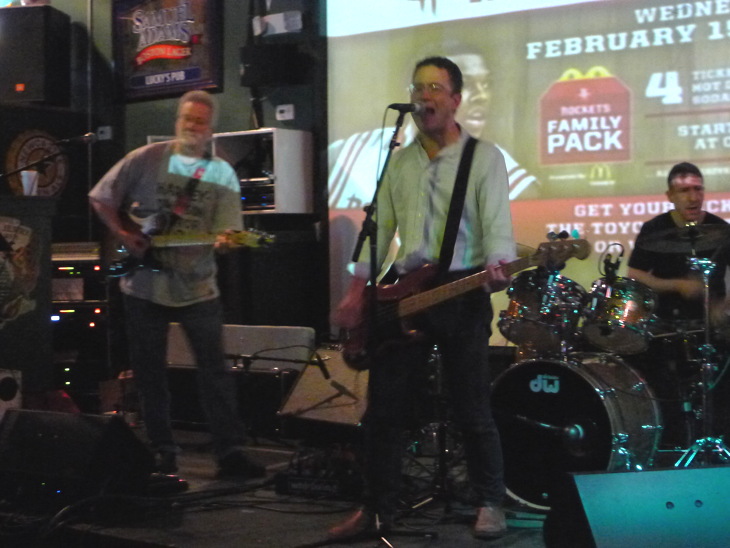
It was into this historical milieu that the CODES entered on Monday night, 2/6/12 to play a gig supported by SCCM.  I recognized the place immediately. A loud jukebox playing classic country-western songs loud. Shapely blond barmaids sporting ragged jeans and tank tops.  Longhaired guys with western hats and tattoos sitting around drinking alone. Lots of alcohol related posters on the walls (including the World’s Most Interesting Man”- Dos Equis Beer). A crowded, dusty stage for the band.

We were about as much a part of this scene as the Allman Brothers Band at a Yo Yo Ma concert.  I was pretty sure the CODES could get maybe halfway through one song before we were roughly ejected out onto the street for tainting the pure essence of local musical tastes.

But, life never ceases to surprise me.  After sound checks, we fine-tuned a couple of numbers and were greeted with some actual applause from the locals.  Go figure. By the time the evening was over (around midnight) the locals were boogying around the dance floor with the SCCM dignitaries and it was our typical rowdy bar scene the CODES are more or less famous for.

All things considered, it was a success and everyone seemed to have a great time.

Somewhere the Foo Fighters are smiling.