Stress, physicians and age

0

Physician “burnout” is defined as loss of enthusiasm for work, feelings of cynicism, low sense of personal accomplishment.

I think the factors involved are infinitely complex. I will also hazard a guess that the issue of burnout builds on two fronts:  Stress and Age, and the nomenclature for each is radically different.

Front 1– The peak “burnout” in the age group of 36-45 comes on two groups:

Group 1.  Doctors that emerge from the long training grind to find out they’ve bitten off more than they can chew and are having trouble digesting it. Too many responsibilities, too much work load combined with the era of mortgages, spouses, kids and mounting expenses acquiring the creature comforts lacking in the austere training days.

Group 2.  Doctors that emerge from the grind to find out that their reward was a false promise and they really don’t like living with the end product. The difference between training for a career and the nuts/bolts of the career don’t match and they’re miserable locked into the saddle with no escape.

The salvation of group 1 is usually that the personality type that thrives in this environment is selected out during the gauntlet. Those that can’t hack it fall by the wayside during training, like Navy Seals in boot camp that ring the bell when they’ve had enough. I think this is an unusual burnout group.

I think group 2 is much more common and not necessarily amenable to filtering by the gauntlet. By and large, there is a big qualitative difference between trainees and attendings, and the realities of that difference are not necessarily apparent before the fact. Some seemingly high quality trainees go bust quickly in the clinch and vice versa, and as far as I can tell, it’s very difficult to discern which is which before the saddle is cinched.

I’d hazard a guess that this group is at highest risk for becoming functionally incapacitated, call it what you will, and also I might add a risk for suicide if there is no escape valve.

All complain about the following factors, but most realistic physicians understand these factors are identical to working for any major corporation in any career position.

Bureaucratic tasks, Too many hours, Compassion fatigue, Difficult employer, Difficult colleagues, The Affordable Care Act of 20008

I don’t think I have ever met a doctor that burst into tears at the thought of onerous paperwork. I do know some however that started drinking heavily at the thought of the Affordable Health Care Act of 2008. The stark reality is that all these things are the price of admission to medicine highly unlikely to cause significant lack of professional fulfillment for no other reason than they are ubiquitous to nature.

Front 2-  aging physicians are a much more convoluted and textured phenomenon- physicians who have successfully run the gauntlets to arrive at a place of relative safety only to discover seniority is a new liability. Inevitable physical limitations and the duty and obligation to make way for others climbing up the same ladder behind them. A different and much more subtle order of “burnout” from the rest.

The limitations and hassles of old age are not linear. They escalate rapidly after a variable certain age”. At 65 I was doing four night calls a month and bounced back easily. I was racing motorcycles and doing high-speed track days at 66. I thought of myself as limitless.

Then I slowly discovered my concentration on the track at 120 mph was fading and I started crashing, once twice in the same corner. I quit at age 66+ before I hurt myself or someone else. Night call quickly became difficult to maintain concentration and the day-after became more difficult to bounce back. I still had the same knowledge base but not as much concentration ability to apply it under stress.

At age 70, I have the exact same drive and passion to be the best I can as when I was at the top of my game at 36.  The only limiting factor is my physical ability to bring it all to bear as effectively and efficiently in a world of emerging young people with the same fire in their bellies. Thereby burns the age related “burnout” flame- the fear of becoming irrelevant. An absolutely terrifying, life threatening burden.

That will be the burnout issue that I think will require some creative thought on how to rectify, if it’s even possible.

Epitaph on my headstone:

“This is my generation…..

Hope I die before I get old”

Pete Townshend, 1965. (BTW, Pete is 71 this year)


Crippen enters the rarified air of high-end audio

0

mcintosh-mcaire-xlI’ve been thinking that I’m behind the curve when it comes to actually listening to music anymore: a victim of the “digital ease” age.  It’s easy to just keep a menagerie of music in my iMacs and play them out of relative cheap desktop speakers.  In my office, I have speakers that stand about 2 inches high and they’re hooked to my desktop computer.  I have a huge supply of music and I just let it run during my day, mostly in the background.

My ears have grown accustomed to music the fidelity of which is about the same as a car radio. But as it turns out, the “real” fidelity of digital music is incredibly bad once you have something to compare it too.

The advent of iTunes has killed “high fidelity” as I remember my dad exploring it in the 50s with tube amplifiers and incredibly big speakers fed through enormous turntables. Highly compressed (for portability) MP3 music files lose a LOT of fidelity in the process. Even the music on garden variety CDs is pretty crummy compared to what it could be. The vast majority of the speakers they’re played through are junk, including and especially ear buds.

Music purchased through iTunes or over Internet radio contains a fraction of the total sound information captured in the studio — as little as 3% of the original. Even CD formats contain as little as 10% of the original information so it can be contained on a 4 3/4-inch disc.

It dawned on me that there must be more to musical life than Pablum in a world otherwise filled with sirloin, so I started sniffing around the erudite world of “audiophiles”.

To begin with, digital music is capable of “high fidelity” in the form of uncompressed audio files such as FLAC, WAV, AIFF, and “Apple Lossless files” but there are two problems.  Space and bandwidth. It takes a LOT of space to contain these files and the equipment required to play them to their maximum extent is expensive.

Aging 60s rocker Neil Young has led the charge to affordable players for uncompressed music files for the past several years. Young filed six trademarks with U.S. Patent and Trademark Office in 2012, all of which would offer a higher quality audio alternative to mp3 files, but none have reached the marketplace yet. He’s starting to release albums on Blu-Ray for better sound quality and his high-resolution player is said to be in the works for 2014.

http://www.rollingstone.com/music/news/neil-young-plans-pono-launch-for-2014-20130904

Then comes the re-emergence of “audiophile” 33-1/3 vinyl discs. Yes, vinyl is definitely coming back, and in extremely high-resolution format, said to be as close to studio quality as it’s possible to get.

They’re going all the way back to the 50s and finding the original master tapes, then putting them on vinyl in an amazingly lossless high tech process no one dreamed of back in the day. What you hear is as if you were standing in the control booth watching Linda Ronstadt in 1976. They now cost about US$30.00 each. The “sound” is said to be amazing and spectacular (I have not heard one yet).

http://www.mofi.com/product_p/mfsl1-319.htm

As the discussion proceeds, we’re now talking about the rarified air of hardware for the discriminating listener.  With a little research, three things become apparent. There is no limit to the ability of hardware to reproduce sound fidelity, there is no limit to the amount of money that can be spent to do so but there is a limit to what my aging ears are capable of discerning.  A perusal of the available hardware is fascinating (especially the cost).  You can easily pay US$10,000 for a set of speakers.  Many of the hard core literally build their houses around US$350,000 audiophile hardware.

There is simply no discernable point of diminishing returns. The more you pay, the more rarified audio acuity you can get. But at some point, the line on the graph heading up into infinity exceeds sanity, especially since I only listen to 60s and 70s classic rock. Not exactly the same fidelity required might be the entire New York Philharmonic playing Beethoven at 100 decibels.

Interestingly, all my research eventually led to the same place it did for my dad in 1956 when my mother was loudly predicting the end of the world at the hands of the Prince of Darkness, Elvis. McIntosh Audio. (Note different spelling- not to be confused with Macintosh Computers). In the end, when you’re seeking high end, all paths lead to McIntosh and once that obsession becomes manifest, an emptying of your wallet.

http://www.mcintoshlabs.com/us/systems/pages/systemdetails.aspx?SystemId=SoHoIIMusicSystem&Systemcatid=Music

Back in the day, the high-end amplifiers were all vacuum tube driven. They were big and heavy and required equally big pre-amplifiers to drive them into enormous stereo speaker cabinets.  My father ate peanut butter sandwiches for months to afford what was then a rudimentary McIntosh setup. Tell the truth I can’t remember what it sounded like but I remember him reposing for hours in a darkened room enjoying it.

So I decided to dip my toe in these waters with a relatively entry-level McIntosh combo unit that will play uncompressed digital files (for me, FLAC “Free Lossless Audio Codec” files) on my iPad and iPhone. Each of these files are not completely uncompressed but somewhere in the range of “better” to “much better” than straight up MP3. Not even close to vinyl but cheaper.

http://www.mcintoshlabs.com/us/Products/pages/categorylanding.aspx?CatId=NewProducts

The unit allows wireless loading with FLAC files from either an IPhone or iPad.

http://www.youtube.com/watch?v=_SMma_CQJ3I

It sounds absolutely amazing. So this will give me a taste of audiophile. Someday if I save my pennies and dimes (US$100 bills) I might look into building a full McIntosh system with a high-end phono player for the emerging mastery of vinyl.

It’ll be in my Scaife office around Christmas week. Drop by and I’ll give you a quick lesson in the difference between MP3 and FLAC.


Some personal observations on the events of Nov 22, 1963

0

It was the year 1959 AD. My dad was the only general surgeon in a town of about 10,000 souls located in northwestern Wisconsin studiously picked for his hunting and fishing passions.

He was a very conservative Republican as most if not all doctors were at that era. The “up by your bootstraps” age selected for them. The best government was no government, and in the escalating post war, post-Eisenhower age of prosperity, that seemed attractive.

Credit cards were virtually unknown. Gas was 29.9 cents a gallon, a mortgage on a nice house was a hundred bucks a month, a nice car cost US$2000 and virtually all health care was affordable out of pocket. There was no Medicare or Medicaid.

But the Eisenhower era was closing and a new era of cold war paranoia was emerging with the Presidential election of 1960. The world was becoming a dangerous. I was a sophomore in high school and my only interest was girls and cars, pretty much in that order. My interest in politics was yet to emerge so I was pretty much a disinterested observer.

The two candidates that emerged for 1960 were polar opposites, Richard M. Nixon, a crusading anti-communist from California and Kennedy, a relatively new senator from Massachusetts.

In the first ever TV debates in living black and white, he looked sneaky, dark and foreboding as opposed to the other guy, Kennedy, who brightened up the screen with an articulate vernacular. Even to my naïve eye, Nixon looked positively sinister.

Seemed like a pretty easy choice to me, but there was a problem. Kennedy happened to be a Catholic, a big problem in 1959 American culture. Catholics were very much discriminated against in mainstream America, thought by many to be as much a cult as “Christian Scientists” or “Scientology”.

Catholic. That’s all my bible thumping conservative Baptist mother needed to hear. So I could hear from my bedroom the fervent pleas that Richard Nixon would save us from being ruled by the Pope. But it wasn’t to be. Kennedy was elected by the thinnest of margins and my dad had to pull my mothers head out of the oven.

But in the end, Kennedy went on to become possibly the more revered President in American history, maybe rivaled by Bill Clinton. Interesting that they shared the same vices, but with different media access saturation.

But no matter. Kennedy was perhaps the most intelligent, articulate, funny President our country ever had. If he had shortcomings, all downplayed them. He and his family formed a veritable dynasty that was almost immediately equated with the Camelot legends of King Arthur. It is impossible to overestimate the love this man accumulated by the American public, (never my mother).

It was an idyllic scene unsullied by the eventual cultural revolution of the late 60s and the war in Vietnam. A relatively brief period of quietude and prosperity that was destined to collapse under it’s own weight, but it was extraordinary while it lasted. My only worries were girls and cars.

Cut to November, 1963. I had flunked out of the University of Wisconsin the first time (long story) and had eased into a job as an “orderly” at the local hospital where my dad practiced general surgery as I plotted my next move. The then Director of Nursing was the venerable and formidable Miss Myrtle Worth who watched me closely. After she died the hospital was re-named after “Myrtle Worth Memorial Hospital”. But that’s another story.

Sometime in the early afternoon of 22 November I was perambulating down the hall of one of the hospital floors on my way to some chore, probably carrying a bedpan, when one of the TV sets in the rooms I was passing by suddenly proclaimed a “We interrupt this program”.

This was a little unusual as these kinds of interruptions rarely justified breaking into regular programming. So I stopped and backed up in time to see Chet Huntley (NBC News) solemnly announce that President Kennedy had been shot in Dallas and no details were available.

Everything in the entire hospital instantly stopped cold. Every nurse, every administrator, every doctor all stopped what they were doing and congregated around the nearest available TV. Shortly thereafter came the famous spectacle of American’s most trusted TV commentator, Walter Cronkite, sadly proclaim with tears in his eyes that the President was dead.

There are no words even in my formidable vocabulary to express to you the emotional and cultural disaster that followed. This was absolutely unprecedented on every level. Camelot by its nature was impenetrable. No one ever thought in their wildest dreams that Camelot was vulnerable. To have it come crashing down was a cultural train wreck of immeasurable consequences. Like an out of control LSD trip, there was n way to process it.

What was to follow was unbroken ground, chronicled minute to minute by the unblinking eye of network TV in living black and white. Everything in the country stopped dead in its tracks, and I mean EVERYTHING. Every radio station carried only continuous funeral dirge music. There was no traffic anywhere. All businesses were closed including gas stations.

Everyone in the country sat ensconced before a TV set watching the funereal progression, the caisson, the riderless horse with boots reversed in the stirrups, the lying-in-state under the Rotunda, the unimaginable grief and horror of his wife preserved on.

It was like a nuclear winter until after the funeral when things slowly came back to at least baseline, but never actually back to normal. Even my mother was in tears. We then went on to the further culture shock of Bobby Kennedy and Martin Luther King, further illustrating the danger society never dreamed of on November 21, 1963.


0

EddieWhen I was a resident in about 1980 or so, someone from a production company landed in the ED at Methodist Hospital in Indy and I ended up involved somehow. A bunch of their wonks showed up and I ended up getting involved with them explaining the case. Turns out they were part of Detroit rocker Bob Seger’s road show “Bob Seger and the Silver Bullet Band”. So one of them gave me 2 tickets to the show and a backstage pass. Also gave me a T-Shirt from the British metal group “Iron Maiden” as they were involved with that road show as well.

That was back in the days when I wore a medium T-Shirt and that particular shirt has been long since lost. I should have kept it as EBAY is selling authentic vintage 70s “Iron Maiden” T-Shirts (featuring “Eddie”) for US$1500 (but that includes free shipping).

http://www.ebay.com/itm/VINTAGE-IRON-MAIDEN-T-SHIRT-1980-L-ORIGINAL-RARE-/350893574413?pt=Vintage_Unisex_T_Shirts&hash=item51b2e3090d

Iron Maiden been around 33 years now, still playing, over 80 million album sales, more than 2000 live performances and 15 studio albums. Original bass player Steve Harris is still with the band.

http://www.ironmaiden.com

Iron Maiden has also played the T-Shirt niche like a Stradivarius.  THere are a thousand variations of Iron Maiden T-Shirts and they still sell briskly. Serious collectors snap them up like hotcakes.

http://tshirtslayer.com/patch/iron-maiden-backpatch-collection

Recently one turned up in a box of my junk. It’s a little small but it still pretty much fits. I think I purchased it in London sometime in the 80s. It doesn’t have the outrageous value of the 70’s versions but it’s pretty much the same ilk. I wore it for a CODES gig a while back.

Take Home message:  Save those Allman Bros T-Shirts. Who knows in 20 years?


Forward to the past: Come walk with me

0

I send this remembrance out every year at this time. This and Timothy Leary and “Alice’s Restaurant”, the theme song of a generation that my Fellows know nothing about threaten to be forgotten, like Vietnam.

Let me bring back the vibrant remembrance because it’s important.

August 28, 1963 is the date of one of the most important and profound communications ever uttered by a human.

I have been a student of the 60s for most of my life, having lived and participated in much of 60s culture. I’ll spare you the details this time of my own experiences standing twenty feet from Dr. King during a speech in Atlanta in 1965, but if you have an interest, you can check out my first book on the subject:

http://store.blurb.com/ebooks/404827-the-60s-70s-confessions-of-an-attentive-observer

The eBook version is free.

I lived in Georgia for a huge chunk of the civil rights years and I experienced and participated in much of it. Someday I’ll write the full book on it, but for the moment, just walk along with me.  I’ll paint you the color commentary as we maneuver through the throngs toward he stage. I’ll interpret what’s going on from the vantage of a participant.

This day, August 28, 1963, produced the “I have a dream” speech by Dr. Martin Luther King, a communication rivaled only by Lincoln’s Gettysburg Address at Gettysburg, PA, November, 19,1863, 100 years earlier. There are similarities and differences between the two speeches.

Like King, Lincoln explored the principles of human equality, but proclaimed the Civil War as a struggle for the preservation of the Union necessary to frame principles thereof.  But unlike the King speech, Lincoln’s mood is described by Ken Burns as a quiet, almost whispering matter-of-fact tone directed at no one in particular within the relatively small group present.  At the time, it was virtually ignored. There is only one photograph from the Matthew Brady collection of Lincoln delivering the speech and it was from a distance.

The enormity of Lincoln’s speech is contained in the words, not the enunciation. Conversely, Dr. King’s speech occurred at the largest and most important civil rights demonstration in history and it was loud, covered by all three major TV networks. At the time of the demonstration, two thirds of the nations persons of color were not allowed to vote, attend integrated schools or use public facilities. 250,000 participants jamming the National Mall demanding civil rights legislation that was only to come two years later.

King took the stage just before noon with a prepared speech and began reading from it word for word. The text decried the fact that “fivescore years ago” Lincoln’s Emancipation Proclamation on July 1, 1863 freed the slaves in the ten states that were still members of the Confederate States of America, applying to a relatively small number, around 4 million slaves at the time.

But King goes on to lament: “100 years later the negro is still not free!”  “Lincoln’s promises were a bad check and “we’re here to cash it!” Then about halfway through the text something important changes. King looks up at the crowd sensing an opportunity to pontificate extemporaneously, as he did frequently in other speeches. The text did not match the emotion required at the moment and King simply went with the flow as he felt it, acting more like a Baptist preacher on a roll than an interpreter of a prepared text.

King was the undisputed master of grabbing audiences and holding them spellbound. On this day, he found his theme and worked it mercilessly, alternately chastising the crowd then raring back smugly, basking in himself. His words did not exist in any text. They were created in his soul for the occasion and they flowed freely, some of the most important words ever uttered by a human, relegating King to every history book.

 “I have a dream that one day on the red hills of Georgia the sons of former slaves and the sons of former slave owners will be able to sit down together at the table of brotherhood”

“I have a dream that my four little children will one day live in a nation where they will not be judged by the color of their skin but by the content of their character”.

“I have a dream that one day every valley shall be exalted, every hill and mountain shall be made low, the rough places will be made plain, and the crooked places will be made straight, and the glory of the Lord shall be revealed, and all flesh shall see it together”.

At this point, King is totally consumed by unrelenting passion and running completely on maniac fervor.  A shoddy analogy might be watching Neil Young play “The needle and the damage done” on The Johnny Cash variety show in 1971. Young doesn’t know where he is or who’s in the room. He doesn’t know where the chords come from. He’s completely consumed with the story he wants to tell and everything accompanying it flows like a wild river.

“I hit the city and

I lost my band.

I watched the needle

Take another man….

Gone, gone, the damage done……”

But I digress.

Dr. King continues:

 “From every mountainside, let freedom ring. And when this happens, when we allow freedom to ring, when we let it ring from every village and every hamlet, from every state and every city, we will be able to speed up that day when all of God’s children, black men and white men, Jews and Gentiles, Protestants and Catholics, will be able to join hands and sing in the words of the old Negro spiritual………”

At this point King is close to emotional collapse. Those around him stare with slack jaws.

(Rising tonal cadence)  “Free at last! Free at last! Thank God Almighty, we’re free at last!”

King collapses into a chair, staring blankly at Ralph Abernathy. For a moment, the audience was shocked silent. John Kennedy allegedly turned to an aide and muttered: “Damn, this guy’s good”.

The “I have a dream” speech was he high point of his career, changing his public persona dramatically from a commonly perceived rabble-rousing jailbird to a fisher of men.  King biographer David J. Garrow wrote that King had created a masterpiece on the fly like some kind of jazz musician.

King was assassinated on April 4, 1968.  I was finishing Jungle School in preparation for Vietnam on that day and I witnessed the pain and frustration.

Here is a youtube rendition of the speech. It MUST be watched and absorbed by anyone claiming to be an educated person. Take the time to watch the entire eleven minutes of this one of the most important speeches ever made by a human. Watch for the transition to extemporaneous passion.

Rock Band “Boston”. Looking for a connection.

0

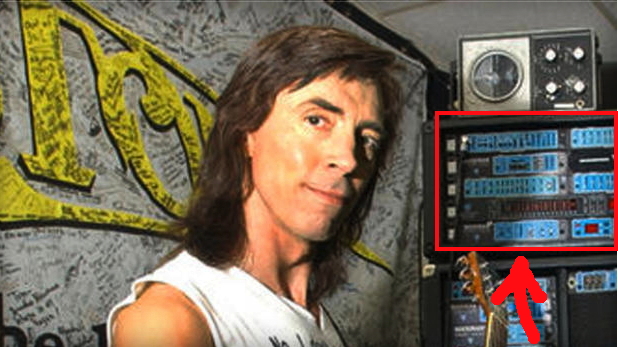
Tom SholzIf you’re a fan of Rock, you know and love the band “Boston”.  They burst on the scene in 1976 with the classic self-titled album and they have been a mainstay since. Tom Scholz is the heart and soul of the band, an authentic genius schooled at MIT and a hopelessly neurotic perfectionist that puts out an album about every eight years.

If you look around, you’ll see there is NOTHING written about the band in the way of an anthology or history. This is quite unusual, as virtually all the other big league bands have a historical biography in the mainstream media. Unclear why this is, possibly Tom Scholz’s enduring fear and distrust of all media.

At any rate, I would really like to write that biography, and I think I can do it justice. I have a few thin connections to some of the Boston personnel but none sufficient to get me an intro.

The problem with this effort is that I don’t have any major Rock journalism chops. Neither David Fricke and Ben Fong Torres know who I am, but  Rolling Stone has taken a chance of talented amateurs in the past, allowing Cameron Crowe to explore the Allman Brothers in the early 70s at age 18.  Gregg Allman demand Crowe to his room and told him to bring identification to prove he was not a DEA shill.

And the selection of Tommy DeCarlo (an incredible Brad Delp look-a-like with the same vocal range) occurred when Scholz noticed Tommy doing a cover of a Boston song on “My Space” and invited him to audition. So, it isn’t out of the question that I can get a foothold.

Another problem is that Tom Scholz is about as eccentric as they come and rarely if ever communicates with anyone outside his circle.  Without access to Sholz, it would be difficult if not impossible to write their history.

I think I understand a lot about Tom Scholz and his passions. They were similar to mine at the same age and we both made them happen. He and I are a lot alike in many ways although he’s much smarter than me.  I have extensively researched him and also his innovations in the field of sound processing.  In the mid 80s, he designed and created “Rockman” modules for guitarists that allow an incredibly rich array of analog sound processing guitar-to-amplifier. Each module creates a different effect, compression, sustain, chorus, echo, distortion and a full range equalizer is a very small package.

He designed these for studio use and they must be played through a different kind of sound system than a common guitar amplifier, but as you can see from the number of switches and controls, the processing of tone and audio is virtually endless. (See Photo).  Over about two months I obtained all the hard to find modules, set them up in my music room and I am playing with them. The creation of these modules is just simply genius.

So I’m looking for volunteers to get me a connection to anyone that could help me some kind of intro to someone that could help me accomplish this goal.

Hombres MC visit some American Civil War National Battlefield Monuments.

0

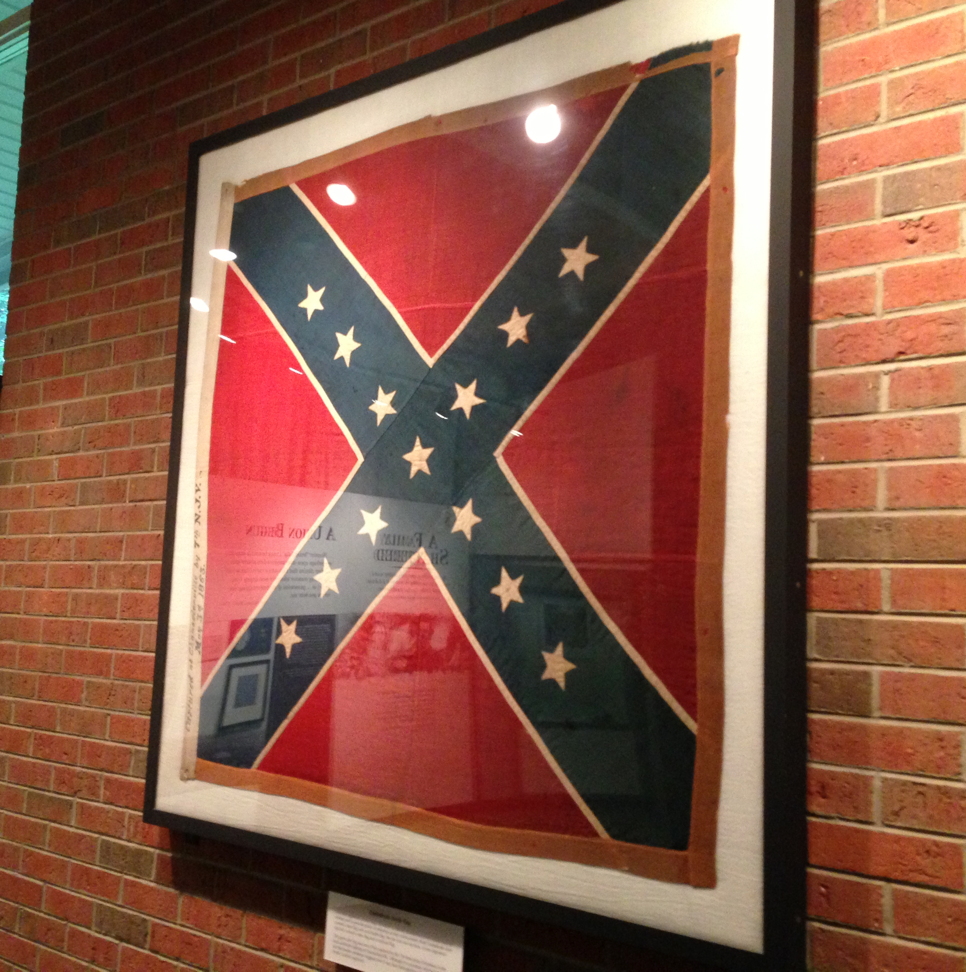
flagHombres MC visit some American Civil War National Battlefield Monuments. Many located between Washington, DC and the Confederate Capital in Richmond, VA.  We had five days and we put on about 700 miles. Then we went up part of the Blue Ridge Parkway toward home (in the rain and fog)

Most of the landmarks within the battlefield areas are not well preserved after 150 years.  The farmhouse named “Chancellorsville” is no longer there and the crossroads where the battle was fought is now a four-lane highway. The Fredericksburg site is in the middle of a housing project.

The National Park Service has constructed exceptionally interesting sites containing films outlining the events, artifacts and on-site lectures from park rangers. All well done, and I might add limited now because of the “sequester” so if you go, be sure and put some cash in the pot to maintain this essential American history.

Naturally, it would be impossible for me to delve into much of the history of the American Civil War as very notable authors have spent lifetimes trying to understand it. Ken Burns filmed the progression over 12 hours.  There are, however, a few issues of personal interest to me I can scratch the surface of.

Some of the famous battles are remarkable not so much for what happened as what might have been.

The first major battle to take place on Union soil occurred on Sept 17, 1962 at Antietam creek, near Sharpsburg, Maryland. Union Maj. Gen. George McClellan launched a frontal attack on the Confederate Army led by Maj. Gen. Joseph Hooker in and around a cornfield used for cover for both sides.

After the brutal battle in which over 23,000 young men lost their lives in one day, was fought to a brutal draw, but advantage lay with the Union as the Confederate troops were outnumbered and disorganized.  Lee ordered the Confederate troops to withdraw and re-group. At this point, a further push by the Union Army might have decimated Lee’s meager residual forces before they could re-group.

However, McClellan was a notoriously cautious General and fearful of ordering his men into actual battle unless victory with minimal casualties was a virtual lead pipe cinch. McClellan refused to pursue Hooker, even with the assistance of reinforcements from Maj. Gen Ambrose Burnside’s fresh troops lingering outside the action. He simply didn’t think he needed to. The Confederate Army was conceptually doomed and would collapse soon anyway with no additional loss of his troops. This allowed Hooker to safely retreat back south of the Potomac to re-constitute.

In terms of military strategy and tactics, McClellan fatefully failed to bring the full brunt of his forces to bear as a “Force Multiplier”, to make a given force more effective than that same force would be without it. Essentially, to cause disproportionate losses on the enemy, and therefore destroy the enemy’s ability to fight.  Sherman notoriously used this strategy that came to be known as “scorched earth” in his “march to the Sea” in 1864.

This lapse allowed Hooker to shift his forces to meet each encounter with the best possible efficacy using fewer men. Some historians believe that Lee’s army could have been wiped out at Antietam and had that occurred, the war would have been dramatically shortened or over.

The battle at Fredericksburg, VA occurred on December 11-15, 1862 between the Confederate Army commanded by Robert E. Lee and the Union Army commanded by Maj. Gen Ambrose Burnside. This battle is remembered for one of the most spectacular tactical blunders in the history of warfare, resulting in Union casualties twice as heavy as Confederate.

Burnsides plan was to cross the Rappahannock River on pontoon bridges to meet the Confederates south of the village of Fredericksburg. However, on arrival at the riverbank, Burnside found no pontoons (due to bureaucratic blunder) and was assured they would arrive in a day or two. So Burnside camped out and waited.

Meanwhile, Lee’s forces wondered where the Union Army was, so Lee sent scouts up who reported the situation. This allowed Lee to move up to meet Burnside in and around the town of Fredericksburg and more importantly, occupy the high ground south of the town with a stone wall for cover.

When the pontoons arrived, Burnside was forced to endure withering fire moving his troops across the river. On finally arriving on the opposite bank, Burnside ordered multiple frontal assault against 3,000 Confederate infantrymen lined up in multiple ranks behind the stone wall for about 600 yards and another 3,000 with artillery behind it. The Union troops were repulsed with heavy losses. It’s said that a walk along the entire of the killing field would not allow a boot to touch a single blade of grass. Only bodies.

Burnside stubbornly continued these assaults until he essentially ran out of manpower, following which he attempted to blame his subordinates. The following day, Dec 14, Burnside asked Lee for a truce to attend to his wounded, which the latter graciously granted, but ultimately proved to be a tactical mistake. The next day Dec 15, the Federal forces retreated across the river, and the campaign came to an end. The Union army suffered 12,653 casualties in three days of fighting. The Confederate army lost 5,377 men. Burnside was relieved of command a month later.

Again, as at Antietam, the military strategy and tactics are remarkable. For the entire battle, Lee’s forces needed only maintain their position and thin out assaulting Union forces from a position of relative safety. By the evening of Dec 14, the Union army lay decimated and extremely vulnerable, trapped between a superior confederate force occupying protected high ground and a river. For unclear reasons, Lee decided to wait out the night before actually assaulting the Union forces the following morning. This allowed the residual Union forces time to escape back across the river and eventually regroup on Union soil. Lee is said to have regretted this decision bitterly.

The Union Army (of the Potomac) then went on to another defeat at Chancellorsville in early May of 1963, followed by a series of smaller but cumulative losses. Ultimately, the loss of the Confederacy became a self fulfilling prophesy ending with the ill fated Appomattox Campaign and the evacuation of Richmond that culminated in Lee’s surrender on April 9. 1865.

A neutral spot, The McLean House (a private residence near the Appomattox Courthouse) was selected for the two Generals to meet and discuss terms, which were exceptionally generous. Roughly 175,000 Confederates remained in the field were allowed to keep all the possessions except arms and flags.  Each was issued a signed “parole” document guaranteeing free passage back home (avoiding potential charges of desertion).

Maj. Gen. Joshua Chamberlain, commander of one of the major Union brigades was a stirring figure responsible for one of the most poignant scenes of the era. He had personally directed 20 battles, was cited for bravery four times, had six horses shot from under him and was wounded six times.

Chamberlain ordered the line of Union troops to “order Arms” as the Confederates passed by as a measure of respect.  Observing this action, surrendering General of the remaining Confederate troops, Gen. John Brown Gordon wheeled his horse around, drew his sword placing the point against the toe of his boot and decreed similar respect for the Union troops. This order was carried out and the two movements proceeded silently and mournfully.

Thus ended the bloodiest battle in American history.  A total of 214,938 deaths in combat. At least 500,000 deaths from disease and ultimate wounds for a total death count of ~ 625,000. WW II yielded 405,000 deaths and Vietnam a paltry ~58,000 deaths in eight years. 23,000 men died at Antietam in one day and ~50,000 at Gettysburg in three days.

An interesting medical aside is the story of Dr. Jonathan Letterman, a Civil War surgeon said to have developed the concept of “triage”. Born in Canonsburg, PA, he was named medical director for the Union Army of the Potomac in May 1962. He initiated forward first aid stations, devised systems where fallen soldiers would be classified as to urgency of treatment while attending casualties at Antietam. He also refined ambulance systems and distribution of supplies.  He was light years ahead of his time.

Interestingly, there is a note on EBay (and a mention on “Pawn Stars”) flatly stating that any Confederate Flag that might be found on any Internet auction site is virtually guaranteed to be fake. There are simply none left that aren’t in museums and the chances of finding one, however unlikely, would bring tens of thousands of dollars. Virtually all Confederate swords and other hardware are expert fakes.

In my photo gallery, you will see his portrait, the barn where the “enlisted” troops were treated (Naturally- officers were treated up at the mansion) and some of the accouterments of his trade.

Here is my photo journal if you have an interest:

http://youtu.be/aI_sEAIAkog

(Click the HD icon and full frame)

——————————

Further Study:

I think Mississippian Shelby Foote writes the definitive history of this era and it’s as complete as it gets. His trilogy contains over a million words.

http://www.amazon.com/gp/product/0679643702/ref=pd_lpo_k2_dp_sr_1?pf_rd_p=1535523722&pf_rd_s=lpo-top-stripe-1&pf_rd_t=201&pf_rd_i=0394749138&pf_rd_m=ATVPDKIKX0DER&pf_rd_r=14ZA0Z6DJS0HAPSWXTAH

For the visually inclined, Ken Burns’ twelve-part documentary of the era on PBS (1990) is a masterpiece.

http://www.imdb.com/title/tt0098769/

A bit of 60s and early 70s history (by me)

0

BillIntroduction

What follows is about  3000 words of personal observations on this history as it applied to me as an observer and participant. I barely scratch the surface of it. Pulitzer winner Taylor Branch wrote three complete volumes on the Martin Luther King years. Robert Caro wrote three volumes on Lyndon Johnson, almost 2500 pages. If I had the time and energy, I could easily write three volumes of my life from 1962 through 1972. Someday maybe I will.

At any rate, I would encourage everyone to read this missive because observer/participant accounts of the 60s are dying out fast. Much political history of the period died with Hunter Thompson. The definitive history of the Vietnam Conflict died with Bernard Fall. The social history of the 60s and early 70s will die with Tom Wolfe. Soon the only accounts for you to read will be from partisan politicians.

A superficial scratch on the history of protest in a previous generation

“Yes, my guard stood hard when abstract threats

Too noble to neglect 

Deceived me into thinking

I had something to protect

Good and bad, I define these terms

Quite clear, no doubt, somehow

Ah, but I was so much older then

I’m younger than that now”

                 Bob Dylan, “My back pages”, 1964


http://www.latimes.com/entertainment/movies/moviesnow/la-et-mn-angela-davis-20130405,0,2829526.story


In order to put the Angela Davis issue into perspective, one must understand the temper of the times. That requires an exploration of the socio-political situation in the 60s and early 70s, a time of intense social and political unrest that will probably never be seen again in this country. The next revolution will be financial.

We understand the progress of the 60s generation play by watching the players. In modern times we are allowed to view the aftermath of this progression as astronomers view dying galaxies from a safe distance.  An alternate universe of unconventional social mores passing through optimistic iterations to ultimately to end in a fatal mutation. An exploration of “no limits”, the price of admission for which a number of very talented players paid with their lives.


Music and revolution

The price you paid for your riches and fame

Was it all a strange game?

You’re a little insane

The money, the fame, the public acclaim

Don’t forget what you are

You’re a rock ‘n’ roll star!

                The Byrds, “So you want to be a Rock and Roll Star”, 1967


Parenthetically, this social upheaval was irrevocably intertwined with the music of the day. The medium of Rock has always been one of rebellion against conformity and conventionality, and accordingly fit like a hand in a glove with the 60s. Rock is the stuff of existential anti-heroism, inviting those seeking salvation by immersing their souls in cathartic rock media masquerading as social profundity.  The high risk-high gain medium selects for those who actively live the dream. The musicality selects strains and chords evolved to selectively pull resonant strings of the human brain, abandoning order.

Those selected as the cast had no safety net and were drawn in at their peril. Normally composed hominids become temporarily irrational and start ripping out seats at a Jerry Lee Lewis concert. Jerry Lee lights a piano on fire and is carried out with it by firemen, still playing. A surging crowd trying to get prime seats at a Who concert trample and kill eleven people. Concertgoers assault the Rolling Stones on stage at Altamont resulting in one death at the hands of the Hell’s Angels. Dimebag Darrel of Pantera is assassinated on stage. Duane Allman thought he was immune to laws of traffic. Bonzo and Moonie thought they were immune to the toxicity of ethanol. Hendrix couldn’t sleep without escalating soporifics that ultimately put him to sleep forever. Cobain chose the brief pain of a shotgun blast to end the constant pain of his life. Jim Morrison died alone in a bathtub.

It’s also necessary to understand the influence of former President Richard M. Nixon. 


Nixon Agonistes: The crisis of the self made man (Garry Wills, 1970)

“Well, come on generals, let’s move fast;

Your big chance has come at last.

Now you can go out and get those reds

‘Cause the only good commie is the one that’s dead

And you know that peace can only be won

When we’ve blown ’em all to kingdom come”.

                      Country Joe & the Fish, “Feel like I’m fixin’ to die rag”, 1967.


The demonization of our current sitting president is a frolic compared to the bitter division Richard Nixon incited among a huge fraction of the population, mostly young people and students galvanized by his diffidence regarding the Vietnam conflict and his oppression of the American citizenry (using the IRA and FBI as political weapons against dissidence).

Richard Nixon has no peer in contemporary politics. Many remember him as one of the most nefarious humans that ever drew breath.  He was so spectacularly evil he glowed in the dark. Dr. Hunter S. Thompson said it eloquently in 1972:

“For years I’ve regarded his existence as a

monument to all the rancid genes and broken

chromosones that corrupt the possibilities of

the American Dream; he was a foul caricature

of himself, a man with no soul, no inner convictions,

with the integrity of a hyena and the style of a

poison(ous) toad”.

Nixon permeated and exacerbated the revolution by injecting his own agenda into the irrepressible change and got squashed like a bug in the process, but not before he became identified as the compleat villain on virtually every level. There was no possibility of his survival. He was the ultimate sacrificial lamb necessary to complete the revolutionary process. If he hadn’t existed, he would have had to be invented.


Angela Davis and her part in 60s history

“Her brothers been a fallin’,

Fallin’ one by one.

For a judge they murdered

And a judge they stole,

Now de judge he gonna judge her

For all dat he’s worth”.


                Rolling Stones “Sweet Black Angel”, 1973


Angela Davis rose through the ranks of professional protesters to become a polarizing figure making Sarah Palin look like Cinderella. At this point in my diatribe, you’ll have to endure a bit of dry history.

Angela came up through the School of Hard Knocks in 50s racial discrimination. She combined a lot of brain-power (PhD in Philosophy) and a serious head of advocational steam for the poor and downtrodden of society, particularly for persons of color and women. In order to set herself apart from her perception of societal oppression, she worked hard to alienate herself from mainstream white rank & file.  She assumed a very ostentatious Afro hairstyle, membership in the Communist Party and a very cozy relationship with the Black Panther Party, an organization famous for frequent firefights with the local Federales.

Because of her brainpower, she was recruited for an assistant professorship at UCLA in 1969 and promptly fired for her social views at the behest of then Governor Ronald Reagan. The cry immediately went up that she was a victim of race discrimination. Later that year, a federal judge ruled the university could not fire Davis because of her affiliations with the Communist Party, and she briefly resumed her post, followed quickly by another dismissal because of the inflammatory language of she media speeches.

In 1970, Davis became a full time social activist, plying the media expertly. In August of 1970, a black student took hostages in a courtroom and affected an escape by car, following which the police fired on the vehicle killing the judge, a hostage and three accomplices. It turned out that Davis had purchased the firearms used in the melee, she was prosecuted for “aggravated kidnapping and first degree murder” as an accomplice and she vanished into the social activist underground to avoid arrest. FBI director J. Edgar Hoover made Angela Davis the third woman and the 309th person to appear on the FBI’s Ten Most Wanted list.

She was, of course, ultimately found and jailed in January 1971. A splashy, racially saturated movement to “Free Angela” followed, the subject of this film.  After spending 18 months behind bars, Davis was acquitted of all charges by an all-white jury. The fact that she owned the guns used in the crime was judged not sufficient to establish her responsibility for the plot.

The incarceration of Angela Davis stands as a monument to the evolution of racial discrimination in the 70s post Selma, Alabama. She was selected for this honor pretty much because of her visibility in the social activist movement, that ostentatious females were a relative rarity within those groups and because of her eloquent articulation to the media.  John Lennon and Yoko Ono recorded a song “Angela” on their 1972 album some time in New York City in support of her. The Rolling Stones song: “Sweet Black Angel released in 1972 on their seminal album “Exile on Main Street” is dedicated to Davis.

I think that the Angela Davis situation was one of the seminal events that gelled 70s political activism.


Welcome to the evolution, revolution

“You say you want a revolution

Well, you know

We all want to change the world

You tell me that it’s evolution

Well, you know

We all want to change the world”

Beatles, “Revolution”, 1968


Although difficult to imagine for most of you, the years 1970-71 were a straight up revolution, exacerbated by the assassinations of Robert F. Kennedy and Martin Luther King in 1968 and nurtured by the violent Democratic National Convention of 1968. Much but not all of it related to an intensely polarizing President and the unpopular Vietnam conflict that remained in full swing while the “peace accords” spent months arguing about the seating.

Virtually every city in the country brimmed with firebombs, looting and the crackle of small arms fire. Business owners sat in shifts with shotguns propped on their toes outside their storefronts nightly. You kind of had to be there to appreciate the frightening enormity of it.


On the nature of protest

“Come mothers and fathers throughout the land

And don’t criticize what you can’t understand

Your sons and your daughters are beyond your command

Your old road is rapidly agin’

Please get out of the new one if you can’t lend your hand

For the times they are a-changin’.

                             Bob Dylan, 1964


In the middle and late 60s, protest against racial discrimination, an established and entrenched culture in the South (and equally so but more occult in the Northern cities) took the form of “nonviolence” (passive resistance) after the late Martin Luther King. The working theory was that if enough resisters brought media attention to racial inequality, it would eventually collapse under it’s own weight. To meet violence with more violence would be contra-productive and also violate the strong religious undercurrent of the movement. It was just a matter of time and MLK protesters were willing to wait it out.

However, the forces of social and racial culture continued full steam ahead with the assassination of Robert F. Kennedy, Martin Luther King and the violence at the Democratic National Convention in 1968, acerbically chronicled by Dr. Thompson in his formative work: “Fear and Loathing on the campaign trail, 1972”. The spectacle of cops on horseback busting kids heads with nightsticks in Chicago and kids shot dead at Kent State by National Guardsmen in 1970. It suddenly dawned that non-violence and simply pointing out evil and waiting for a logical response wasn’t working. Every kid clocked by a nightstick became an instant radical.

It was only a matter of time before a selection of the protesters escalated their visibility to make the establishment take notice. If violence were the answer to protest, then protest would meet that challenge by becoming more violent. Accordingly, the Students for a Democratic Society (SDS), previously a leftist student group advocating participatory democracy evolved to a radical revolutionary unit. The earlier iteration of the SDS was oriented along the lines of the Student Nonviolent Coordinating Committee headed by Stokely Carmicheal.  The next SDS iteration, Weather Underground (WU) rose because of the failure of passive resistance to accomplish its goal. Bernadine Dohrn articulated the manifesto: “You don’t need a Weatherman to know which way the wind blows”, a line taken from Bob Dylan’s “Subterranean Homesick Blues”


Any way the wind blows

“Blood on the rocks

Blood on the streets

Blood in the sky

Blood on the sheets

If you want blood – you got it…”

                     AC/DC, “If you want blood”, 1978


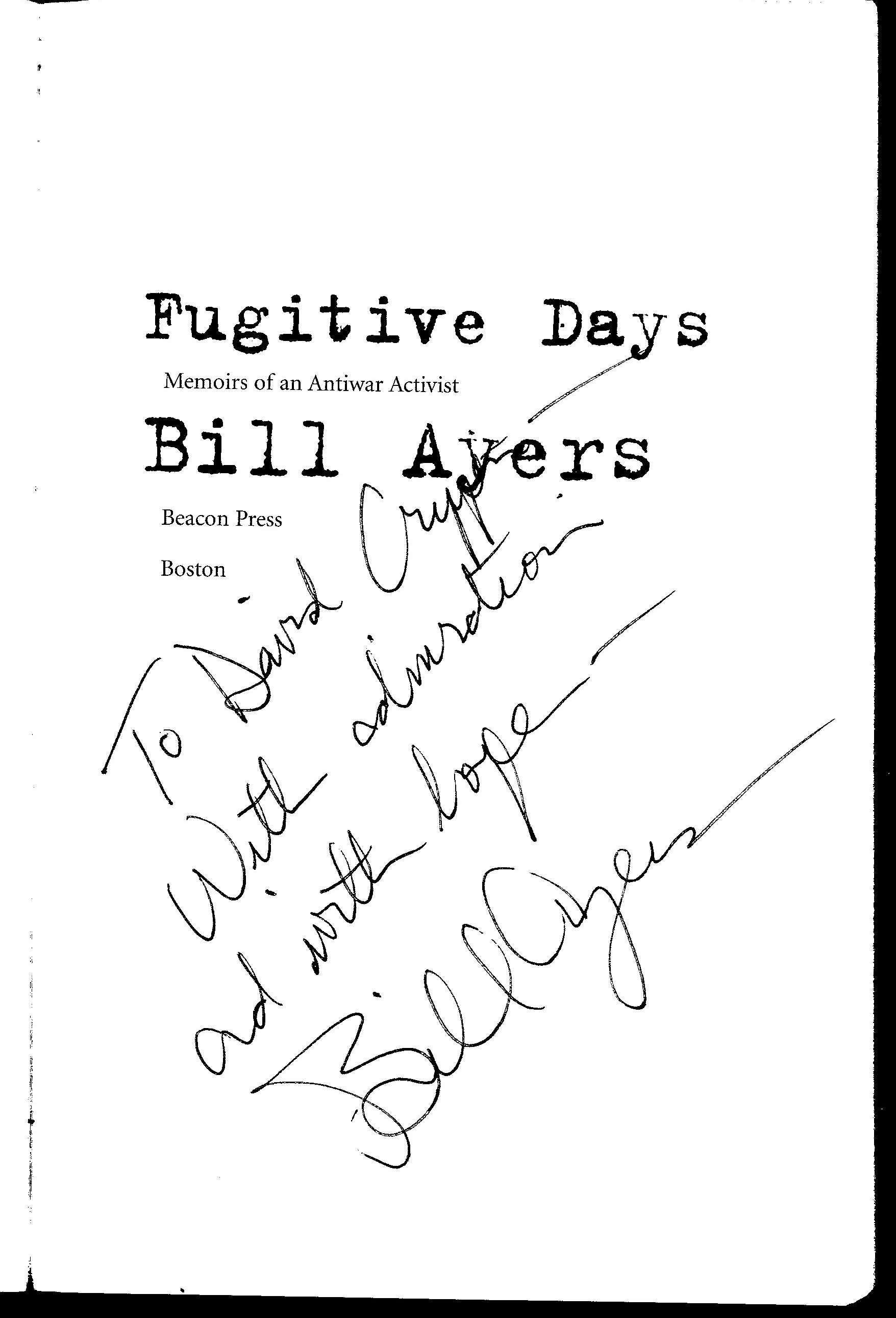
The Weather Underground consisted of mostly upper crust students dedicated to reforming what was considered to be a thorough corrupt and morally bankrupt government. Two of the prime movers of the WU were BiIl Ayres and Bernadine Dohrn, both of whom flashed across the underground activism sky briefly but brightly, and both of whom I will discuss later.

The SDS considered Nixon to be a politician so aggressively evil he glowed in the dark and an administration that needed to be brought down by an escalation of protest to that more physical.  To quote Malcolm X:  “We declare our right on this earth to be a man, to be a human being, to be respected as a human being, to be given the rights of a human being in this society, on this earth, in this day, which we intend to bring into existence by any means necessary (1964).”

This was to be accomplished by selective property damage associated with the government, specifically to bring media attention to the problem. Violent demonstrations raising public consciousness and civil disobedience used to generate publicity pointing out the evils of mainly the Nixon administration. The express purpose of the Weather faction was to get attention via property damage they knew would attract media coverage, and this was the goal. With media coverage came visibility of the protest. So for a time, small bombs were planted in strategic areas like the Pentagon, with the express purpose of doing damage and generating publicity by which the message could be disseminated. If they got busted for property damage, so much the better. Martin Luther King became more famous for his sojourns in jail, not marching.

Briefly paraphrased, this faction figured out that the only way to get the attention of the public was break the machine. Mario Savio at Berkeley: “place your bodies upon the gears.” Bernadine Dohrn: “There’s no way to be committed to non-violence in one of the most violent societies that history has ever created.” Mark Rudd: “The weather is changing for this government and we’ll be forecasting it. We’re the Weathermen!”


Domestic terror redux

“Oh, a storm is threat’ning

My very life today

If I don’t get some shelter

Oh yeah, I’m gonna fade away

War, children, it’s just a shot away”

                 Rolling Stones,  “Gimmie Shelter”, 1969


In recent years, would-be meta-politician Sarah Palin has referred to the Weather Underground and those associated with it as  “Domestic Terrorists.” She has no idea what she’s talking about since she wasn’t there and everything she says is scripted by partisans. Whether you believe the “domestic terrorist” theory depends on which acts of “terror” you’re looking at.

Never at any time did anyone in the Weather faction intend for death or injury, as this was, of course, totally opposite to their protest message against random death and injury. There were actually very few of these bombs set, fewer actually went off and each was loudly advertised in advance to insure no one was in the area.  If Ayres et al, were guilty of anything, it was property damage, a misdemeanor punishable by a fine and probation.

Tim McVeigh set off a bomb calculated to kill as many innocents as possible. No one knew it was going to go off and there was no “protest” of anything. It was a random killing. McVeigh turned tail and tried to get out of town, never intending to tell anyone who did it and why. There was no protest message and no responsibility by anyone. Tell me again how McVeigh’s bomb relates to the Weather Underground?


Did we matter?

“I’ll tip my hat to the new constitution

Take a bow for the new revolution

Smile and grin at the change all around me

Pick up my guitar and play

Just like yesterday

Then I’ll get on my knees and pray

We don’t get fooled again”

                             The Who,”Won’t be fooled again”, 1971


It was arguably the first time in history that a major youth uprising against a political regime occurred with such singularly coordinated organization. I was at the Vietnam Vets against the War rally in Washington DC, April 1972, wearing my LRRP tiger stripes along with then President of the VVAW (now Secretary of State) John Kerry. I bumped into him at least once in a To Do Street Saigon bar as I recall. He wouldn’t remember me but Kerry has a face you don’t forget. We stood by as Vietnam veterans lined up around the block in crutches and wheelchairs to toss their Bronze Stars, Silver Stars, and Purple Hearts over the White House wall. I wept openly. I have never been so moved before or since. In character, Nixon ignored it all, setting the stage for what was to come next.

Did a bunch of scruffy, longhaired kids bring down a President of the United States? What is “morally acceptable” in bringing down a nasty, repressive, oppressive regime?  Was MLK’s passive resistance the “right” thing to do as these regimes burn themselves out under their own weight?  Or was Bill Ayres right: “There is no way to be committed to non-violence in the middle of the most violent society history has ever created”.

In retrospect, I think history shows that we were an association to the fall of Richard Nixon and the end of the Vietnam War, not necessarily a cause. Nixon ignored anything and everything that occurred in the way of early 70s protest, walked away scot-free in 1974 and dying peacefully of old age in 1994. The Vietnam conflict simply burned out in 1975.  If we were primary movers and shakers, it didn’t show up in the time line. By a stretch, we may have hastened it just a little.

Looking back now 40 plus years later to issue a blanket condemnation of the SDS and Weather faction demonstrates a lack of understanding as to   the way things were then. Few if any of you can fully appreciate the passions of youth in the late 60s unless you were there and you were a part of it. There was no road map. No one knew what was right or wrong. We didn’t know what a “terrorist” was. We were on a mission from God. There was only the passion. Were we Domestic Terrorists or righteous protestors against unfair government? It will be for history to decide.


Urban Warriors: Bill Ayres and Bernadine Dohrn

“Cancel my subscription to the Resurrection

Send my credentials to the House of Detention

I got some friends inside”

                 The Doors, “When the music’s over”, 1967


Bill Ayres and his wife Bernadine Dohrn are in perfect positions to teach modem youth what the politics of the 60s and early 70s was all about, and how the Students for Democratic Society and the Weather faction fit into it. This is history that needs to be preserved, and what better teacher than someone that was a part of it. His political positions are a matter of public record. Both Ayres and Dohrn grew up and out of the 60s as most of us did, and now reside quietly in Chicago where Bill is retired Professor at the University of Illinois at Chicago, College of Education. He is active in community activities. Dohrn became a lawyer and espoused this as an example of a person’s ability to “make a difference in the legal system.” Dohrn said of her political beliefs: “I still see myself as a radical.

If I were a graduate student studying history or sociology, I would drool to take a course with Ayres and pick his brain extensively. I don’t have to share any of his views but I certainly can learn from them. He, like Israel, has a “right to exist” because we are a pluralistic society.

For those interested in serious study, you cannot begin to understand the era without reading:

*  The Sixties: Years of hope, Days of rage.  Todd Gitlin.  (1987).  0-553-27212-2

*  SDS:  The rise and development of the Students for a Democratic Society.  Kirkpatrick Sale. (1973). 0-394-71965-4

*  Fear and Loathing: On the campaign trail, 1972.  Hunter S. Thompson. (1973) 0-446-31364-5


An impertinent history lesson about collecting

0

In Grade School (6th Grade), everyone was promoted automatically just for showing up. It was a pretty big shock that when Middle School (7th Grade) rolled around, they expected a kid to actually study and pass exams covering material presented in distinct classes much like High School. In addition, many families with small children purchased homes for “good school areas”, but then Middle School rolled around, many of these schools were located much further away.

So “getting to school” in the morning in Middle School became more problematic. It usually boiled down to bicycles for the “middle class” of kids or school busses for truly down and out losers.

Albuquerque, NM was a big desert in 1957, long distances between almost anything. I lived in the Southeast Heights and the facility I was assigned to Woodrow Wilson Middle School, about three miles from my house starting in 1956.  “Lizard King” Jim Morrison was in my homeroom (confirmed via school annual) and no, I don’t remember him. He looked a lot different then ;-).

There was no school bus covering that route, so bicycle was pretty much about it for most.  However, a lot of savvy kids had small motor scooters to get from home to school and back. The scooter issue was the beginning of my passion for and love affair with motor vehicles. Predated the apocalyptic onset of girls by about a year.

Everyone how was anyone had one. One’s social status in middle school was fully depended on whether you rode a bicycle of a motorized scooter. I’m convinced that this stuff set the stage for Fraternities in college. Of course, bus riders were categorically ignored by all.

Scooters were all parked directly across the street from the Wilson Jr High facade. The entire front lot of the length of the school contained among other brands, Cushman Eagles, Vespas,  “Allstates” (Vespa knock-offs from the Sears catalog painted all green).

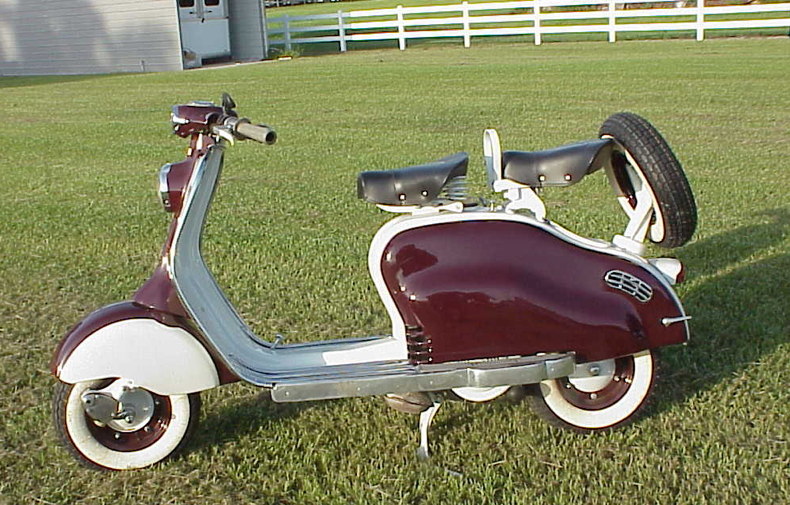
ImageBut the motorized love of my life was the curvaceous Italian Lambretta. The curves on a Lambretta rivaled any supermodel to a middle school kid. Super models (or any ambulatory genotypic female) came later.

Cheaper models included the various Cushman step-downs, the tiny “Doodle bug” and the Indian “Papoose”. The Cushman Mustang led upscale models heading toward true motorcycle ethos. There was a 165 cc Harley in those days, a precursor for the Sportster. I loved them all.

In New Mexico, 13 year old could legally ride one without a license if the engine horsepower rated below 5 horsepower. The Lambretta hit 4.9. I desired a scooter more than anything in the world.  I held my breath, turned purple, cried, foamed at the mouth, seized, threatened suicide and homicide but all this was greeted by variations on the theme of  “You’ll shoot your eye out, kid” from my father the doctor.

There was NO chance of me given free reign in a two-wheel vehicle capable of 45 miles per hour, especially with my grades (four F’s and a D, as far as I know, still an institute record). So, I was left to lust after all of them, walking the parking lot rounds every day gawking at them and occasionally bumming a ride with one. That was about as good as it got.

I became the local technical authority on Lambretta. . I was like the sex expert that knew 385 positions but didn’t know any women.  I could recite specifications down to the minutest detail, even to the point of speculating Lambretta futures on the stock market. I would take the bus up to the downtown Lambretta store to gawk at the new ones for an hour or so till they asked me if I was actually going to buy anything, and then threw me out.

I built up a terrible desire debt for these things that was not to be fulfilled till many years later.

Cut now to last week as I idly perused one of the vintage motorcycle mags I get monthly. They all have vehicles for sale and one caught my eye, a ’57 Lambretta with the classic two-seat/rear-spare tire configuration that is now pretty rare. The guy selling it lives in Florida and has 150 motorcycles in his stable!  Said he was selling some of them as he prepared to retire!

It isn’t possible to go home again. Lord knows I have tried. I weighed 110 pounds in ’57 and I weigh 220 now. I would look just plain silly dwarfing this thing like a rhino on a pogo stick, even if it could get up the hill to my house with me on it (unlikely). It would just sit in my garage and I would gawk at it. Pretty expensive unusable toy. So, sadly, I gave it up and trudged over to my other “usable” classic/vintage bikes in the garage for solace. There was some to be had.

The history I have just related explains why I have become an erstwhile collector of vintage/classic motorcycles. Collecting vintage/classic automobiles is VERY expensive and requires huge space to keep and maintain them. There’s a classic car dealer near me with some incredible cars in their warehouse. ’57 Triumph TR-2s, ’56 Corvettes, assorted classic Ferraris and Porsches. Each PHENOMENALLY expensive to own and maintain. I marvel walking around this place.

But in the end, I can’t afford to warehouse a car so valuable it can’t be insured to drive on the street. I love the cars but I want something I can use every day to get back and forth to work and to the grocery store (albeit on nice days). So, I can afford ONE classic automobile (a Lotus Elise) that is beautiful and full of vim/vigor AND can be driven like a normal car. Following that, I fulfill my passions by collecting vintage/classic motorcycles, all of which can be ridden functionally, and all of which will appreciate in value as a straight up annuity.

I started with ‘70s BMW “airheads” (air cooled boxer engines) that were way ahead of their time functionally and still very all purposely rideeble today.  Inevitably, and ultimately I graduated to my first and true love- Triumph. the vintage Triumphs made in Meridian GB are harsh mistresses. They are finicky, idiosyncratic, difficult/expensive to maintain like your 30 years younger than you, soon-to-be 3rd wife, but when you walk into a room together, every head turns. (No jokes abut why heads turn, please).

The Triumph marquee has a history going back over 100 years and is far too convoluted to outline here. Suffice to say there are five or six thick books in my collection exploring that history.

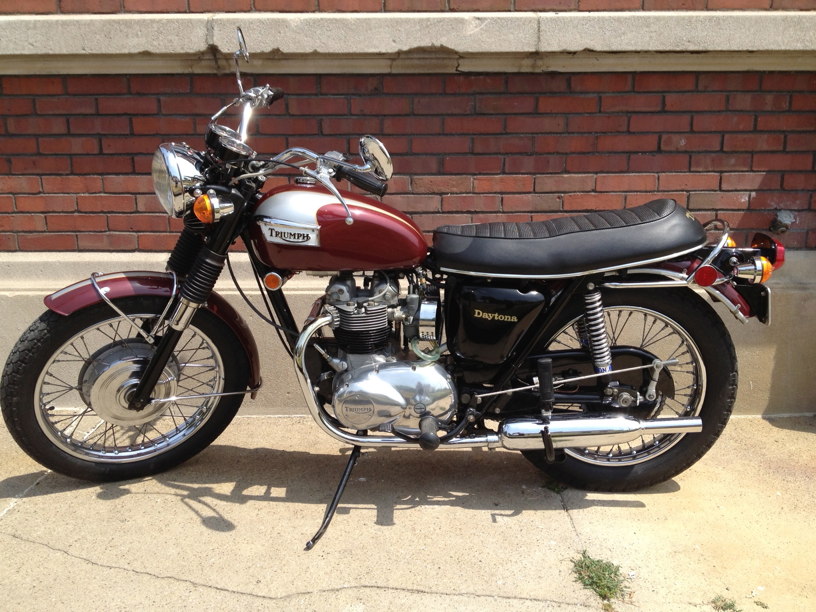
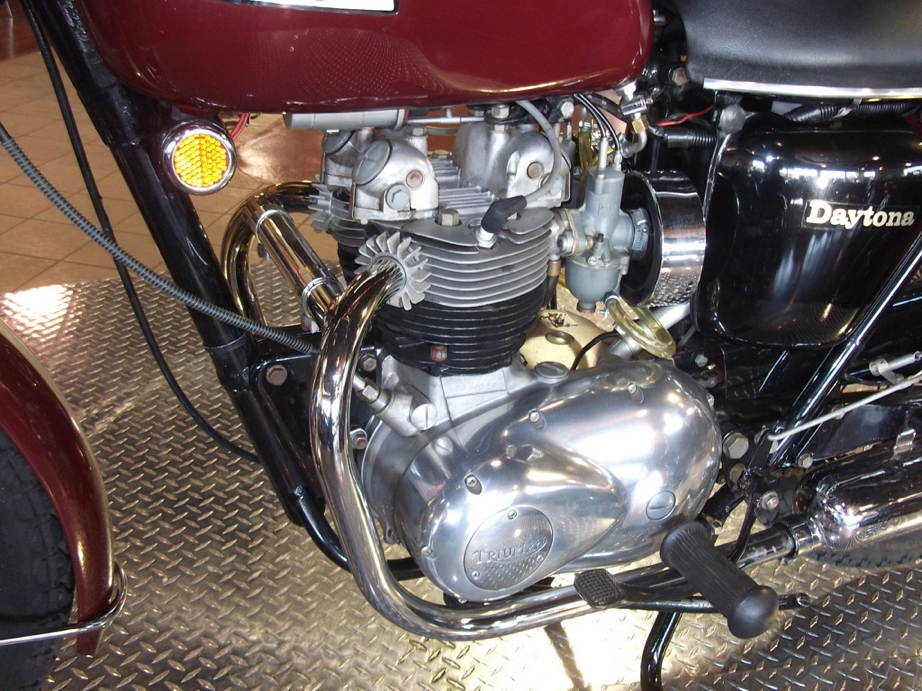
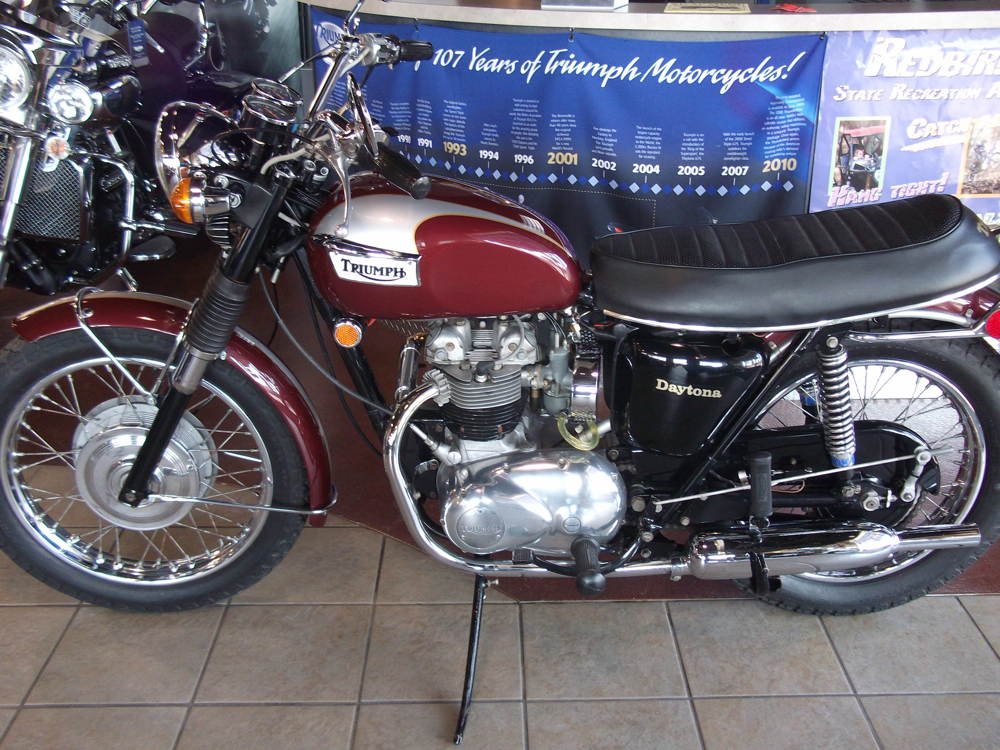
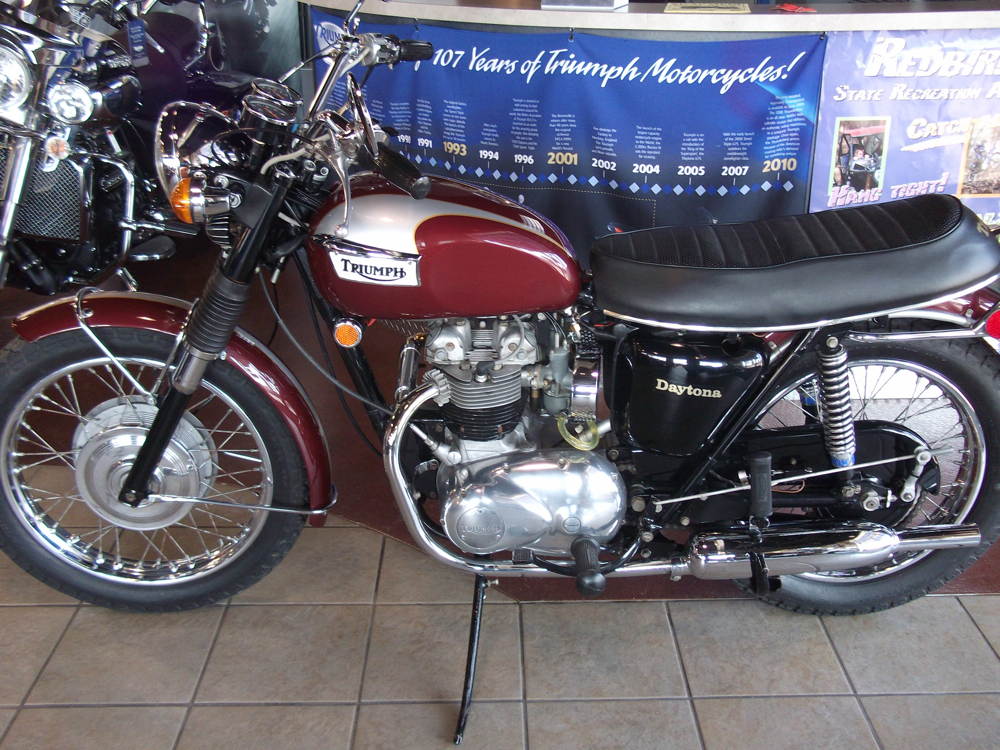
ImageNow cut to now.  A couple of months ago I managed to acquire a mint condition ’72 Triumph 500cc Daytona. A VERY desirable collectable that runs like a Swiss watch and will appreciate in value as it’s ridden. I fell deeply in love with this bike which was just as well as my wife assured me I would be sleeping with the next one she found in the back garage.

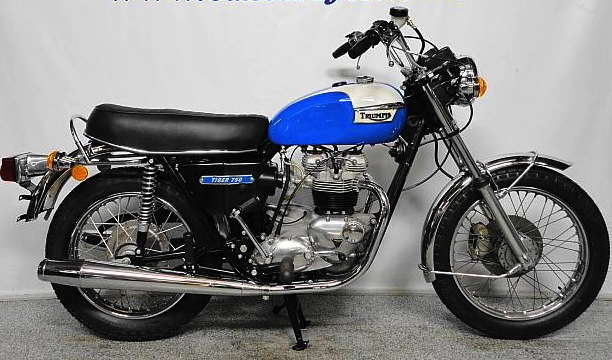
As painful as it was to admit, I knew I must have another Triumph to keep my baby happy.  I denied it for a while, but I had my eye open.  This week, lo and behold there appeared two possibilities- an immaculate ’69 Bonneville and a concourse ’73 Tiger, restored by an award winning master restorer in Texas.

ImageIt was a tough decision, but I chose the Tiger because I liked the color (blue) and there were numerous safety issues.  The ’69 Bonnie had only one rear view mirror, drum brakes, no turn signals and a 4-speed transmission. The ’73 had all full mirrors, turn signals, disc brakes and a 5 speed transmission. In the end, safety prevailed which is just as well as I am not sleeping with the bike. There isn’t any room for me in the back garage.  I’m sleeping in the car.

Crippen Mergers & Acquisitions Dept (11/18/12)

0

“Triumph of Great Britain” is one of the oldest makers of two wheeled vehicles in the world. Started making bicycles as the Triumph Cycle Company in 1889. In 1898, Triumph extended its production to include motorcycles and by 1902, the company had produced its first motorcycle, a bicycle fitted with a small Belgian-made engine. In 1904, Triumph began building motorcycles based on its own designs and in 1905 produced its first completely original motorcycle. By the mid-1920s Triumph had become one of Britain’s main motorcycle producing 30,000 motorcycles each year. By 1939, the 500 cc Tiger 500, capable of 100 miles per hour was released. To satisfy the American desire for more long distance riding, Triumph turned out the “Thunderbird, a 650 cc version of the Speed Twin design.

The Triumph brand got a lot of publicity in the United States when Marlon Brando rode a 1950 Thunderbird 6T in the 1953 film “The Wild One”. In 1959, the T120, a double carburetor version of the Tiger which came to be known as the Triumph “Bonneville”.  In “The Great Escape” (1963), the famous motorcycle jump over the fence performed not by Steve McQueen but by Bud Elkins, was done on a ’59 Triumph TR-6 camouflaged as a war bike.

As Triumph developed massive sales in the USA, Harley-Davidson became aware that their motorcycles were not as sporty as modern riders would like, resulting in a decreasing share of the market. This resulted in the introduction of the smaller Harley “Sportster

In the 60s, Triumph began to excel in racing. In 1969 Malcolm Uphill, riding a Bonneville, won the Isle of Man Tourist Trophy race with an average speed of 99.99 miles per hour.  By 1969 fully half of the US market for motorcycles belonged to Triumph, but, inevitably, technological advances from competitors marched on and Triumph failed to keep up. Triumphs lacked electric start, relied on out-of-date push-rods engines rather than overhead cams, vibrated and famously leaked oil.

Japanese competitors such as Honda were building more advanced features into cheaper, more attractive machines. Triumph’s manufacturing processes were very labor-intensive and inefficient. Inevitably, Triumphs became obsolete quickly. The British marques were poorly equipped to compete against the massive Japanese financial resources that targeted their competitors for elimination via long-term plans subsidized by the Japanese government.

Triumph and other British bikes like BSA and Norton created variations on their previous themes, but were insufficient to counter the wave of Japanese bikes flooding the USA. The original Triumph Company in Meridian, UK went into receivership in 1983.  Residuals of the original Triumph team visited its competitors’ facilities in Japan in 1985, determined to find a way to get back in the game competitively. They became especially interested in the new-generation computer-controlled production machinery. By 1988, the company had moved into a new factory site in Hinckley, Leicestershire, UK.

In March 2002, the Hinckley facility burned to the ground and by 2006. Triumph had relocated into a new ultra-modern plant with cheap labor overhead in Thailand. September 2008, Triumph announced that they were expanding their Thailand factory to increase capacity to over 130,000 motorcycles per year. Modern Triumph motorcycles are well made, stylish and get good reviews for design and safety.

The vintage Triumph motorcycles are considered strong collector’s items as they appreciate in value while still being functional if kept in pristine condition. Of all the array of collectable Triumph motorcycles, the two that lead the list are the early 70’s 650 cc Bonneville and the 500cc Daytona. The ‘Daytona’ name was derived from American racer Buddy Elmore’s win at the 1966 Daytona 200 race, with an average speed of 96.6 mph on a 500cc Triumph Tiger T100, the precursor to the T100R that I now own.

As the aesthetics of motorcycles go, I think the 70s Triumph Bonnevilles and Daytonas rank in the upper reaches, and they are very rideable for limited uses. The Daytona of the early 70s (ended production in 1974) was truly a thing of mechanical beauty. I am lucky to have found this one in another Midwest city. The 500cc engine puts out only 40 horsepower, the same as a Volkswagen Beetle of the same era, but it’s plenty enough for riding around town on nice days. It has drum brakes, but the bike only weighs 370 pounds wet so that’s plenty for occasional riding. An Antique license plate avoids inspections and the insurance is a hundred bucks a year.

There aren’t many of them around. This one is a ’72 and has been aggressively restored from the ground up by professionals. 10,000 miles on it. Check out the photos and see what you think.