I visit Israel (July 2012)

0

For the Israeli Society of Critical Care Medicine, July 12-14, a meeting I previously reviewed on Postcards from the Road.

The real fascination to me was learning about this fascinating place, the Jews, some things about orthodoxy and how a combined Church and State works. Sadly I missed a visit to Masada because of the intense heat. Will remain on my bucket list for another day.

The old city of Jerusalem is an interesting place with an over three thousand year history.  It’s split up into four sections, Christian, Jewish, Moslem and, interestingly an Armenian quarter dating back to 95 BC. Unlike the majority of Christians in Israel, Armenians ethnically and religiously separate, a homogeneous group, intermarrying over the years and keeping their culture intact.

The Christian quarter contains what is traditionally said to be the path of Christ carrying the cross to Golgotha, the hill where the crucifixion took place. Constantine built the Church of the Holy Sepulcher around the whole site around 333 AD. Stations are identified where certain events occurred during the trek with the cross, and a burial site said to be compatible with what it would have looked like at the time is a short distance from the preserved rock formation the cross is said to have been erected upon.

There is some suspicion that this whole arrangement has been molded as a tourist attraction as it would be highly unlikely that anyone would know exactly what happened at any of the stations 2000 years ago. Similarly, in the town of Tombstone, AZ, the reconstructed town cemetery probably doesn’t really contain many of the infamous figures of the old West, but the site is a popular tourist visit.

One of the high points was the food. The cuisine was just incredible, some of the best food I have ever had. The wine (grapes grown locally) was also excellent. Very authenticBeef Stroganoff in one bistro by the sea.  Lots of tasty local dishes prepared in picturesque restaurants. A real treat.

Here are some of the photos:

http://www.youtube.com/watch?v=VlFVhWXfjps

(Screen size can be enlarged- bottom right of viewer)

Starts with photos in and around Tel Aviv. Then Jerusalem, grave sites of Jews who live in other areas but come back and be buried in Israel. The Wailing Wall, some open markets, Christian areas. Then the Roman era ruins of Caesarea, much of which is remarkably preserved. A road unearthed, an aqueduct that goes for kilometers, well preserved statues. A chariot racetrack like in Ben Hur, rooms with much of the original floor detail intact.

On the plane, I read the latest and seemingly most informative book about “Lawrence of Arabia” T. E. Lawrence, his life and accomplishments: “Hero”, by Michael Korda (2011).

http://www.nytimes.com/2010/11/22/books/22book.html

It turns out that his involvement in the shaping of the Middle East was very significant and interesting. I have endeavored to summarize some of the fascinating history below just to possibly pique your interest in reading more.

———————————————

In 1914, Turkey joined World War I on the side of the Germans and specifically against their traditional enemy, Russia.  The British analyzed the situation and decided the cheapest and safest way to neutralize the Turkish war effort was to tie them up with an Arab revolt in what was then Arabia, a major part of the Ottoman Empire.

In the spring of 1915, the Allies (Britain and France) undertook operations in the Dardanelles intended to break the back of the Ottoman Empire with one blow and open the waterways for the passage of supplies to Russia. Amphibious landings at Gallipoli failed due to unexpected Turkish resistance. Subsequently, the Ottoman army defeated a British expeditionary force at Baghdad in 1915.

It was quickly discerned that the Brits weren’t adequately equipped for a desert war. It was decided to pay the Bedouin tribes of the area to harass the entrenched Turks. The Bedouins were happy to accommodate in return for gold sovereigns. In this way, the Turks could be kept busy on an irrelevant front and out of the major European theater.

Into this arena arrives lieutenant T. E. Lawrence, a square-peg-in-a round-hole minor military mapmaker with archeology experience, selected to go to Arabia as an intelligence officer because of his extensive knowledge of the area and his fluent Arabic. His charge was to look around and report to his superiors in Cairo what was going on in the desert.

What was going on was that the Arab revolt on horse and camel back, using outmoded shoulder arms including some muzzle-loaders, was out gunned and out manned by the Turkish aircraft, artillery and mechanized army. At best, the Arabs were simply an irritating inconvenience for the Turks.

Lawrence’s superiors had no idea what they were getting involved with by sending him to Arabia. Lawrence had a strong interest and loyalty to the Arabic dream of throwing out the Turks and establishing a Pan-Arabic political State. Aligned with Prince Feisal, Lawrence quickly evolved to a position of guerilla leadership with the aim of throwing the Turks out of Arabia. He became involved n blowing up Turkish trains and tracks, tying up the Ottomans with repair to maintain supplies to their occupation troops.

The big break in the offensive came in 1917.  The route to protected Damascus (held by the Turks) was guarded by the 12-inch guns lining the mountains surrounding the port city of Aquaba, part of what is now Jordan. It was virtually impossible for an invading party to approach Damascus via the Red Sea. The entire defense was pointed toward the sea.

It was inconceivable that Aquaba could be approached via the extended and brutal inland desert route.  On 6 July 1917, Lawrence and his rag-tag Bedouin followers survived a month is one of the most inhospitable deserts in the world (The ”Sun’s anvil”) to overwhelm Aqaba’s small and unprepared Turkish garrison from the unprotected rear.

Once Aquaba was taken, Damascus lay unprotected. Accordingly, Lawrence and his Arab invaders entered Damascus in October 1918. Lawrence was instrumental in establishing a provisional Arab government under Faisal, which, following localized arguing and bickering amongst the various factions, collapsed quickly.  The French Forces entered Damascus shortly thereafter, destroying Lawrence’s dream of an independent Arabia.

Of course, it was always a foregone conclusion that the British and French never had any intention of giving up the spoils in favor of an independent Arabic nation. It continues to be a bit of a controversy whether Lawrence knew about the (poorly kept) secret Sykes-Picot Agreement, prospectively dividing up the geography of the area to benefit the Brits and the French, with a nod to the Russians. It’s inconceivable that he wasn’t aware of this agreement. He had years of experience in the area and it’s history and he almost certainly knew the transparent motives of his superiors.

It’s thought that his ultimate reasoning was to get the Arabs ensconced in Damascus as a force the Brits/French had not counted on, thereby making them a political force to be reckoned with in subsequent negotiations. Lawrence hadn’t counted on generations of feuding between the various tribes ultimately collapsing any potential for them to work together as a cohesive political force.

The results of the Sykes-Picot agreement split up the Middle East according to the extremely complex Paris Peace Conference of 1919.  Britain was given much of what are now Jordan, southern Iraq, and the port of Haifa in Palestine to allow access to the Mediterranean.  France was allocated portions of Turkey, northern Iraq, Syria and Lebanon.  Russia got Istanbul and portions of Armenia.

The division of Palestine was a special issue, crafted by Lloyd George of Britain, and is extremely complicated, much more that can be described briefly. However, Jerusalem ended up being carved up on the basis of the religious interests of the Allies, Brit Protestants, French Catholics and Russian Orthodoxies.

Lawrence eventually left Arabia frustrated and depressed at his failure to bring the Arabs to a political bargaining position with the allies.  He never sought a political position of leadership again in his remaining lifetime, ultimately enlisting in the Royal Air Force as an aircraft mechanic, desiring nothing more than mechanical busy work (as described in his later book “The Mint”).

In May 1935, Lawrence was killed in a motorcycle accident near London. Swerving to avoid unexpected bicyclists on a country road. He suffered an isolated head injury (probably a brain contusion) and died 6 days after the accident, never regaining consciousness. He was 46 years old. He rode a Brough Superior SS100 motorcycle, considered to be the Rolls Royce of two wheel vehicles at the time. It is currently on display at the Imperial War Museum in London and a stone pillar marks the site of his accident.

 

Rest in peace now Mildred Eden Crippen (1918-2012)

0


Three days short of her 94th birthday my mother quietly and mercifully died in her sleep last week.  I had discussed this eventuality at length with her in better days. She had agreed to make me full Power of Attorney with lawyers filling out the paperwork. Iron clad. She had asked if any small amount of money that may be left over after her death be given to my children. My children are well cared for so I elected to give anything left over to my daughter Andrea’s son who is starting college this Fall.

My mother  was exceptionally well cared for at the facility she resided in. She had a semi-private room and she was quite comfortable, pictures of glory days on the wall. I blew in now and then always unannounced and spoke with care givers, and I was always pleased.   She eventually progressed to deafness and musculoskeletal difficulties due to arthritis but was clear of mind. She read big print books and did lots of crossword puzzles right up to the end. I’ll probably rot in purgatory for giving her a big print copy of Sarah Palin’s book (hard to find big print). Her response to that was “that woman’s an idiot”, so her mind was definitely clear.

She went to sleep one night last week and was found with “Altered Mental Status” (unresponsive) in the morning. Probably a stroke as she was hypertensive her whole life. On hearing that by phone, I had previously arranged to make her hospice status and she died quietly a day later without ever coming around.  It was a good death, as they go 😉

I think the story of her and my father is interesting. I will relate it for anyone with an interest in such things. Delete if no interest. It is, after all, Sunday and I can write anything I want 😉

My father was born into extreme poverty in 1918 on a dirt farm in Spooner, Wisconsin, a brutally barren place with no hope for anyone unfortunate enough to live there. No running water and outside bathroom. Like the cliché, he really did walk miles to school (and the outhouse) in waist deep snow and no one cared whether he went or not. It would have been easy to drop out and go to work at whatever brought body and soul together. He didn’t have two nickels to rub together.  His father was a neer-do-well itinerant jack-of-all-trades and master of none who traveled around the country hopping on freight trains, scratched out a living doing what he could. Performed magic tricks for a few pennies, drew pictures (I have some), did odd-jobs and so on. He hung around just long enough to impregnate my grandmother, who eventually threw him out. He died of a ruptured appendix at Cook County Hospital in 1944.

To make a VERY long story short, my father ended up in veterinary school at Texas A & M, did pretty well.  He worked hard and managed to dumb luck into some good things for him in veterinary medicine.  He liked anatomy and he was offered an assistant professorship at Texas A & M in the Veterinary School with the promise of a career and tenure. My mother had attended Texas Christian College in Austin and ran out of money and so was working as a secretary in the Department of Anatomy at Texas A & M where my dad was teaching.  They had proximity and started dating around 1941, married in 1942. This is apparently the life my mother had anticipated and one of the premises she married him for. She wanted to be a nice stable professor’s wife in the milieu she knew and understood. She perceived their future as it appeared to be at the time.

Dad didn’t say why he decided to marry my mother but I suspect it was because she exuded some element of class he thought would be good for him. Nailing down a beautiful woman is a pretty big ego trip and I think he thought he needed that boost to reinforce his ambitions. I think she had a great body too.  It was a whirlwind romance.

But my father had an unrelenting subliminal passion to be a medical doctor more than anything in the world.  Mother didn’t perceive or understand the all-consuming, steam rolling passion to go to medical school that boiled within him.  It never crossed her mind that a graduate of veterinary college with a great career ahead had any other passions.  Their whirlwind romance was not long enough or intuitive enough for to understand anything other than what appeared to be.  Ultimately, in a feat of dumb luck that is pretty close to the dumb luck episode that got me into medical school, he managed to squeak into the first class at Baylor School of Medicine, 1943, and their lives changed radically and unpredictably.

Suddenly, she was pregnant with me and they were scrounging for every dime to keep him in school. He was working every odd job he could find after school to pay tuition and expenses, studying all night and she was selling nylon stockings door to door. This wasn’t what she had signed up for and  there were marital problems from then on. She never liked being a doctor’s wife, especially a surgeon’s wife.  He was gone all the time and there was no reliability in his or her life. I remember epic fights in the middle of the night in which he yells=ed “I can’t do anything else…I don’t want to do anything else….this is my life”.

My father swapped out her life in mid-stream into a lethal iteration and she was not able to adapt or accommodate. She did love her kids and she was always there for us, but it was apparent that her life had been a big mistake she hadn’t signed up for and once it started she couldn’t get out of it. I think many times she would have liked to have gone back and changed that course before it began. But it was what it was, as it is for many.

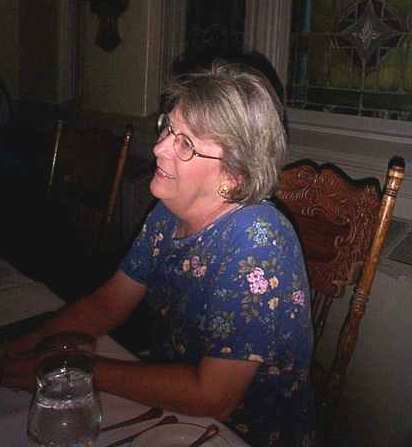
Rest in peace now Mildred Eden Crippen (1918-2012). All things considered, it was a good life.

Rest in peace now Mildred Eden Crippen (1918-2012). All things considered, it was a good life.

Japan 2/2012

0

For the Japanese Society of Intensive Care Medicine meeting end of Feb which was well attended. I am in the debt of friend and colleague Dr. Satoru Hashimoto.

High points of the trip:

*There is no substitute for Business Class. But there was actually a “first class” up front of the plane. Better food, better wine, bigger seats. Flight attendant told me it cost US$25,000 to Tokyo.

*The Bullet Train. 200 miles per hour and very first classy.Internet Access. Tokyo to Kyoto in less than four hours. Passes right by Mt. Fuji with a spectacular view. More expensive than the airlines.

*Really great shopping.Ornate lacquer boxes costumed dolls. Real swords that you can’t bring home will literally split hairs

*Huge cavernous markets with all kinds of food. Looks and smells exactly like the ones in Marrakesh, Istanbul and probably many other places.

*Kobe beef. Cows fed beer and massaged daily, like in a bovine singles bar. Consistency of butter. Said to be best only partially cooked, or as my Aussie friend likes it- still mooing and grazing on the side salad. They’ll remember me for a long time as I’m the only guy in the history of the restaurant that ordered mine medium-well. They had no idea what that meant. It was delicious.

If interested, check out my YouTube blurb (remember you can make the size bigger). Japan

In order of appearance:

·Huge cavernous train station in Kyoto situated in the middle of a huge shopping mall.

·The Ginza at night

·Cavernous market with tons of strange looking food (very aromatic)

·The real thing- fresh Fugu (requires special license to prepare as a meal.

·Shopping pleasures

·The large lacquer box is US$12,000

·Assorted temples

·Japanese traditional wedding ceremony. The bride’s head is covered to hide the horns (really)

·Portions of Hiroshima untouched from the atomic blast. Preserved as monument. Very touching.

·Looking over Kyoto

·Mt Fuji from the bullet train at 200 mph.

CLICK HERE FOR YOUTUBE VIDEO

CODES, Honky Tonks and History

0

A couple of days ago, Ken Mattox sent a post regarding the SCCM meeting in Houston in which he mentioned that the CODES were playing at a local “Honky Tonk”. That term instantly identified Ken as a Texas boy. J

Some history:

What most people think of as “Country Music” originally started out as “Country & Western” in origin.  The “Country” portion originated around Nashville and spread more or less straight South.  The “Western” component definitely originated in Texas and Oklahoma and has pretty much remained there. That genre is said by many to be the most listened-to music in the country.

Along a separate track, the “Blues”, a blending of gospel, church spirituals and black southerners’ perception of jazz, originated in Mississippi Delta area, specifically around Greenville, MS. The blues comprised an eclectic variety of music in the five note minor pentatonic chording, comprising fairly simple 12 bar rhythm featuring the “blue notes”: flattened 3rd and flattened 5th of the normal seven note major scale. These tones are instantly recognizable, conferring a mournful tone to the music.

The “Delta Fathers”, Robert Johnson, Mississippi John Hurt, Son House and Charlie Patton.  These guys had little or no electricity and so played acoustic guitars for little reason other than to keep time and provide background.  Their lyrics universally interpreted their tough life in the cotton fields. The Dobro guitar was invented with a resonator to increase the volume of sound in small clubs. Slide playing was popular and was accomplished with broken off pop bottle tops or pocketknife blades handy as impromptu protective weapons in dealing with plentiful rowdy drunks.

When jobs in the industrializing North opened up, black musicians migrated to Chicago and discovered electrified sound. The “Chicago Blues” was born; BB King, Muddy Waters, Buddy Guy and Howlin’ Wolf added piano, drums, bass to electrified guitars creating combos. Pittsburg, MS was named for the Pittsburgh, PA industrial heritage. BB King is considered by many to be the father of Chicago Blues, and is still playing today, albeit sitting down. At one point in his life, Eric Clapton refused to talk to anyone that couldn’t demonstrate an encyclopedic knowledge of American blues artists.

Shaped by then social issues, blues music followed certain inevitable paths throughout the South, The tributaries that feed the “Chitlin Circuit”, an entertainment venue safe for black musicians started in Louisiana, became manifest in Mississippi through Alabama and Georgia. The song “Tuxedo Junction” (Glenn Miller, 1939) was written about a stop in Birmingham, Alabama. The path swung up through the Eastern Seaboard as far New York City, including the famous “Cotton Club” and the Apollo Theater in Harlem. BB King’s album “Live at the Apollo” is said by many to be one of the best of the genre.

A large number of notable performers have trod the Chitlin Circuit over the years including Count Basie, Ray Charles, Duke Ellington, Ella Fitzgerald, The Jackson 5, Redd Foxx, Aretha Franklin, Jimi Hendrix (with Little Richard), Billie Holiday, John Lee Hooker, Lena Horne, Gladys Knight & the Pips, Wilson Pickett, Richard Pryor, Otis Redding, Smokey Robinson, Ike & Tina Turner, The Temptations, Muddy Waters, and Flip Wilson. It was considered a monster breeding ground for talent.

Many clubs in the Deep South were called “Juke Joints”; tiny shacks, dirt floor, a bar, small stage and a juke box.  Musicians followed the circuit night after night, playing for tips and sometimes drinks. When I was 15 years old, I ended up spending a couple of months in Beaumont, Texas with some of my parent’s friends. I got a job moving cases of pop bottles off and on trucks, and spent some time as an assistant to one of the supply trucks servicing area juke joints (and there were a lot of them) with soda drinks. It was a brutal 16-hour a day job and some of those joints were, shall we say, unique. I was not culturally prepared to understand the reality of the model.

Given that bit of musical evolution, the term “Honky Tonk” is a little out of the way of country and blues, but interesting nonetheless. It pretty much resisted evolutionary forces, remaining a staple of the Texas music scene.  The etymology of the term has always been unclear. One of the interpretations came from the sound of geese, which led an unsuspecting group of cowboys to the flock instead of to the juke joint they expected. “Honky Tonks” were rough establishments that sold ethanol-containing libations to patrons with a low threshold for fighting and mayhem. Prostitution was a common theme. They were rugged places that catered to rugged people.

A staple of Honky Tonk music was the upright piano, the ivories of which were tickled in every way from ragtime to Boogie-Woogie rhythms, later made famous by Jerry Lee Lewis. Singers lamented the frequently tragic themes of working-class life: lost love, adultery, loneliness, alcoholism, and self-pity. Icons of Honky Tonk music include Ernest Tubbs, Kitty Wells, George Jones and Webb Pierce. The twelve-bar blues instrumental “Honky Tonk” (1956) by the Bill Doggett Combo, with a saxophone lead and slow driving beat, morphed into an early “rock and roll” hit as that genre split from the blues and do-wop in the late 50s. A very interesting separate discussion.

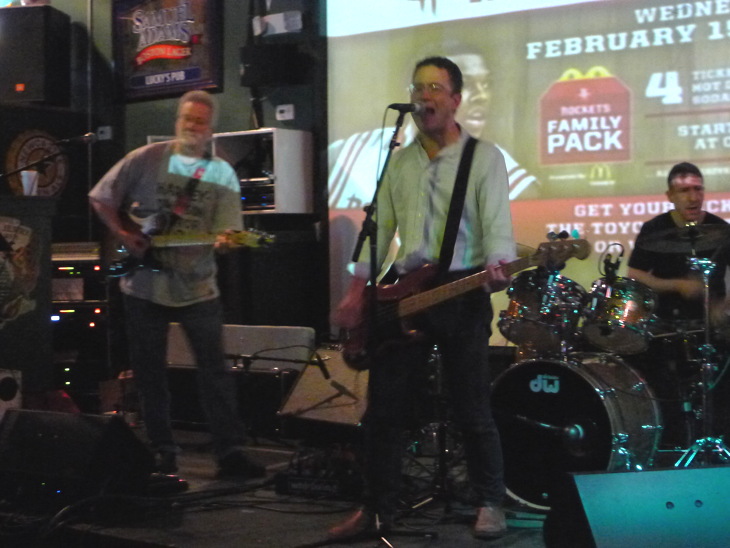
It was into this historical milieu that the CODES entered on Monday night, 2/6/12 to play a gig supported by SCCM.  I recognized the place immediately. A loud jukebox playing classic country-western songs loud. Shapely blond barmaids sporting ragged jeans and tank tops.  Longhaired guys with western hats and tattoos sitting around drinking alone. Lots of alcohol related posters on the walls (including the World’s Most Interesting Man”- Dos Equis Beer). A crowded, dusty stage for the band.

We were about as much a part of this scene as the Allman Brothers Band at a Yo Yo Ma concert.  I was pretty sure the CODES could get maybe halfway through one song before we were roughly ejected out onto the street for tainting the pure essence of local musical tastes.

But, life never ceases to surprise me.  After sound checks, we fine-tuned a couple of numbers and were greeted with some actual applause from the locals.  Go figure. By the time the evening was over (around midnight) the locals were boogying around the dance floor with the SCCM dignitaries and it was our typical rowdy bar scene the CODES are more or less famous for.

All things considered, it was a success and everyone seemed to have a great time.

Somewhere the Foo Fighters are smiling.

The CODES play The House of Blues in New Orleans (Again)

0

After Katrina, it was doubtful whether New Orleans could ever come back to its former glory. On the way from the airport, the cab driver pointed out watermarks from 2006 in residential areas that were higher than the roof of the cab. Now, six years later, convention and tourist business is thriving and the City with a Soul is back full steam.

I say City with a Soul to contrast NOLA with Las Vegas, a city with a counterfeit soul. A city built by and for gangsters; a city full of gangster chic and no place to sit in any hotel lobby unless there’s a slot machine in front of it. A city whose soul purpose is separating suckers from their cash.

New Orleans is a unique American social experience.  The area around Bourbon Street teems until the wee hours with every strata of society. A place where most of the social laws of God and Man are suspended for the purpose of conviviality.

Of course, the CODES brought down the house at the NOLA House Of blues. This was our third gig there. Total head count was 510 and they had trouble keeping up with the demand for ethanol. The audience was still going strong when we were pulled off the stage at midnight after a three hour set.

Following evening on the town, we soaked up the culture. Mimes in the middle of the street stop their act to compliment my T-Shirt. (The Dude Abides!), Live girls swing out over the sidewalk on trapezes from Bordeaus. Proper ladies in heels give high fives to biker guys. Perfect strangers greet each other with hugs like long lost relatives to a cacophony of music emitting from virtually every doorway. In the words of Paul Simon; “An atmosphere of freaky holiday”.

One street over (Royal Ave) is full of art and original mementos, including much of what you might see on “Pawn Stars”.  An autograph shop with signatures from just about everyone who’s anyone (some very expensive) from Marilyn Monroe to every President of the United States. A poster from the Godfather signed by the major cast that includes a real circa 1032) Thompson Submachine gun in the frame.

Bourbon Street is a bit like Paris. Virtually any eatery a passerby might bumble into has great good. Every other bar on either side of the street has live music of virtually any variety. Straight up jazz, Dixieland, hard rock, blues all preformed masterfully.

We bumbled from bar to bar sampling the rich texture of music (enhanced by continuous cups of “Hurricanes”). Ultimately, we ended up in a bar with an incredible set of blues musicians so far outta sight musically we were stunned. The place was packed like sardines and running about 80 decibels. I journeyed up to the bar to get (another) set of Hurricanes, and the barmaid gave me a pick on the cheek. We were all friends by implication of the situation. We were there.

The band was incredible. I managed to get just a hint of it with my iPhone before getting reminded of the no photos/video policies that all have in place.  The lead singer/guitarist mentioned between songs something about football and Tebow and that he and his wife were graduates of LSU and, of course, were Saints fans.

That means that this guy playing for us in the middle of the night has a day job. But you could see in his face and his music that his undying passion was being exactly where he was, and the loves of his life were Jimi Hendrix, Stevie Ray Vaughn and ZZ Top. He was immersed and saturated and through him we were all one. There were people dancing in the aisles and the humanity was at least for the time at peace with the innocence of the universe.

It was an experience I do not believe anyone on this list should ever miss.

I give Bourbon Street at midnight 4 of 5 gas lamps.  Must do.

Feline issues

0

A couple of years ago, my youngest daughter the tree hugging vegetarian, decided she wanted a cat. Not just any cat, a cat that had been rejected by all others. So she and my wife made a trip down to the pound to check out reject cats, presumably awaiting a fatal demise.

So she perused all the available cats, and settled on a black/white tabby caged with it’s sibling. Unusual. They were brother and sister, ensconced in the same cage as the keepers had discovered they basically refused to be parted. So when it came to pulling one of them out of the cage, they both entangled themselves with each other, wrapped themselves around each other and simply refused to be separated. It was incredible. Finally, after much yowlling and hissing, the keeper finally said it didn’t look like they were going to separate them, so they would need to be taken as a two-cat unit or not at all.  So, she took both of them. Then after about a month, she developed a new roommate with a cat, and the cats didn’t get along so in the interests of maintaining the kid’s domicile, we inherited the two cats, both appropriately neutered and spayed.

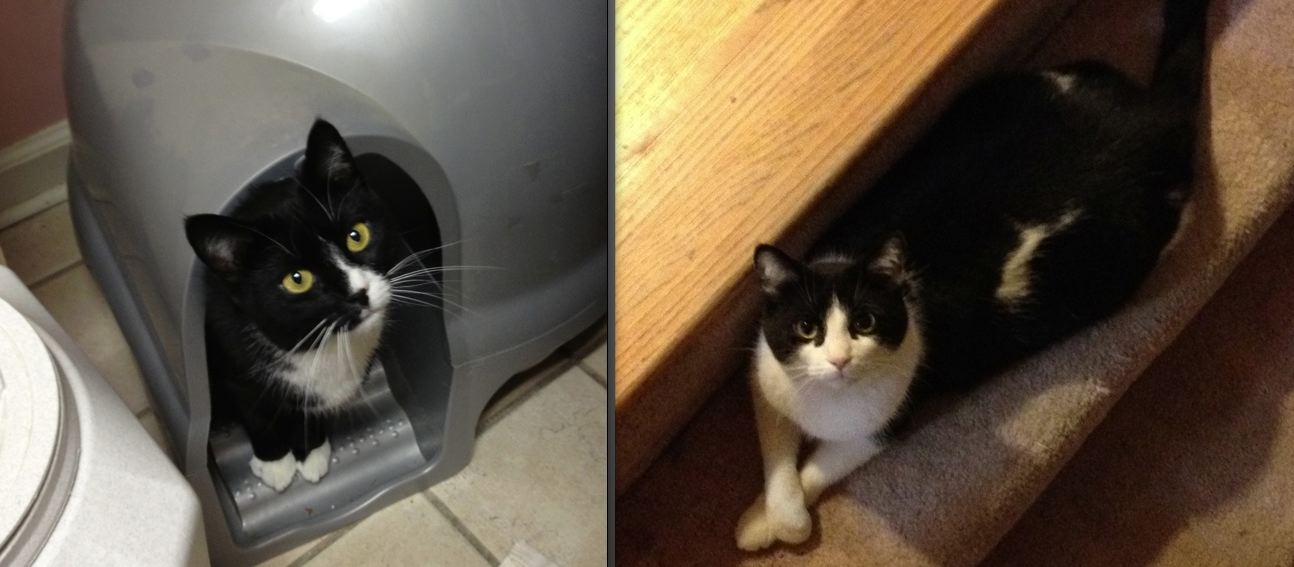
These are two VERY strange cats. The male is proportional white face on both sides and mottled black body (Kitty1). He acts just like a male lion in the wild. He lays around all day, sleeps and eats. He frequently sits on his front paws and surveys his world dispassionately. You rarely see him. The female, half white face (Kitty2), is like a lioness in the wild. She struts around all over the house looking for anything to get into. No one can do anything without her there gawking. Sitting on laptop keys a specialty. She’s everywhere and a big pain in the ass.

When it comes to feeding time, she always eats first; he waits his turn. When she’s eaten exactly half of the ration, she exits licking her chops and he finishes. Sleeping arrangements- the male sleeps on my wife’s side of the bed I’m not on, about six inches from her. Evry night. The dog (standard Poodle) sleeps at the foot of the bed on my wife’s side and every night reliably chases the female off. I have no idea where she sleeps. He never bothers the male.

When I get up in the morning about 0700 hours to go to work, I plop down on the John and the male cat reliably follows me in there, plops down on his back, exposes his underside and looks as if to say “It’s not gonna scratch itself!”. He accepts some belly scratching and that’s it. Never gives me the time of day again until the next morning. The female has no interest in petting at all and will run off every time I try.

Neurocritical Care Society Symposium, Montreal, CA. 9/21-24/2011.

0

Neurocritical Care Society Symposium, Montreal, CA.  9/21-24/2011.

Montreal was easier to get into than I thought it would be (judging from past experiences getting and out of Canada).  Minimal hassle, but did require my passport.  Absolutely full of French as a first language, but most are happy to switch to English very easily. However, I don’t translate heavily inflected French accents well. Sounds to me like they’re either gargling or choking.

The French have an established reputation of being obnoxious to Americans. I didn’t see any of that, probably because they have figured out they are a service industry and they have to at least pay lip service to customer satisfaction. However, some of the hotel interfaces when faced with “irregularities” tended to be what I would call “short”. Almost like they were trying hard to be accommodating but they didn’t really feel that much accommodating off camera.

The hotel said they offered “WiFi”, but like many other hotels that doesn’t mean in the rooms. It means in the bars where while you’re there, you might like to have a drink or snack. They never miss the smallest chance to extract money from tourists or conventioneers.

The hotel was nice but nothing out of the ordinary for a major city. Usual price- expensive. Food was good but not as good as that in Paris I don’t think. Hotel food always tastes the same. Prices for everything was the International-usual, jacked up anywhere from 50% to 100% over what might be considered reasonable in a non-touristy city elsewhere.

The big draw I think was that most of the “old” section of the city was within walking distance from the hotel, so that’s what I did.  Most of the city I saw was clean and seemingly prosperous. The huge church was incredible. Said to be where Celine Dion got married. There were more street beggars and panhandlers than I see in most American cities I think, excluding San Francisco, which leads the list in that regard.  I think the Canadians have much more of a sense of “Country” than most Americans who have degenerated to much more of a sense of  “Political Affiliation”. I could see myself living here.

Here’s the photos I took, easiest to make a movie of it.

http://www.youtube.com/watch?v=5PcCw0srdRw

I like the architecture, old and new.  Lots of motorcycle parking on the street as you can see. Also bicycles for rent.  You put coins in, ride the bicycle somewhere and drop it off when done at another site around the city.

CODES played in an enormous ballroom with all the amenities and all went well. Didn’t get any photos. Maybe some will be forthcoming. Next gig for the CODES is in Cleveland Oct 21, followed by New Orleans I think first few days in Feb and I’m told we may possibly have the House of Blues there again which is a nice venue. Then the big one……Houston for SCCM.

I go to a wedding

0

I haven’t been to a wedding in many years. The last one in the mid-90s, followed five years later by a funeral after one of the couple committed suicide. I’ve never attended a big splashy $50,000 extravaganza expertly choreographed by a lot of consultants and vendors with a strong incentive to provide goods and services a modern couple cannot live without on the most important day of their lives. In my age group, most are austere second and third marriages, focusing on the legal benefits of such a union.  It’s been said that second marriages are the triumph of hope over experience.

This happened to be a young Jewish couple, neither of whom I knew but I was very good friends with their father. They each had careers and their decisions regarding matrimony seemed well thought out.

I don’t know if a Jewish ceremony is much if any different than any other. This wedding was very informal and low key. The couple emerged into the limelight with no fanfare, she in what looked like a white evening dress, he in an open collar dark sport jacket. There was then what must best described as a master of ceremonies. A Jewish guy about their ages who seemed to be a friend more than an official, but he must have some kind of credentials as he actually pronounced them. There was some Jewish symbolism in it but not very much. There were a lot of people there, at least 300, and none of them knew me so I just people-watched.

The master of ceremonies’ job was to infect the crowd with the enthusiasm of the couple, a job he did well. Very light-hearted jokes and anecdotes, relaxed and informal with lots of good cheer all around. The memorable symbolism was them each lighting a single candle from two other shorter ones, then snuffing out the lights from the individual candles. Ouch. Very nice touch. The couple was very much into each other and were clearly very nice people expressing their full lives and future with their friends and family.

As an aside, I happened to be standing by a couple about my age and I couldn’t help but overhear their brief conversation. The woman, as they all are, was very enthusiastic about the ceremony, clapping, cooing and ohh-ah-ing.  The male portion of the combo was very clearly not as impressed and was near rolling his eyes.  Finally she poked him and told him to start getting with the program, to which he muttered “They all look this way now. We’ll see how this looks in ten years”.  She poked him again and told him to keep his opinions to himself.

This scenario brings up an interesting issue, that of the “life snapshot”.  I have always thought that marriage is a snapshot of the hopes, dreams and aspirations of a couple at the instant of their bonding, fueled by genetic imprinting (inevitability of marriage) and hopping hormones. But that snapshot moves on in time to divergent snapshots and the ability of the bonded couple to evolve with it is wholly unpredictable. Smiling, gregarious, infectious couples sharing glee at day one have about a 50-50 shot at turning into Jon & Kate plus Hate, suing each other, creating accusations of anything that will affect child custody, moving out of State to avoid legal issues and killing each other.

I suspect that “falling in love” (a term created and only fully understood by females) is merely a genetically imprinted imperative designed to get people who would ordinarily kill each other on site together for the purposes of procreation.  Finding the “right” person is sort of like a focus screen template in a reflex camera. Photo readiness is evident when all the lights flash in unison.  People consciously or subliminally screen everyone that comes into view.  Most of the time only a portion of the lights flash. On the occasion that all the lights flash in unison, that’s “the one”. At least “the one de jour”. For males it is heavily invested in female body habitus. For females, I suspect many subliminal characteristics of their fathers.

Regretfully, that process is meant only to identify prospects with the most chance of yielding healthy babies, not necessarily be the most compatible for long term living arrangements.  Once the hormones wear off and the lights go out, there is no provision in the template for longevity, which is left to dumb luck. This probably explains the (for want of a better term) amorous antics of contemporary politicians, reflective of the rest of the population, only more visible in the media.

At any rate, I am hoping for the best for this couple, clearly into each other. Time of their lives. The dark, murky unknown nowhere to be seen today, but lurking. May they luck out.


Requiem: Donna Jean Crippen (1947-2008)

0

She was born precipitously in September of 1947. My dad was a surgical intern at what was then Cleveland City Hospital and we lived in “married student housing” about two blocks from the hospital. I was about four years old and this era is among my earliest forming memories. I vaguely recall the apartment as being bare and austere.  My father, or course was never there. Worked 36 hours on and 12 hours off as a surgical intern. (I did too at Bellevue in 1976-77)  He was paid $100.00 a month plus his food at the hospital and the apartment.  One night my pregnant mother started hemorrhaging per vagina and quickly passed out.  My father said it looked like an open fawcet.  She went into shock immediately and, owning no car, he fireman carried her over his shoulder two blocks to the hospital where they emergently opened her and took the baby. It is only a vague memory. The only reason either her or the baby (Donna) survived was simply because it happened on a night my father happened to be home.

Subsequently, my sister was what you would call “sickly”. Caught every bug that came around. Skinny and looked malnourished. But she had lots of friends in school and managed the social scene reasonably well. She fell in love with her then high school sweetheart and they both proclaimed each other as the loves of their lives. He accidentally drowned in a lake swimming incident in his senior year in six feet of water. Donna never recovered from this and I don’t believe ever again had a love of her life. (Her subsequent marriage in the 80s was an unmitigated disaster.)

She decided to go to nursing school and did so at a “three year” diploma school at the Medical Center of Central Georgia, where she spent the rest of her life and career. In her final year of nursing school she came down with a mysterious metabolic disease creating a hugely enlarged liver and no clear explanation. She had to be helped to the podium to graduate from nursing school. She came very close to death, I’m told. I was in Vietnam. Then for some reason someone put her on an ultra-low fat diet and she got better, but was never near “normal”..

She worked in the first aid tent of the largest rock concert in the country, the Atlanta International Pop Festival in 1970. 600,000 kids headlined by the Allman BrothersShe worked as a scrub nurse at MCCG in Macon, GA and was in the hospital the nights they brought both Duane Allman and Berry Oakley in near death from motorcycle accidents in Macon, a year apart and a block away from each other. She married probably for convenience to an affable but irresponsible guy with a drinking problem, a union that produced one child born premature at 28 weeks and multiple complications including a neonatal subarachnoid hemorrhage and resultant behavioral disasters..

Divorce followed and she essentially spent the rest of her life running interference for this learning disabled child. She was one of the founders of a school for learning disabled children in Macon, and her daughter graduated from there. At some point, inevitably, the daughter entered the parental rebellion phase and got pregnant by one of the other learning disabled students, and they eventually married. He was unable to find work due to a severe reading disability and Donna essentially supported them for years until he was able to get into a school to learn truck driving and got a good job as a local truck driver. They vanished shortly thereafter nd I don’t have any idea where they are today.

Ultimately Donna became weaker and started having trouble walking up stairs. She was again evaluated and a muscle biopsy finally yielded the diagnosis. Limb-girdle-muscular dystrophy, a chronic, debilitating disorder that can occur in females. She then worked as a hospice nurse and a phone referral nurse for doctors, filtering calls from patients calling at night. She was able to work with a minimum of walking. Ultimately the day came when she could no longer get around and was confined to a wheelchair. At this point she applied for disability, and after the usual hoop jumping and bureaucratic hassles designed to limit the number of applicants by inconvenience, she was granted some monthly income from the State.

Then it became clear that disability would not cover her real expenses. I helped her along, as I was able, not clearly understanding the situation at the time. Unbeknownst to me, she lost her car and her house. She was a victim of the utterly contemptible situation in this country where those that have get more and those that don’t do without. On 2/15/08 she complained of a flu bug and told her daughter she was going to take a nap. The daughter went to the store to grocery shop. On her return Donna was found dead in bed. She had been dead several hours and there was no sign of a struggle. She simply went to sleep permanently. I sometimes entertain the notion that she helped this process along at the end, but that will never be proven. I continue to harbor the suspicion that she ended her life by an intentional overdose of pills she had access to, but it will never be proven.

All things considered, I think it was a blessing for her to go to sleep peacefully and not wake up.   The alternative was progressive debilitation and penury. She didn’t ask me for any resources because she probably knew it would only prolong the inevitable. I should have suspected more than I did and been more aggressive in ferreting out what was going on. I might have been able to do something. I will not forgive myself for that selfish lapse.  We were never a terribly “close” family. We were all pretty independent, and that independence manifested itself as not needing family anymore once we struck out on our own. We were always cordial, but we didn’t seek each other out unless we particularly needed to. We saw each other if it was convenient. Otherwise, we didn’t think about each other much. That’s just the way it was and we all accepted it.

And I am sorry for that. Too often, families manipulate each other in thinly veiled power struggles to insure their independence is known, or their anger at another member is expressed in ways that hurt the most.  These manipulations assume an eventual amicable resolution. “I’ll show you, I’ll ignore you, then you’ll pay, and after you pay enough we’ll be OK again”. Then comes the sudden, unexpected finality of death.  Then there is never a way to make any of it right. It’s instantly left hanging at that instant, it can never, ever be resolved by any other manner. There are no “goodbyes”. No “I’m sorrys”. No “I really loved you through it all”. Just a remaining lifetime wishing it had been time to make it different. I cannot tell you the agony I have seen with sons and daughters weeping hysterically at the bedside of a suddenly dead parent because of unresolved issues. I wish I had more time to change the course of this sad situation.

Donna Jean Crippen (1947 – 2008)

Kiev, Ukraine and some travel tips

0

Kiev is the largest city in the Ukraine, a major industrial, scientific, educational and cultural center of Eastern Europe, population probably about three million. The city is thought to have been founded in the 5th century as a trading post for the the early Slavs. Kiev was completely destroyed during the Mongol invasion in 1240, and (obviously) subsequently rebuilt.  The Ukrainian National Republic declared independence from the Russian Empire in 1917, Kiev became its capital.

Following a turbulent process from 1918 to 1921, the city became a part of the Ukrainian Soviet Socialist Republic, a founding republic of the Soviet Union. The Soviet Industrialization that started near the end of the 1920s turned the city into a major industrial, technological and scientific center  Joseph Stalin’s Great Purge of 1937–1938 almost eliminated the city’s intelligentsia.  During World War II, Kiev was occupied by Nazi Germany from 1941 to 1943. During that period, a team of sequestered Russian officers dynamited most of the buildings on the Khreshchatyk, the main street of the city, buildings that were being used by German military.  25,000 people were left homeless. In retaliation the Germans rounded up all the local Jews they could find and massacred them at Babi Yar. Kiev quickly recovered in the post-war years, remaining the third largest city of the Soviet Union. Following the collapse of the Soviet Union and the Ukrainian independence of 1991, Kiev remained the capital of Ukraine.

Kiev (and for that matter Moscow) have changed greatly following the social revolution.  The drab, cramped landscape of the 80s evolved to Western-style residential complexes, modern night clubs, restaurants and comfortable hotels. We saw beautiful, spacious and VERY expensive residential areas in the ‘Burbs just like in American cities. Music from Europe and North America appears on Ukrainian radio stations. The relaxed visa rules facilitate Kiev as a prime tourist attraction. The airport is modern and efficient. Buildings have been restored, especially Khreshchatyk street in Independence Square. Many historic areas, such as Andriyivskyy Descent, have become popular street vendor locations, where one can find traditional Ukrainian art, books, and jewelry for sale.  As a youth, my friend and former colleague, the late Sergei Ermakov, lived in Dnepropetrovsk, a day’s drive to the south. This entire area was closed to foreign visitors until after the collapse of the Soviet Union in 1991. Someday I’ll go back there.

Enjoy the photos of this beautiful place. I home some of you someday get to travel there.

Travel tips:

1.  If you’re going any distance by air, especially if it involves overnight, scrimp and save as long as it takes to scrounge up the funds for Business Class. Travel by air is your worst nightmare in the best of situations, but having to sit in a seat the backrest of which reclines two inches with your knees up against your chest is simply torture. Squeezed into an airport gate area is extremely uncomfortable. In Business Class, you sit in a comfortable lounge with food and booze, you’re first on the plane, first off, you get good meals and a full entertainment system, the seat turns into a bed and you arrive ready to start your day instead of exhausted. This is a VERY big issue, trust me on this.

2.  Try to get away with taking only carry-on luggage instead of checking bags. I took ONE roller with my clothes in a plastic bag suctioned down to a smaller volume.  Take throw away underwear and clothing to make room for whatever you might want to bring back. OK so you wear one pair of pants for four or five days. Not a big deal. Then an unobtrusive backpack in which I only carried iPhone, iPad, Laptop, and camera. I had NO problem living in Europe and the Ukraine for 8 days. I missed out on all that waiting for luggage and the potential for the airline to lose it, which they still do.  Air France lost Darwin’s suitcase in Paris and as far as I know he still doesn’t have it. Seems pretty hard to lose luggage using bar-codes and in a country whose President convinced Carla Bruni to marry him, but it happens.

One caveat:  If your aircraft in the USA is an MD 88, it’s likely your roller won’t fit in the overhead. I ended up with mine in the closet bin. Also, the foreign airlines are getting tighter and tighter about rollers. It’s only a matter of time before they ban them, I think.

3.  If you are going overnight, to arrive in the AM of your destination (most trans-Atlantic flights) get someone to write you an Rx (or write it yourself) for “Sonata” (Zaleplon10 mg).  It’s a short half-life sleeper (four hours) that works like a charm to get you a few hours sleep with no hangover. Safe and effective. I highly recommend it. If you get short of breath at high altitude atmospheric conditions in most flights, start diamox (acetazolamide) 250 mg the morning of departure, again at noon and again at supper.

4.  Forget about getting any “free” Internet service anymore. Pretty much all the airports and hotels are stiffing you for the max with a cute twist. Several airports (including the business class lounge) advertise “free” service, and when you get in, you find out the only sites you can access are some that no one would ever access in their entire lifetime. Oh…you want to actually get into a useful site?  Well……that’s “available”.

5.  Anyplace in the UK is now so incredibly expensive by the time you find out the conversion factor, it’ll stop your clock.  Much more expensive than New York City now. And much more nickle and diming. You pay for something and find out you aren’t getting “complete” service, you pay more for add-ons you can’t do without. Wireless in Manchester in the interim airport hotel was 19 pounds for 24 hours. Dinner for one with a glass of wine, soup and an entree was 40 pounds.

6.  Security is getting more and more obtrusive.  Because of the Bin Laden thing they were particularly nasty almost everywhere.  Anything resembling electronics out of bags, lots of random searches, demands to see passports every 100 feet of excursion. Endless stupid questions: “Did you REALLY pack this bag yourself???” “Noooooo some guy with a long beard and an AK-47 over his shoulder packed it for me”. Get over it. It’s simply a fact of life now and there isn’t anything you can do about it. Arguing and complaining will just get you searched more thoroughly. If you look remotely Indian or Arabic, you can probably count on “random enhanced scrutiny”.

7.  If you’re a biker, I’ve figured out how to do it. Travel in packs like the Brits do it. I saw several packs I knew from experience had to be Brits. Completely leather bound, all riding Japanese bikes, Suzukis and Kawasakis. Five or six in a pack, all equipped with GPS, all with an itinerary and traveling tight for safety. Not safe to be a singleton in these places.

8.  Double and triple backup all photographs. These shots may be irreplaceable. Having them accidentally wiped off your camera disc is easier than you think.

In the immortal words of Diamond Dave Lee Roth:  “Happy trails to yooooo”