When I was a resident in about 1980 or so, someone from a production company landed in the ED at Methodist Hospital in Indy and I ended up involved somehow. A bunch of their wonks showed up and I ended up getting involved with them explaining the case. Turns out they were part of Detroit rocker Bob Seger’s road show “Bob Seger and the Silver Bullet Band”. So one of them gave me 2 tickets to the show and a backstage pass. Also gave me a T-Shirt from the British metal group “Iron Maiden” as they were involved with that road show as well.
That was back in the days when I wore a medium T-Shirt and that particular shirt has been long since lost. I should have kept it as EBAY is selling authentic vintage 70s “Iron Maiden” T-Shirts (featuring “Eddie”) for US$1500 (but that includes free shipping).
Iron Maiden been around 33 years now, still playing, over 80 million album sales, more than 2000 live performances and 15 studio albums. Original bass player Steve Harris is still with the band.
Iron Maiden has also played the T-Shirt niche like a Stradivarius. THere are a thousand variations of Iron Maiden T-Shirts and they still sell briskly. Serious collectors snap them up like hotcakes.
Recently one turned up in a box of my junk. It’s a little small but it still pretty much fits. I think I purchased it in London sometime in the 80s. It doesn’t have the outrageous value of the 70’s versions but it’s pretty much the same ilk. I wore it for a CODES gig a while back.
Take Home message: Save those Allman Bros T-Shirts. Who knows in 20 years?
A more or less docu-dramatic reenactment of the daring rescue of Captain Richard Phillips from Somali pirates in 2009. An intricate and precisely modulated thriller that’s…..(pause for effect, Pawn Stars style….AUTHENTIC! (Smiles all around).
The film is extremely well done on every level. Hanks channels Daniel Day-Lewis in an intense and convincing performance. Newcomer Barkhad Abdi, said to have been recruited from a large Somali population in of all places Minnesota, is brutally magnificent. He has no acting experience, picked out of 700 applicants from a cold casting call, but he masters the role of the antagonist in a masterful fashion.
The film takes pains to show the Somali’s incentive for piracy without excusing it. Abdi’s native astuteness counters all the defense mechanisms of the ship’s captain. He is at once terrifying but heartachingly human. This is a truly masterful performance from his heart, not theatrical training.
THe real white knuckle portion of the trip begins with the arrival of the seal team, heeded by cold blooded team leader Max Martini, who icily demands “Gentlemen, I need three green screens”, following which an incredible rescue takes place that could never have been dreamed up. Well done, Gentlemen.
Parenthetically, it seems that the speed and complexity of society have bred equally complex dangers to us and we are very effectively training a class of super warriors capable of rescuing us from increasingly composite dangers. Viz: “Zero Dark Thirty” (2013).
Best features: Clearly Barkhad Abdi. He upstaged Tom Hanks at every scene. Seal team leader Max Martini. The ultimate fixer, ice water running through is veins while toying with the pirates. You can’t take your eyes off him.
Not so best features: Jiggly, extreme closeups don’t work well, tend to cause viewer vertigo.
I give it 4.5 of 5 wild eyed AK-47 wielding pirates. Must see.
Heavily hyped space opera starring bankable actors doesn’t disappoint on a visual level, but I remain not terribly impressed with the thin story line and predictable plot.
Heavy pre-debut media machinations such as: “life-altering,” “stunning,” “A great leap forward in film making” need to be taken with a liberal dose of perspective. There’s nothing in “Gravity”, (the sacrifice of one to save the other, hypoxic hallucinations generating sudden revelations to survive rising from the ashes of despair), that hasn’t been done endlessly before.
Yes, the visual effects are really world class, but in the end this film chronicles two people floating in space for an hour and a half set in very visual and loud amusement park destruction derby. There’s only so much actors can do with that before getting pretty predictably embellished. Sandra Bullock stripping down to her skivvies as a tribute to Sigourney Weaver in “Alien” (1979).
Aside from the visual effects, the film undercuts the human element by using Sandra bullock as a “woman-in-distress” as a set-up for the next pyrotechnic blowout accompanied by a mercilessly loud sound track. If you’re left speechless is more likely because of sensory overload than interacting with the actors.
All that said, “Gravity” masterfully overwhelms the senses. The suspense is on a par with but not as consistent and pervasive as “Aliens” (1986). It cannot be compared to “2001: A Space Odyssey (1968) filmed 45 years earlier.
Best scenes: The beauty of the earth from 600 kilometers above.
Not-so-best part: The side story of Ryan Stone’s child- goes nowhere.
Cameo: Ed Harris as the voice of Houston.
I give this 3.5 of 5 damnations by faint praise. Definitely must be seen on IMAX/3D. Don’t wait for it to come on TV.
Vietnamese General Vo Nguyen Giap died today. He was estimated to be 102 years old. Not a commonly known name, he is a very remarkable person.
General Giap’s career began in 1944 commanding a ragtag band of 34 Vietnamese citizen soldiers in December 1944 vowing to fight to the death for a Vietnam independent of foreign rule. Their original armament is said to have included flintlock rifles. Gen. Giap molded this force into what was to become Vietnam People’s Army, an underrated force that would defeat the French and American armies over thirty years of warfare, ending in 1975.
General Giap routinely led his troops into battle against better equipped, better supplied forces. His military strategy and tactics dealt the French colonial army under General Henri Navarre a humiliating defeat in 1954 after a 55 day battle at Dien Bien Phu. I have studied that battle at length and stood at the site pondering it in 2010. It’s one of the most fascinating stories in history and can best (and only) e appreciated by reading Bernard Fall’s “Hell in a very small place” (1967). The epic analysis from the undisputed master.
Giap went on to command other historically significant battles including the iDrang Valley offensive (1965), Tết Offensive (1968); the Easter Offensive (1972); and the final Hồ Chí Minh Campaign (1975) that eventually ended American occupation of Vietnam.
Of particular interest was the Vietnamese offensive at iDrang in November of 1965. A turning point in the American war; the battle that convinced Ho Chi Minh he could win and convinced Lyndon Johnson (or his advisors) that more troops were necessary to hold on.
The battle and it’s aftermath was expertly and lyrically recounted by then Lt. Col, (now General, ret) Hal Moore in “We were soldiers once, and young” (1992). Gen Moore wrote a second volume recounting his followup visit in 2010 in which he interviewed General Giap. “We are soldiers still”, both highly recommended general education reading.
General Giap is considered to be one of the most brilliant military strategists of all time, comfortably sitting at the same table as Napoleon Bonaparte, Stonewall Jackson and Erwin Rommel.
“But we still fought because, for Vietnam, nothing is more precious than independence and freedom,” he said, repeating a famous quote by Ho Chi Minh.
Winning in Formula One for the World Championship of Drivers from two extremes of skill.
In 1976, one end of the spectrum contained British driver James Hunt, a fashionably longhaired blond darling of the media and not a few females. Hunt had no concept of fear. He won races by blundering around the track at speeds unapproachable by mere racing mortals, surviving by natural talent and dumb luck.
On the other side of the spectrum was the Teutonic technocrat of the track, Austrian Nikki Lauda, who won races by figuring out the track dynamics as a quadratic equation. Nikki won by superhuman consistency around the geometrically determined shortest point between numerous lines. One could place a toothpick lengthwise on the fast line of a corner and Lauda would put the outside of a tire on it every lap for an entire race.
The new Ron Howard film “Rush” brilliantly explores the area in between these extremes, the clash of these personalities. Possibly the greatest dual in the history of Formula 1, decided in the final minutes of the final race, by one point.
It also must be remembered that in 1976, drivers actually piloted and controlled the cars, unlike the new F1 cars that run by multiple computers manipulated by the chauffeur once removed. As it turns out, the computers are quite capable of speeds beyond the capability of even immortals to control as the best F1 driver in the world, Aryton Senna, sadly found out in 1994 at Imola. (“Senna”: 2010).
The human stories between these two mostly exhibit how polar human extremes relate to each other. Howard masterfully explores them and the actors flesh out their roles to perfection, especially Daniel Bruhl, whose performance is nothing short of brilliant. The cinematography is amazing, much more textured than was previously done in “Grand Prix” (James Garner: 1966) and “Le Mans” (Steve McQueen: 1971). Unclear how Howard pulled this off with a limited budget, but he definitely gets it done.
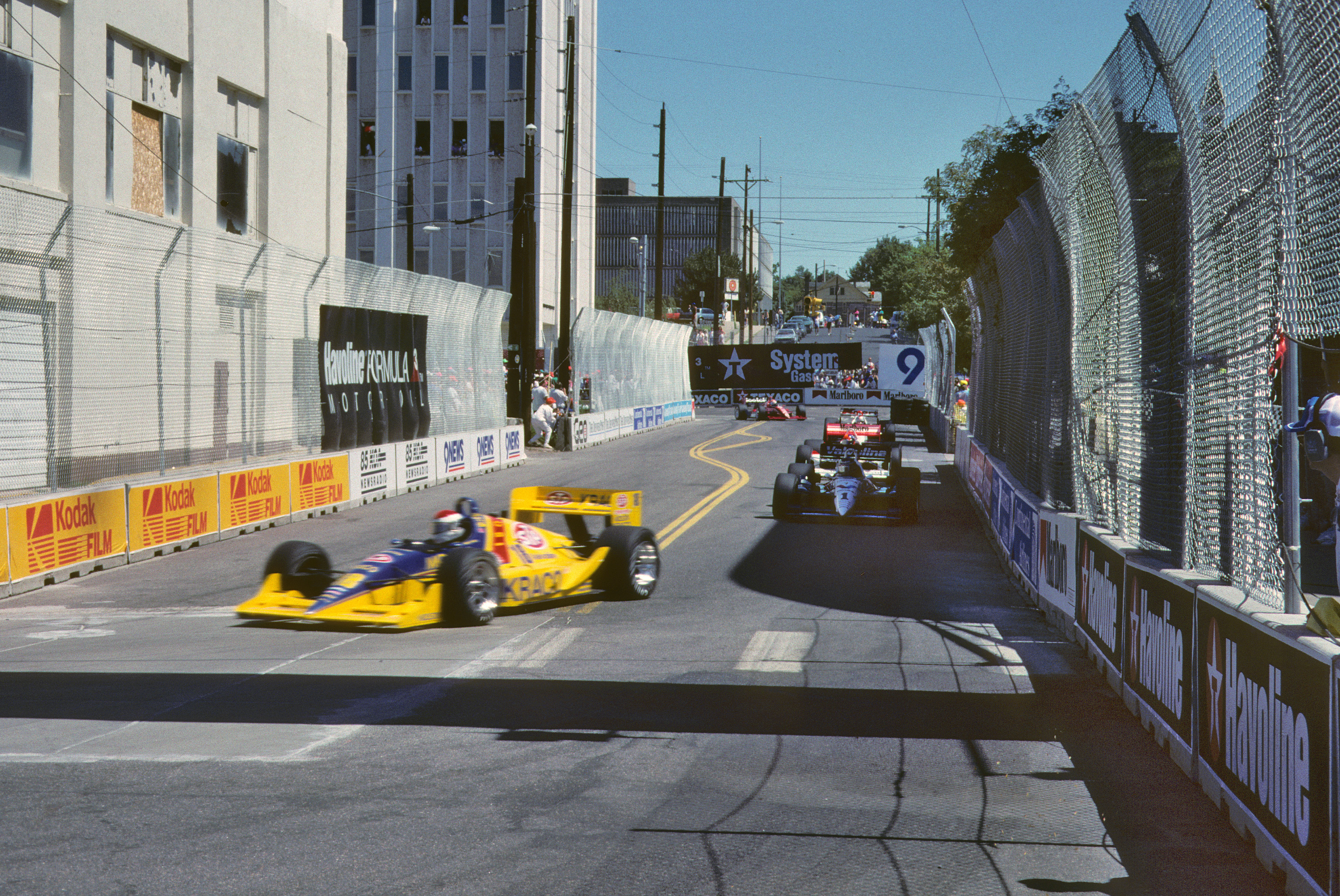
Disclaimer: I was the Assistant Medical Director of Championship Auto Racing Teams (Indy Cars) from 1980 through 1995, and I was present in the pits and around the track at several Formula One races here in the USA, Watkins Glen in 1980 and the Detroit street race around the Renaissance Center in ‘82. The F1 Medical Director at that time was Professor Sidney Watkins, a neurosurgeon in London and I knew him on the track, talked to him at length about F1 racing. I also spoke several times to Nikki Lauda but James Hunt died unexpectedly of cardiac arrest before my time and I never saw him. Burned out rather than faded away. Somewhere Neil Young was smiling.
Nikki Lauda was a consultant for this film and blessed it.
History not mentioned:
* Nikki crashed at Bergwerk, the the Nürburgring’s north loop, perhaps the most dangerous corner of the most dangerous track in the world, and its left-hand kink is now referred to as the Lauda Links.
* Clay Regazzoni was severely injured at the Grand Prix of the United States at Long Beach in 1980 and was paralyzed from the waist down, ending his F1 career.
Best quip: “James is a good driver but an immortal ****” (Clay Regazzoni)
Hunt’s will stipulated that £5,000 be set aside so that his friends could give him a proper send-off. Loved ones received invitations that read, “It is James’ wish that you get pissed.”
For my money, the Formula One circus is one of the most exciting and colorful sporting events in the world. The skill and intensity required to compete at nineteen international circuits, rain or shine is unimaginable. I was lucky and proud to have been a tiny part of it at some point in my life. The saga of Hunt and Lauda is an accurate representative sample. This is brilliant film making. Go see it and feel the rush.
A little slow in the first half but catches up quickly. I give it four and a half of five 18,000 RPM wails. (Must See)
Five season, Golden Globe award winning drama about the workings of a motorcycle gang in California. Working class stiffs with incredibly tight bonds with each other as members of “the Club” and as an ancillary issue, with their women. In the words of Gemma Teller-Morrow: “You love the man, you learn to love “the Club”. Motorcycles serve not so much as the transportation but as the vehicle that explores the limits of fealty and loyalty.
Their roots are much like the original Hells Angels MC whose earliest members came back from Korea bored with civilian life and found a common bond in motorcycling. Looking for “adventure” eventually taking the form of illegal activities bringing tension relieved as intense group bonding. The Sons of Anarchy are similar, wearing “colors” (identifying leather jackets) loudly advertising their bond, scruffiness and attitude. The ultimate expression of male bonding.
They all work in an auto repair shop which hides their money making enterprise; running guns to anyone who’ll purchase them, including those they know will use them for mayhem. However, they draw moral line at drugs and abusing otherwise innocent women, endeavors they consider anathema for their town. They work with the town lawmen to keep these entities at bay, and the police look the other way as it pertains to guns.
These guys then get into incredibly complex adventures with various levels of the law and each other. They emerge as classic anti-heros in the Marlon Brando-Lee Marvin mold from “The Wild One” (1953). Alternately mean and self-serving then loving and caring for others in various capacities. Sonny Barger, the original Hell’s Angel President and Maximum Leader is a perfect role model for Clay Morrow.
Hunter Thompson described the Angels to perfection in his 1966 book “Hell’s Angels: A Strange and Terrible Saga”.
“They were a bunch of overgrown adolescents, stuck in their religious mind-set as a way of life. They defined themselves by their opposition to any and everything. The strength of their antagonism was the source of their faith, and like all holy wars, their greatest enemies and their greatest source of bloodshed was from within, battles against rival factions competing for bottom of the barrel status”
Murder and mayhem come easy for them if it’s in the best interest of “The Club”. Revenge and retribution are their stock in trade. The viewer finds him or herself liking and even grudgingly respecting them despite their shortcomings if for no other reason than they’re such an interesting side of an alternative life. The characters come alive in a hierarchy of texture and subtlety.
The creator and maestro of the Sons is Curt Sutter, who plays off-the-wall lunatic biker “Big Otto”. Shutter was completely nuts before and is now over the cliff completely in episode 1 of Season 6 but he has an uncanny ability to create. Sutter is a totally fearless writer, everything is fair game. He’s outdone himself this episode, with promises of more to come.
The boys have decided to quit their previous avocation of running guns as it turns out to be too dangerous. So their new chosen endeavor is prostitution, a much safer occupation. The cops aren’t interested and many of them are clients. The profit is high and the overhead is low.
Remember, however, these are guys will kill you and their hart rate would never break 80 if you violate one of their mores, especially a club issue. Their morality is non-linear; they get all upset over punks violating women and take them out as a matter of good taste. One has a habit of creative killing when he isn’t lavishing love on his dog. The look on his face when the boys raided an illegal dogfight is worth the entire series.
So everything seems to be moving forward in episode 1 of Season 6, were it not for an isolated shot or two of a clean cut 10 year old kid in a private school coat and tie that doesn’t fit anywhere in the plot. Except for one cryptic shot of the boy’s face morphing into Jax’s face. Even though disconnected, you get the impression this kid is going to be important somewhere along the line.
Then the kid calmly removes a full automatic submachine gun from his book bag, pockets an extra clip full of rounds, strolls into his school and kills everyone in sight. Subsequently, the connection to the boys emerges. The gun is one that the boys sold to an un-named customer when they were in the gun business.
Much more remains to be seen as the moral code meets the past.
This is just an interesting aside. You cannot get the thrust unless you watch it from Episode 1, Season 1. Not for everyone, but if you like intensely creative writing, with no limits, it’s worth a look.
I give it 4 of five black leather jackets with colors. Caution: Habit forming.
Interesting and intelligent tale of intrigue revolving around some investigative attorneys chasing down leads that suggest an intelligence agency might be responsible for a huge disaster similar to the World Trade Tower in 2001.
Interesting and watchable even though they tap into the current hysteria about National Security Agencies collecting data on the general public (most pundits think there is no convincing evidence of evil intent.)
The reality is that intelligence agencies don’t go around killing people that might connect them to wrongdoing. If that were the case, both Bradley Manning and Edward Snowden would be reposing in shallow graves somewhere in the wilds of New Hampshire.
Intelligence agencies both here and in Britain collect organize and root out information as in “Zero Dark Thirty”. None of John Lecarre’s characters ever became involved in any kind of violence. James Bond is a plausible myth, but a myth just the same. John Drake of “Secret Agent” (1960-62) never carried any kind of weapon and said “Oh Dear” a lot when confronted with danger.
However, it’s fun to surmise that intelligence agencies could evolve to all kinds of violent trickery as in “The Manchurian Candidate (Frank Sinatra, 1962) and “The Parallax View” (Warren Beatty, 1974). “Bond about to be sectioned by a hot laser beam: “Do you expect me to talk? Auric Goldfinger: “No Mr. Bond, I expect you to die!”
All that said, if you’re wiling to forgive the obvious paranoia, the film is interesting, well acted, coherent and offers a lot of intrigue, much like a LeCarre film.
Worst feature: Like LeCarre, the plot is slower than it could have been.
Best feature: Near the end, Jim Broadbent as the sinister Attorney General explaining to Eric Bana how the system will effectively deal with the apparent legal mess as a self fulfilling prophesy.
Oddity: One of the characters in named Farroukh, which is the real first name of the late Freddy Mercury, “Queen” front man who was born in Zanzibar and educated in India.
I thought it was intelligent and interesting.
I give it three of five cryptic cell phone warnings.
I send this remembrance out every year at this time. This and Timothy Leary and “Alice’s Restaurant”, the theme song of a generation that my Fellows know nothing about threaten to be forgotten, like Vietnam.
Let me bring back the vibrant remembrance because it’s important.
August 28, 1963 is the date of one of the most important and profound communications ever uttered by a human.
I have been a student of the 60s for most of my life, having lived and participated in much of 60s culture. I’ll spare you the details this time of my own experiences standing twenty feet from Dr. King during a speech in Atlanta in 1965, but if you have an interest, you can check out my first book on the subject:
I lived in Georgia for a huge chunk of the civil rights years and I experienced and participated in much of it. Someday I’ll write the full book on it, but for the moment, just walk along with me. I’ll paint you the color commentary as we maneuver through the throngs toward he stage. I’ll interpret what’s going on from the vantage of a participant.
This day, August 28, 1963, produced the “I have a dream” speech by Dr. Martin Luther King, a communication rivaled only by Lincoln’s Gettysburg Address at Gettysburg, PA, November, 19,1863, 100 years earlier. There are similarities and differences between the two speeches.
Like King, Lincoln explored the principles of human equality, but proclaimed the Civil War as a struggle for the preservation of the Union necessary to frame principles thereof. But unlike the King speech, Lincoln’s mood is described by Ken Burns as a quiet, almost whispering matter-of-fact tone directed at no one in particular within the relatively small group present. At the time, it was virtually ignored. There is only one photograph from the Matthew Brady collection of Lincoln delivering the speech and it was from a distance.
The enormity of Lincoln’s speech is contained in the words, not the enunciation. Conversely, Dr. King’s speech occurred at the largest and most important civil rights demonstration in history and it was loud, covered by all three major TV networks. At the time of the demonstration, two thirds of the nations persons of color were not allowed to vote, attend integrated schools or use public facilities. 250,000 participants jamming the National Mall demanding civil rights legislation that was only to come two years later.
King took the stage just before noon with a prepared speech and began reading from it word for word. The text decried the fact that “fivescore years ago” Lincoln’s Emancipation Proclamation on July 1, 1863 freed the slaves in the ten states that were still members of the Confederate States of America, applying to a relatively small number, around 4 million slaves at the time.
But King goes on to lament: “100 years later the negro is still not free!” “Lincoln’s promises were a bad check and “we’re here to cash it!” Then about halfway through the text something important changes. King looks up at the crowd sensing an opportunity to pontificate extemporaneously, as he did frequently in other speeches. The text did not match the emotion required at the moment and King simply went with the flow as he felt it, acting more like a Baptist preacher on a roll than an interpreter of a prepared text.
King was the undisputed master of grabbing audiences and holding them spellbound. On this day, he found his theme and worked it mercilessly, alternately chastising the crowd then raring back smugly, basking in himself. His words did not exist in any text. They were created in his soul for the occasion and they flowed freely, some of the most important words ever uttered by a human, relegating King to every history book.
“I have a dream that one day on the red hills of Georgia the sons of former slaves and the sons of former slave owners will be able to sit down together at the table of brotherhood”
“I have a dream that my four little children will one day live in a nation where they will not be judged by the color of their skin but by the content of their character”.
“I have a dream that one day every valley shall be exalted, every hill and mountain shall be made low, the rough places will be made plain, and the crooked places will be made straight, and the glory of the Lord shall be revealed, and all flesh shall see it together”.
At this point, King is totally consumed by unrelenting passion and running completely on maniac fervor. A shoddy analogy might be watching Neil Young play “The needle and the damage done” on The Johnny Cash variety show in 1971. Young doesn’t know where he is or who’s in the room. He doesn’t know where the chords come from. He’s completely consumed with the story he wants to tell and everything accompanying it flows like a wild river.
“I hit the city and
I lost my band.
I watched the needle
Take another man….
Gone, gone, the damage done……”
But I digress.
Dr. King continues:
“From every mountainside, let freedom ring. And when this happens, when we allow freedom to ring, when we let it ring from every village and every hamlet, from every state and every city, we will be able to speed up that day when all of God’s children, black men and white men, Jews and Gentiles, Protestants and Catholics, will be able to join hands and sing in the words of the old Negro spiritual………”
At this point King is close to emotional collapse. Those around him stare with slack jaws.
(Rising tonal cadence) “Free at last! Free at last! Thank God Almighty, we’re free at last!”
King collapses into a chair, staring blankly at Ralph Abernathy. For a moment, the audience was shocked silent. John Kennedy allegedly turned to an aide and muttered: “Damn, this guy’s good”.
The “I have a dream” speech was he high point of his career, changing his public persona dramatically from a commonly perceived rabble-rousing jailbird to a fisher of men. King biographer David J. Garrow wrote that King had created a masterpiece on the fly like some kind of jazz musician.
King was assassinated on April 4, 1968. I was finishing Jungle School in preparation for Vietnam on that day and I witnessed the pain and frustration.
Here is a youtube rendition of the speech. It MUST be watched and absorbed by anyone claiming to be an educated person. Take the time to watch the entire eleven minutes of this one of the most important speeches ever made by a human. Watch for the transition to extemporaneous passion.
Not reviewed well by Rotten Tomatoes and others. The reviews complain that Kutcher does a passable job of creating a caricature of Jobs, but never gets inside the man.
But I strongly disagree for a lot of reasons.
I agree that the film doesn’t do a super job of exploring the intricacies of one of the most influential men of our century. However, I think it’s impossible to portray Jobs in film. In the end, I think Kutcher does a yeoman job of becoming a Steve Jobs we can understand, right up to the uncompromising, piercing glare that put the fear of God into so many of those that knew and worked with him.
If you want to see inside Steve Jobs, a much better visual is the 14 minutes or so of his commencement address to the Stanford graduating class of 2005. A fascinating must-watch.
The thing about Jobs is that his genius perceived the need for products that would be in demand for a market that didn’t exist and for a population that knew nothing about any of it. To show users what they need, then supply it. A cryptic talent that can’t be interpreted on film. Like most authentic geniuses, Jobs is also bathed in imperfections and inadequacies that swirl around him as he changes the world, unclear whether they held him back or were a silent but integral part of his genius.
Business experts said Jobs had little or no business talent and got by on dumb luck. It was remarked frequently that although he was a genius at creative innovations he would have been an unqualified disaster as President (of the United States). His genius was not arriving at the future, but getting there. At some point in his past, his colleagues put up a banner stating: “Steve: The Journey is the Reward”.
A personal note: Sometime in 1984 I wandered into a computer shop looking to see if there was an upgrade for my Radio Shack TRS 80 with whopping 16 kilobytes of RAM. I was shown the latest IBM offering, something called a PC Jr, which was clearly junk. Over in the corner, all by itself was a greenish tan shell and keyboard smirking at me. I asked about it to be told it wasn’t a serious computer; a toy that would vanish in a few months and I needed to stick with the tried and true IBM.
Then the shell stopped smirking and flat out dared me. So I tentatively wandered over there and was struck by lightning never to depart from the Apple Markee. As the years progressed, it was said that the difference between Macintosh users and “all others” was that Mac users were immature, insolent, audacious, impertinent, contrary, defiant, oppositional, nonconformist and conflicting. I can assure you all that’s true in spades and it all radically changed the world.
Best feature: The Woz’s soliloquy informing jobs he was quitting Apple.
“Jobs” is entertaining, coherent and Kutcher nails Jobs as well as can be expected. I can’t think of anyone that could do it better.
I give it a solid 4 of 5 piercing stares.
Recommended by me..
Coming soon, eagerly awaited: “Rush” directed by Ron Howard. The story of the fabled competition between James Hunt and Nikki Lauda in the mid-70s Formula-One racing circus.
“Jane Fonda is guilty of treason and should be prosecuted to the full extent of the law:
“Forgiveness is divine, but to forget is foolish. As often stated,
” to forget the past is to repeat the same mistakes”.
“Forgetting the past is not an option for any of us
that want to maintain our liberty”.
Well, time to round out the above platitudes with a bit of an alternative view. DISCLAIMER: I am a card carrying liberal Democrat who supported Obama in 2008 and 2012, for little other reason than to avoid what the opposition offered. That said, I’m an OK guy and even my conservative Republican friends like me although they roll their eyes like Stevie Wonder when we talk politics :-). So slash away. I can take it and frequently do in “Med-Events” a forum for politics where blood runs freely.
It bears remembering that opposition to the Vietnam Conflict was extremely pervasive throughout the country in 1967 and not a function of one highly public figure who got her photo taken sitting in an NVA tank. These heterogeneous forces had reached the point where it was literally tearing the fabric of our society apart I was present at the Vietnam Vets Against The War demonstration in Washington DC in April 1971, headed incidentally by a young version of John Kerry. One of the most heart breaking scenes I ever witnessed was the lineup of vets, some in wheelchairs in turn tossing their Purple hearts, Bronze and Silver Stars over the White House wall. I wept openly and Nixon ignored them.
Jane Fonda gets singled out for the fact that she was extremely visible, but there is little evidence that she mattered other than being a good propaganda shill for Uncle Ho. Fonda has said her trip to Hanoi was primarily motivated by her desire to document the American random bombing of Hanoi that resulted in thousands of innocent civilians being killed and bombing of important dikes that, if destroyed, could devastate the lives of millions more. Fonda is unapologetic about the trip or her participation in broadcasts on radio Hanoi but regrets the pictures taken of her at the gun emplacement. She said it made it appear as though she was celebrating armaments aimed at American planes, which was not how she felt and was not the context in which the pictures were taken. She reminds readers that the U.S. investigated her trip and found no reason to bring any charges against her. Any evidence that captives at the Hanoi Hilton suffered more specifically because of Jane is not pervasive. Their captors had plenty of reasons to hassle them. If it wasn’t Jane, it would be something else.
All this is fraught with a LOT of passionate emotional overlay but the realities are extremely complex and much more difficult to fit into emotional diatribes. As it pertains to Obama, to those just to right of Genghis Kahn, it really doesn’t matter in the slightest what Obama does, it will always be wrong. In fact, there is not and never has been any convincing evidence that Obama is a Muslim or has any sympathy thereof. The supposition that Obama was born in Kenya has been refuted so many times that its laughable now except to serious loonies like The Donald.
Obama is simply a left wing liberal Chicago politician who’s trying to do the best he knows how to do while dodging bullets from all quarters. If Obama came out in support of poop scooping, his predictable opposition will argue that he’s abridging the rights of dogs to poop wherever they like undisturbed and the Constitution guarantees it. So I remain unimpressed with many of the emotional arguments against the President. The voters had alternative options in 2008 and 1012 and they didn’t accept any of them so such arguments are moot.
The problem with Vietnam is that as some of you mentioned, we didn’t learn from previous mistakes in South East Asia. Trying to fight a conflict that could never be won if for no other reason than holding up a spectacularly corrupt local government. The French found this out bitterly at Dien Bin Phu in over 170 days of fighting in 1954 in which the Viet Minh took 11,721 prisoners, of whom 4,436 were wounded.
That should have been pretty convincing evidence for the Americans to avoid this area of the world. I stood at the site in 2010 and felt the vibrations of all the suffering that occurred there. Strategically, it was apparent to even me that the French never had a chance. The Viet Minh held the high ground and that was the end of it. Read “Hell in a very small place” by Bernie Fall for a word picture of what happened there.
But at the time, the prevailing political thought was that if left alone, Communism would flow horizontally instead of vertically, so it was necessary for the forces of good to stop that progression. A disastrous mistake that left over 50,000 young Americans dead for an objective that never could have been realized ever.
And speaking of objectives that could never be realized, this argument bleeds directly into our attack on Iraq in 2003, based on non-existent evidence that a tin horn dictator in this obscure area might be a threat for the rest of the world. The rationale of the attack on Iraq remains a mystery to all but Cheney and Rumsfeld, neither of whom mention it much anymore. Presumably a manifest of the paranoia following 911. But it must also be remembered that all the conspirators of 911 were Saudis, but bombing Riyadh would not have been in the best interest of our oil consumption.
So the sum total of the invasions of Iraq amounted to nothing other than an extension of phantom menaces into Afghanistan. And speaking of not learning from history, if may have been useful for the American Federales to look how the Russians got their asses kicked in Afghanistan and unceremoniously tossed out of the country, a maneuver that directly resulted in Communism as a ruling principle collapsing in Russia.
So US troop deaths in these areas are doubly depressing. They’re depressing because they’re young, vital people that should go on to have lives, careers, children and happiness. The second tragedy is that their lives are negated in conflicts that cannot be won in any event and from which we will eventually be kicked out, resulting in a sum total of nothing. We learned nothing from Vietnam and your young people are picking up the tab.
As it pertains to Obama, I supported him not so much because he’s the cat’s ass but because some the truly frightening players of the opposition, including Palin, Bachmann and Santorum, likened to the barflies at the Star Wards Cantina. The ultimate selection of Romney, a rich guy that thought it might be cool to get ferried around in jets and helicopters, and who changed virtually ever stand on anything he held before 2012 to make the Christian Right wackos happy. They had the money. The voters got it very effectively and Romney was out before 11 pm on Nov 6, 2012.
So this has been an otherwise uneventful Friday afternoon and I have time and energy to pontificate on these issues. Enjoy for whatever interest you my have.
David Crippen, MD
Professor
Departments of Critical Care and Neurological surgery
University of Pittsburgh Medical Center
 When I was a resident in about 1980 or so, someone from a production company landed in the ED at Methodist Hospital in Indy and I ended up involved somehow. A bunch of their wonks showed up and I ended up getting involved with them explaining the case. Turns out they were part of Detroit rocker Bob Seger’s road show “Bob Seger and the Silver Bullet Band”. So one of them gave me 2 tickets to the show and a backstage pass. Also gave me a T-Shirt from the British metal group “Iron Maiden” as they were involved with that road show as well.


 Gonzo66's Blog